Thomas Buddenbrook’s existential exhaustion
BuddenbrooksThomas Buddenbrook’s existential exhaustion marks the inward collapse beneath his continuing status as merchant, senator, and head of the family. He has not simply become tired: the purposes that once made effort meaningful have drained away, leaving restless activity, meticulous self-presentation, and public performance to occupy the space where ambition and conviction had been. His polished authority survives, but increasingly as a role he must labor to enact.
Identity and Inner Decline
In his frequent hours of gloom, Thomas asks what sort of man he truly is and what could justify his sense of superiority over his more plainspoken, diligent, and limited fellow citizens. The imaginative drive and cheerful idealism of his youth have disappeared. He once possessed enough vigor, humor, and ease to treat work and play as interchanging pursuits and to invest his ambitions with symbolic meaning; now he feels indescribably weary and listless. The question is no longer how much he can accomplish, but what remains to make accomplishment matter.
He believes he has achieved what he will achieve and has long since passed the high point of his life, if a life so mediocre and shabby can be said to have one. This judgment turns his exhaustion into a reckoning with time: he sees his earlier prospects from the far side of fulfillment, without discovering a new purpose ahead. The conviction that there is no further height to reach deprives both his work and ambition of their former forward momentum.
Work, Status, and Frustrated Ambition
The family firm’s condition sharpens that loss of direction. Though Thomas’s personal wealth, counting his inheritance from his mother and his share of the sale of the Meng Strasse property, exceeds six hundred thousand marks courant, the firm’s capital has lain fallow for years. The business remains small-scale and cautious, and its position has worsened since the failed Pöppenrade harvest deal. As the town prospers after joining the Customs Union and small shops grow into wholesale houses, the Johann Buddenbrook firm seems unable to respond to the newer commercial world. Thomas describes business with a tired, dismissive gesture; a competitor jokes that his function in the market is decorative, a barb made more pointed by his famously groomed appearance.
Civic life offers no compensating horizon. Thomas has held offices and honorary posts and has extended his local political influence, but he sees no new realm left to conquer. His opponents acknowledge that he is the mayor’s right hand, yet he cannot become mayor: he is a merchant, not a professional man, and he lacks a completed secondary education, legal training, or an academic degree. Because reading literature and history has fostered his sense of cultural and intellectual superiority, this limit rankles. He tells Stephan Kistenmaker that they were foolish to enter office work so early instead of finishing school; Kistenmaker agrees, then asks what Thomas means. The exchange leaves the frustration intact: Thomas can diagnose the missing qualification but cannot undo the choices that fixed his place in public life.
Restlessness and the Tyranny of Routine
His private working life reflects the same inward depletion. Thomas spends much of his time alone behind a large mahogany desk, sometimes closing his eyes and brooding with his head in one hand. He has also been driven from his former place at the outer-office window by the fussy habits of his partner, Friedrich Wilhelm Marcus, who repeatedly rearranges his writing implements and strokes his moustache. Marcus’s meticulousness has become a mania; Thomas’s more disturbing discovery is that he, too, has developed a kind of pedantry. The resemblance horrifies him because it suggests that the pettiness he once considered alien has taken root in him, though it arises from a different temperament.
Thomas feels empty and cannot find an absorbing project into which he can throw himself with satisfaction, yet he remains unable to stop working. His energy, unlike his father’s solid pleasure in labor, feels artificial and nervous, almost like a drug; he likens its hold to that of the pungent little Russian cigarettes he constantly smokes. It has gained the upper hand and torments him. Rather than carrying him toward a significant undertaking, it scatters his attention among hundreds of trivial concerns, especially those involving household upkeep and his appearance. He worries over them disproportionately, puts them off in exasperation, and then finds that he can no longer keep them in order.
Appearance as Performance
The habits others call vanity have grown so burdensome that Thomas is ashamed of them, but he cannot free himself from their routines. After unrefreshing sleep, he rises later than he once did and spends an hour and a half dressing before he feels ready to begin the day with morning tea. The sequence is rigid: a cold shower, successive details of dress, a final speck of dust removed from his coat, and the tips of his moustache passed through a curling iron. The elaborate preparation does not restore an inner sense of purpose; it equips him to face other people.
He repeats the preparation before dinners, senate sessions, public meetings, and even ordinary meals at home with his wife, young Johann, and Ida Jungmann. Fresh underwear, an immaculate and discreet suit, a carefully washed face, brilliantine in his moustache, and the dry taste of mouthwash help him feel ready to meet the world. His existence is compared to an actor’s production, with makeup prepared down to the smallest detail. The comparison extends beyond clothing: duty and a grim determination to conceal his frailties have made every word, gesture, and small public action an effortful part in a play. Keeping up appearances is not a brief social convenience but a demand that consumes nearly all his energies.
The performance shapes how he experiences an audience. Thomas dislikes having light behind him, because in shadow he becomes conscious of watching others move in the brightness. He feels detached and secure only when light half blinds him and turns the people before him into a shadowy mass to whom he can present himself as genial, energetic, and dignified. The arrangement lets him inhabit the public image without attending too closely to the audience as individual observers. His authority thus depends not only on what he says or does, but on staging the conditions in which he can appear to be the person he has been expected to become.
Public Poise and Private Weariness
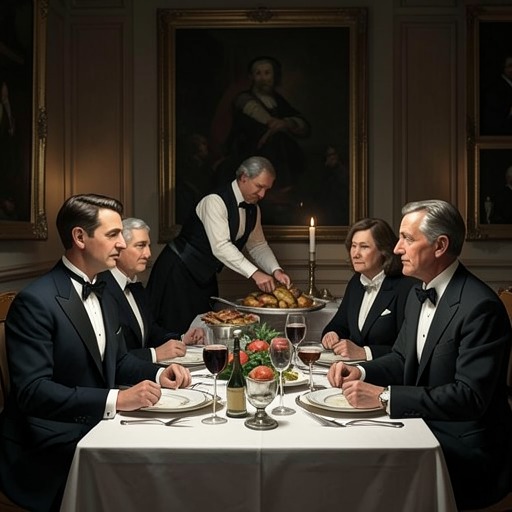
At a dinner table, glass of wine in hand, Thomas can still offer a toast with amiable expression, polished gestures, and phrases that win approval and laughter. In such moments he resembles his former self despite his pallor. The public setting supplies a part to play, an audience, and an immediate response; performance briefly becomes the most bearable aspect of his activity. Yet the relief is conditional. When he sits quietly and does nothing, fatigue and disgust rise, cloud his eyes, and loosen his proud posture and control of his face. He wants only to give in to dull despair, slip away, and rest his head on a cool pillow at home.
That contrast clarifies the nature of his decline. Thomas has not lost every capacity for effective public action: he can still speak well, win a room, and maintain the appearance of command. But these successes no longer prove that his inward life is vigorous. The role briefly masks exhaustion and then makes stillness, when the mask has no audience to sustain it, especially difficult to bear. His outward composure is therefore both a remaining skill and evidence of how much effort survival within his established identity now requires.
Narrative Significance
Thomas’s exhaustion joins the family firm’s stagnation to his personal loss of direction. The business cannot convert the wider commercial optimism around it into renewed activity, while its head expends his remaining energy on private minutiae and the maintenance of a carefully finished public image. Material wealth and social recognition remain, but they cannot restore the conviction that his work or civic career opens onto a meaningful future.
The recurring image of performance gives this inward decline its form. Dressing, polishing, speaking, and arranging oneself before others keep the public Thomas visible; solitude exposes the weariness the presentation cannot resolve. His restless energy continues, but it has become repetition without an absorbing aim. The result is not a simple disappearance from public life but a widening separation between the accomplished figure the town sees and the depleted man who, when the audience falls away, longs only to withdraw.