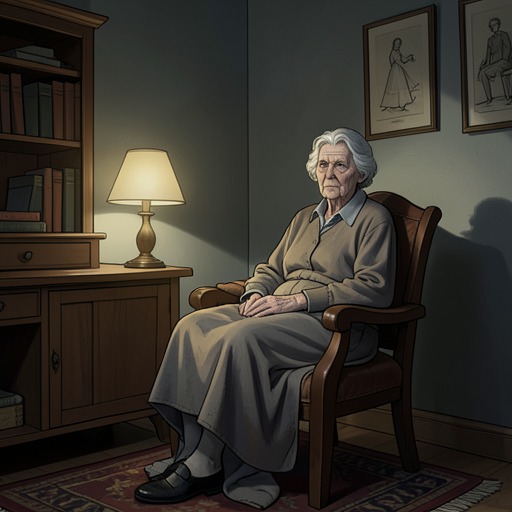
Elisabeth Buddenbrook’s fatal pneumonia
BuddenbrooksElisabeth Buddenbrook’s fatal pneumonia turns an initially uncertain respiratory illness into a prolonged confrontation with bodily decline, medical limits, and the family’s inability to prepare her for death. Its course is defined by a widening gap between the doctors’ cautious language and the increasingly grave signs Elisabeth experiences, until a deceptive improvement gives way to her final night and death.
Diagnosis and Progression
At first, the doctors qualify their concern. Dr. Grabow notes that Elisabeth’s catarrh has worsened, with chills, pain on one side, shortness of breath, and a slight fever. Dr. Langhals names the condition as pneumonia. The diagnosis becomes more serious when both lungs are affected: Dr. Grabow tells Thomas that the spread is precarious, while tempering the warning with the hope that Elisabeth may yet recover.
The illness does not remain a matter of diagnosis alone. Elisabeth’s pulse is poor, her fever rises after temporarily falling, and chills bring episodes of delirium. Her cough worsens, accompanied by bloody mucus and deeper pain; breathlessness alarms her, her digestion fails, and her strength steadily ebbs. The doctors observe signs of disease in the left lung as well as the right. Their language registers uncertainty as well as authority: Dr. Langhals uses the technical term “hepatisation,” while Dr. Grabow says little about it. The disease’s advance is plain even when its precise medical description is not shared evenly between the physicians.
Elisabeth’s Experience of Illness
Elisabeth’s illness redirects her attention toward the immediate management of her body. She prays, but spends still more of her conscious time checking her pulse and fever and trying to control her cough. When she has enough strength, she takes the concentrated nourishment offered to her and carefully monitors the dosage and timing of her medication. Her interest increasingly centers on the doctors, with whom she speaks at length; family members and visitors receive less of her attention.
This focus stands in contrast to the life the narrative recalls: Elisabeth had loved living well, fine clothes, and good meals, and had spent her later years in piety and charity. Yet those religious observances have not reconciled her to dying. The illness arrives before she has become inwardly detached from life, and she fears that it may be her last. Her vigilance over treatment is therefore not simply clinical routine; it reveals how strongly she wants to resist the prospect that her body may force her to relinquish the life she still values.
Her responses to visitors show how illness reorganizes even familiar affection. She receives old friends and women from her social circle with limited engagement and quickly sends them away. When Hanno is permitted to visit during a better spell, she pats his cheek and turns away. The family reads this distance as an acknowledgment that they cannot help her. In contrast, she greets the physicians with warmth and attends to their assessments: the people who can name and manage the disease become the center of her remaining social world, even though they cannot promise a cure.
Family and Medical Care
Thomas seeks clarity from the doctors, but their reassurance remains guarded. Dr. Grabow emphasizes Elisabeth’s considerable powers of resistance and says there is no reason for immediate alarm, yet also explains that pneumonia in both lungs must be taken seriously. He even raises the possibility of informing Christian, while cautioning Thomas not to draw exaggerated conclusions. The family thus receives no firm boundary between hope and preparation: each reassurance is shadowed by the possibility of an unforeseen turn.
A brief episode of apparent peace deepens that uncertainty. After the two Gerhardt twins visit Elisabeth, she lies unusually still, her breathing gentle, and seems to grow weaker. When the physicians enter, however, she rouses herself and welcomes them, saying that things are going well. The apparent calm and renewed animation offer the family a glimpse of recovery, but the disease has not retreated. The doctors confirm that the pneumonia is now in both lungs.
Later, a short-lived improvement renews Thomas’s confidence. The fever eases, pain stops, and Elisabeth speaks clearly enough to prompt him to say that the family will not lose her and that she will be with them at Christmas. The promise is overtaken the next night. Frau Permaneder sends word that their mother is struggling with death, and the household gathers at her bedside: Thomas and Gerda arrive, Christian has been woken, and Frau Permaneder and Erika stand nearby with the nurses and doctors. The scene brings the family together as witnesses, but gives them no means to alter the illness’s course.
Treatment and Death
The doctors’ response to Elisabeth’s final distress is shaped by the medical duty to preserve life. When she asks for help to sleep, those present understand the request in the context of her suffering, but the physicians do not give a narcotic: they believe it would weaken her resistance and hasten death. They instead use drugs to stimulate her heart and induce vomiting, measures that provide only temporary relief. The episode presents care as a conflict between relieving immediate distress and extending life, with the doctors adhering to the latter duty even as Elisabeth’s condition worsens.
During the night, Elisabeth becomes increasingly disoriented and seems to answer calls heard only by her, naming relatives who have died. At five-thirty, there is a brief moment of peace. Then she opens her arms and cries, “Here I am!” before dying. The narration leaves the call’s identity unresolved, describing the final response as immediate surrender rather than explaining what Elisabeth has perceived. Dr. Grabow closes her eyes; the curtains are drawn and the candles extinguished. Her death ends the struggle that medical treatment had prolonged, but the scene offers no definitive account of what she encounters at the threshold.
Narrative Significance
The illness is narrated through a tension between measured medical description and the intimate experience of a patient who fears death. Terms such as pneumonia and “hepatisation,” changing symptoms, and carefully timed treatment place the disease in the doctors’ clinical frame. Elisabeth’s anxious attention to her pulse, fever, cough, and medication supplies another: the illness is not merely diagnosed but occupies her thoughts and changes how she relates to everyone around her.
The brief improvements make hope part of the illness’s structure. A quiet interval, a clear exchange with the doctors, and a fall in fever suggest that recovery may be possible, but each reprieve proves temporary. Thomas’s Christmas reassurance is especially exposed by the reversal that follows: the family’s desire to imagine a future with Elisabeth cannot govern the disease’s course. At the same time, the final “Here I am!” gives her death a religious and relational ambiguity. It may be heard as an answer to a call, but the narrative does not identify the caller; it leaves the family and reader with the gesture, the silence after it, and the limits of what the living can know.