Johann Buddenbrook firm
BuddenbrooksThe Johann Buddenbrook firm is the family’s wholesale-grain business, a commercial enterprise whose changing fortunes give concrete form to the family’s successive ambitions and losses. Founded in 1768 by Jean Buddenbrook’s father, it is handed down with its assets, liabilities, and name; later, Thomas’s drive to make it more enterprising gives way to a testamentary order for its dissolution. Its history turns inheritance into both a business structure and a burden: the firm is treated as a source of family standing, yet its continuity cannot be secured merely by passing it to the next generation.
Foundation, Name, and Inheritance
The business’s formal origin is dated July 7, 1768, a fact preserved in the family records and later brought forward by Tony. Its identity is tied not only to commercial activity but also to the Buddenbrook name: when the senior Johann retires, he publicly states that the firm founded by his late father will pass to his son under the same name, with all assets and liabilities. He asks that the confidence previously shown to him continue to be shown to the new sole proprietor. The printed announcement makes succession a public act, transferring responsibility as well as ownership.
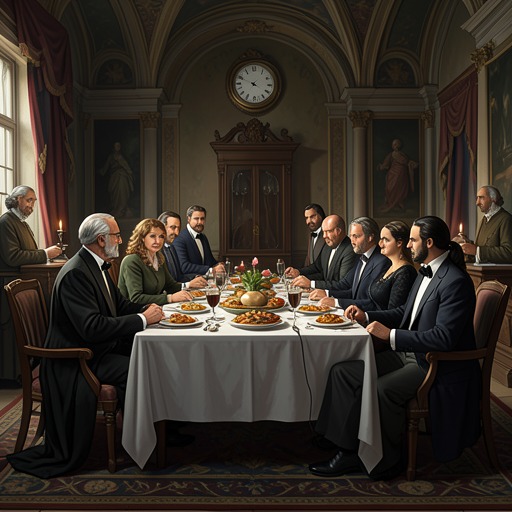
The firm’s longevity is set against the histories of other businesses. At a gathering, the consul recalls that Ratenkamp & Co. began to prosper in 1682, then laments that it has declined over the previous twenty years. The comparison places commercial fortunes within a longer civic memory: a company’s age and earlier success do not guarantee its future. When Tony later establishes the Buddenbrook firm’s centenary date from the family records, the approaching anniversary makes its inherited prestige newly visible, even as its long history remains vulnerable to change.
Succession and Family Capital
The firm’s continuity depends on decisions made within the family, and those decisions can compete with its need to preserve capital. In an earlier dispute over compensation for Gotthold, Jean calculates that paying him 33,335 marks and sending 15,000 to Frankfurt would cost more than sending 25,000 to Frankfurt alone. He argues that compensating Gotthold for a share in the house could invite further inheritance claims after his father’s death, reducing the capital available to the business. The episode shows how a family settlement becomes, in the successor’s view, a commercial risk: the firm’s resources and the distribution of family property are inseparable.
After the death of the senior Johann, Jean and Thomas work to recover the substantial losses that the death has meant for the firm. Jean’s detailed accounting to his wife traces a fortune shaped by dowries, the cost of the Meng Strasse house and its improvements, compensation payments, and earnings accumulated over time. Later, Thomas explains that despite the loss of his eldest daughter’s dowry, the Bremen bankruptcy, and the costs of political unrest, profits over fifteen years helped balance the setbacks; the family’s wealth, apart from real estate, still amounts to roughly 750,000 marks courant. These figures complicate the family’s complaints about decline: the business has suffered, but its history is not a simple, uninterrupted fall, and its apparent resources depend on what is counted as capital and what has already been committed to family obligations.
Thomas’s entry into the business makes succession a practical routine. After breakfast, Jean takes him to the offices, introduces him to chief clerk Friedrich Wilhelm Marcus, cashier Havermann, and the rest of the personnel, then takes him to the Trave warehouses named the Linden, the Oak, the Lion, and the Whale. Though Thomas already knows the workplace, he is now presented as a co-worker. He stamps, copies, and files in his swivel chair, imitating his father’s quiet industry. The labor is ordinary, but its meaning is not: the son is being integrated into an enterprise whose losses have become a family task, and whose word, the narration observes, carries an almost sacred weight for Jean.
Thomas’s Management and Business Reputation
Under Thomas, the firm keeps to a solid course after Jean’s death, but its style changes. Thomas brings a fresher and more inventive spirit, occasionally accepting risk and putting the firm’s credit to practical use rather than treating it as a merely theoretical asset. Men on the exchange notice the change and remark on his determination to make money. Yet his initiative is balanced by Marcus, whose cautious influence restrains the firm’s dealings. Their differing temperaments make management a working tension: Thomas presses forward, while Marcus serves as a check on the speed and scope of his decisions.
Thomas’s ambition is also bound to the desire to preserve the firm’s inherited lustre. He throws himself into daily business because he believes his self-assurance, elegance, charm, and tact have helped him secure profitable transactions. The firm’s reputation is therefore sustained by more than accounts and goods: personal conduct and social presentation contribute to the credit on which business depends. His approach is not simply a break from tradition; it is an attempt to make the old name productive under changed conditions.
The firm’s credit becomes especially consequential when Bendix Grünlich’s business is under pressure. Herr Kesselmeyer warns that a Bremen bankruptcy has cost a well-known firm a large sum, that the firm’s position is the subject of public talk, and that its instability has weakened Grünlich’s standing as well. The episode makes commercial confidence visible as a relation among businesses: one firm’s reputation can protect or expose another. Credit is not merely a number on a ledger but a judgment circulating through banks, customers, and the town.
Thomas also uses personal connections as part of commercial judgment. In considering a transaction involving a hard-pressed landed aristocrat, he sees that the opportunity should not be handled as an ordinary deal according to routine rules. Tony’s role in initiating it and her friendship with Armgard von Maiboom make discretion and tact essential; Thomas believes his firm has an advantage over Strunck & Hagenström, and sees the transaction both as a favour and as an opportunity to use market conditions later when the time comes to sell. The decision places private relationships beside market calculation, showing how the firm’s position rests on social access as well as business acumen.
The Firm’s End and Its Aftermath
The firm’s final change comes through Thomas’s testamentary instruction that it be liquidated and dissolved within one year. Tony is deeply distressed that he has not kept it going for Hanno, the family’s legitimate heir. To her, the firm’s venerable shield is a treasure handed down through four generations, and its sale means that the enterprise’s history will end even if the family itself continues. She tries to reconcile herself to the decision by imagining that Hanno might begin a new enterprise of his own. The distinction she draws—between the end of the business and the survival of the family—makes clear how completely the firm has come to stand for historical continuity.
The liquidation is entrusted to Kistenmaker and the elderly Marcus under a deadline that must be observed exactly. The time limit forces pending contracts to be sold too quickly and on disadvantageous terms; warehouse stores and grain are disposed of at considerable loss. The two men contribute differently to the failure: Kistenmaker acts with excessive zeal, while Marcus’s procrastination allows profitable opportunities to pass. As the losses accumulate, the estate’s paper valuation of 650,000 marks proves misleading: within a year of the will being read, it is clear that nothing close to that sum can be expected. The dissolution thus turns a deliberate effort to settle the firm into a rapid erosion of its realizable value.
The Johann Buddenbrook firm’s trajectory links formal succession, household decisions, public reputation, and commercial judgment. Jean’s concern that inheritance claims could drain working capital, Thomas’s controlled use of risk and credit, and the losses of the final liquidation all show different pressures on the same enterprise. Its name endures in family memory and in the centenary record, but its commercial life ends with the liquidation Thomas ordered—a final contrast between the durability of a legacy as an idea and the fragility of the business that once carried it.