Lübeck Town Council
BuddenbrooksThe Lübeck Town Council is the city’s representative assembly, a civic institution whose work ranges from contested voting rights to transport policy and public infrastructure. Its proceedings bring local authority into contact with popular unrest and changing political expectations; for the Buddenbrooks, they also provide a public arena in which family standing can be exercised, tested, and converted into office. The council’s disorderly 1848 meeting and Thomas Buddenbrook’s later election show both the vulnerabilities and the continuing prestige of Lübeck’s governing institutions.
Structure and Civic Setting
The council meets in a room made available on certain days by the widow Suerkringel, whose property also houses a beer-and-dance hall. The route from the restaurant’s beer-and-food smells leads through a narrow, low, green-planked door into a room unexpectedly large and bare: whitewashed walls, exposed beams, three high windows, and seats rising in an amphitheatre. At the bottom, a green-covered table holds the bell, documents, and writing materials used by the chairman, recording clerk, and any members of a senate delegation present. Coats and hats hang on high racks opposite the entrance. The makeshift location and practical furnishings give civic deliberation a distinctly local, provisional setting rather than the formality of a purpose-built chamber.
The council has 120 members, though attendance can vary. During the October 1848 crisis, roughly a hundred gather in the hall; representatives from the countryside have stayed away because of the circumstances. The group includes merchants, teachers, lawyers, municipal officers, shopkeepers, and other townsmen. Herr Wenzel, a barber who shaves members of prominent families, sits as their equal after election to the council. His local knowledge, good manners, affability, and self-confidence help account for his standing despite his lower social position. The assembly thus brings different ranks into one political room without erasing the distinctions that shape who commands influence and whose voice is surprising when heard.
The 1848 Crisis and Voting Dispute
The political tension develops amid debate over the city’s constitution and the qualifications for voting. A constitution has been adopted by senate decree, and elections have taken place for a representative assembly, but these measures have not ended the dispute. Some old citizens argue for retaining restricted voting rights, including Consul Johann Buddenbrook; others, among them Hinrich Hagenström, demand universal franchise. Still other proposals complicate the argument, including a form of universal but restricted suffrage and changes to the distinction between citizens and inhabitants. Discussion also reaches the conditions for citizenship, including whether non-Christians might qualify. Political reform reaches beyond official debate: the Buddenbrooks’ cook Trina, dismissed after announcing that social arrangements would change and that she would take her place on the sofa while her employer waited on her, makes the class implications of the public controversy audible inside the household.
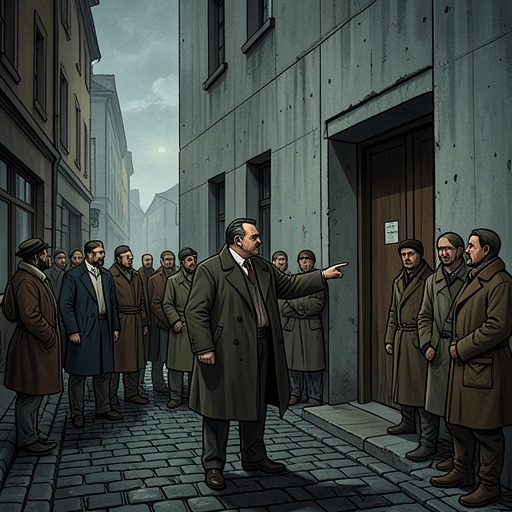
When Consul Buddenbrook and his companion enter the meeting room, the council has not formally opened, but argument is already intense. Members curse the editor Rübsam, whom they believe has incited the crowd, and debate whether restricted voting should remain or universal franchise should be introduced; the senate has already proposed the latter. The assembly’s sense of danger is at once political and physical. A surge of noise reaches the windows, where the men see raised fists and hear hoots and yells. The uproar abruptly subsides, and Lebrecht Kröger’s single denunciation of the crowd as rabble punctuates the silence. The word does not settle the conflict; it makes the gulf between the old civic elite and those outside it unmistakable.
The chairman, Dr. Langhals, asks whether he has consent to open the meeting, but receives no support. When he tries again, he explains that he must submit the final minutes to the mayor within three days and that the town expects them in print. Even so, the members will not move to a vote on opening the session. They fear that a decision might provoke the crowd, and do not know what the crowd wants. The clock of St. Mary’s strikes half past four as the council chooses to wait rather than act. Noise outside swells, ebbs, and returns; inside, the men gradually settle on the benches, listen for changes in the disturbance, and even resume business conversation. The pause exposes an institution’s limits under pressure: its members retain procedure, minutes, and political authority, but cannot confidently use them while the crowd controls the immediate atmosphere beyond the door.
Office, Influence, and Modernization
The council’s authority also depends on relationships with the senate and the mayor. During the 1848 dispute, members surround the senate delegation and Consul Buddenbrook, expecting him to know Mayor Oeverdieck’s position. His family’s connection to the mayor through marriage enhances the esteem in which the Buddenbrooks are held, so social kinship and civic influence overlap in the council chamber. That overlap helps explain why the family’s voice carries weight, but it also leaves political authority embedded in personal and inherited networks.
Years later, Thomas Buddenbrook describes the public influence he has inherited rather than claiming it as wholly his own achievement. He connects the attention paid to his opinions with the trust and esteem accumulated by his father, grandfather, and great-grandfather. He recalls his father’s work after 1848 on the postal system: pressing the council to link the post with the Hamburg coach service, urging the senate in 1850 to join the Austro-German Postal Union, and helping advance lower postal rates, stamps, book rates, mailboxes, and a telegraph connection between Berlin and Travemünde. These recollections make public service part of a family legacy, but also specify its practical content: political standing is sustained by work on systems that connect the city to wider commercial and communications networks.
Thomas’s own municipal ambitions extend beyond the council’s immediate procedures. He is interested in railway policy and serves on the board of the Büchen Line, an appointment he attributes partly to his father’s earlier directorship. He hopes the city will acquire an appropriate site for a station in Hamburg, and argues that he could move the work forward more quickly as mayor. He also points to the new gas lanterns replacing oil lamps and to improvements in streets, construction, and restoration of historic buildings. Lübeck, he says, has grown from 37,000 inhabitants to well over 50,000. He distinguishes these visible changes from what he regards as the more consequential task: joining the Customs Union, which he believes would open Mecklenburg and Schleswig-Holstein to trade and answer the city’s declining command of northern commerce. In his account, civic government must adapt to demographic growth, new infrastructure, and a changed commercial landscape, not merely preserve local independence as an abstract principle.
Thomas Buddenbrook’s Election
The death of Senator James Möllendorpf creates a vacancy that, under the constitution, must be filled within four weeks. On election day in late February, crowds gather in the slush outside the Town Hall while the electors—chosen from the senate and town council—wait in a semicircle of fourteen armchairs. The nomination process drags on because the three electoral chambers have not agreed on one candidate. Rumours from behind the closed doors circulate among the waiting public: Hagenström, Buddenbrook, and Kistenmaker have each been nominated by a different chamber, and the crowd hopes the first secret ballot will produce an absolute majority.
Thomas is elected, defeating Hermann Hagenström. The news reaches him through his sister, who runs through the slush to tell him that the people are coming and that it is he, not Hagenström, who has won. On the following day, Thomas stands in the council chamber before the chair formerly occupied by Möllendorpf. In the presence of the assembled city fathers and a town-council committee, he swears to discharge his office conscientiously, serve the state, obey its constitution, administer public money honestly, and do justice to rich and poor alike. He also promises to disregard personal and family advantage, including when acting as an elector, and to keep confidential matters secret. The oath defines public office as a check on the very family interests and connections that helped prepare his ascent.
The ceremony brings prestige with a burden of performance. On the morning of his public congratulations, Thomas dresses in a black cutaway coat and white piqué vest, strokes his moustache with a curling iron, and prepares to receive a stream of visitors. He anticipates having to find a suitable response for each person—respectful, serious, friendly, witty, or sincere as the occasion requires—before a banquet in the Town Hall wine cellar that will last into the evening. Beneath these rituals, he feels tired and weighed down by an old, indefinite gloom. The council can confer an office and stage its public recognition, but it cannot resolve the private weariness that accompanies the role.
Narrative Significance
The council’s scenes place institutional change beside the habits and hierarchies of commercial society. Its meetings are shaped by procedural objects—the bell, minutes, documents, the chairman’s request to open proceedings—and by social signals that the rules alone cannot explain: family ties to the mayor, inherited reputation, and the deference accorded to those already prominent. During the 1848 disturbance, the council’s formal authority falters into watchful silence; in the later election, the same civic order can still make Thomas a senator through nominations, electors, a secret ballot, and an oath.
That arc is not a simple triumph of civic progress. Thomas’s modernization program looks outward to railways, telegraph connections, gas lighting, urban growth, and expanded trade, while his account of influence openly recognizes its inheritance from earlier generations. The oath asks him to put public justice before private advantage, even as his family’s accumulated esteem helps bring him to office. The council therefore embodies a tension central to the Buddenbrooks’ civic life: public responsibility can be genuine and practical, yet access to it remains entangled with family prestige, commercial interests, and the struggle over who counts as part of the political community.