Strunck & Hagenström
BuddenbrooksStrunck & Hagenström is an expanding export firm associated with the ambitious Hagenström family and the rise of newer commercial interests in town. Its competition with the established Buddenbrook business is more than a contest for individual orders: through its repeated success, the firm becomes a measure of the Buddenbrooks’ weakening commercial position and of a changing social order in which business results increasingly outweigh inherited prestige.
Identity and Position
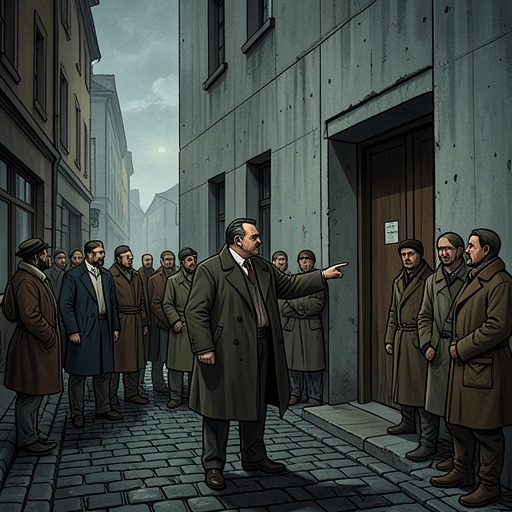
The firm is identified as the export business of Strunck & Hagenström, in which Hinrich Hagenström is a partner. The family is described as comparatively new to the town, and its rise draws attention from established households. Hinrich involves himself actively in civic affairs, serving on committees and councils and pressing his views in local institutions. The Buddenbrooks regard his conduct as obstructive, but the narrative also establishes that his business is thriving.
That contrast shapes the firm’s role. The older families’ disapproval of the Hagenströms’ social manner does not cancel their commercial effectiveness. Strunck & Hagenström is already building a substantial business, and its success gives the family a growing claim to local importance.
Commercial Rivalry
The rivalry appears in concrete competition over trade. When the Buddenbrooks lose a large rye consignment intended for Holland, the reason is that Strunck & Hagenström has secured it first. The loss leaves Johann Buddenbrook and his son upset, while the family describes Hinrich as a sly competitor. Their complaint reflects real commercial displacement: the newer firm can take business the established house expected to win.
The conflict is also personal and civic. Johann says Hinrich blocks him whenever he can, including in a meeting of the Central Committee for Paupers and in the Finance Department. In the Buddenbrooks’ account, commercial rivalry and public disagreement reinforce one another; Hinrich appears to challenge their authority both in business and in town affairs. Yet the complaint is filtered through their perspective, and the firm’s continued expansion gives the opposition a practical basis beyond mere social resentment.
Expansion and Changing Status
The Buddenbrook children discuss the Hagenströms’ progress with a mixture of disdain and reluctant recognition. Tony objects to what she sees as a lack of culture and refinement, and she resents the family’s increasing acceptance. Thomas answers that Strunck & Hagenström has built a fine business and that the Hagenströms are hard workers. He points to Hermann’s growing importance in the firm and notes that Moritz, despite poor health, has graduated at the top of his class and plans to study law.
Thomas’s response makes the change in status explicit: the family’s rise cannot simply be dismissed because it conflicts with older standards of distinction. He acknowledges that the Hagenströms are an up-and-coming family, even as Tony insists on the Buddenbrooks’ inherited standing. The exchange shows social prestige adjusting to commercial achievement, while also revealing that the Buddenbrooks’ own family has vulnerabilities that make confident comparisons unsafe.
The Buddenbrooks’ Counterpoint
In a letter to his son, Johann Buddenbrook sets the firm’s cautious business ethic against the expansion of Strunck & Hagenström. He says that his own earlier interest in developing trade in regional products had been abandoned after he judged the export prospects precarious, and he invokes the family maxim that business should be conducted so as to allow a peaceful night’s sleep. He admits, however, that doubts arise when he sees Strunck & Hagenström prospering while the Buddenbrook business remains quiet.
The contrast is therefore not simply between success and failure, but between competing measures of commercial conduct. Johann presents restraint and prudence as principles worth preserving, even when they appear to bring slower growth. The firm’s expansion makes those principles harder to inhabit with confidence: the Buddenbrooks must confront the possibility that the rival’s visible success will continue while their own business fails to grow.
Later Significance
By the time the Buddenbrook business is being liquidated, the rivalry has acquired the force of a broader reversal. At a gathering of former business associates, Gosch remarks that Strunck & Hagenström now has all the important business. The comment reduces the earlier contest over particular consignments to a stark final comparison: the rival is not merely taking an occasional opportunity but has come to dominate the important trade.
Across these episodes, Strunck & Hagenström serves as both competitor and measure of change. Its rise tests the Buddenbrooks’ confidence in inherited status, prudential business principles, and civic authority. The firm’s growing importance does not by itself explain the Buddenbrooks’ decline, but the contrast makes that decline legible: while the old family debates the costs and limits of its traditions, the rival’s expanding business increasingly occupies the commercial ground the Buddenbrooks once expected to command.