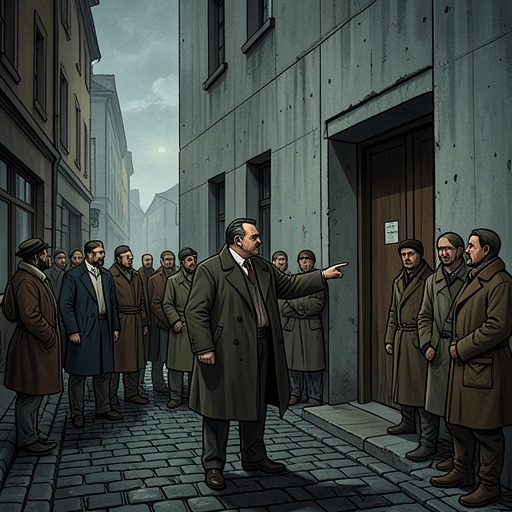
Senate of Lübeck
BuddenbrooksThe Senate of Lübeck is the governing body through which the novel stages the changing political life of the city: it drafts and adopts constitutional arrangements, debates who may vote, receives elected members, and directs questions of commerce and public improvement. Its routines—meetings, minutes, oaths, and elections—give institutional form to conflicts over authority and representation. At the same time, Thomas Buddenbrook’s rise within the Senate reveals how public standing can rest both on personal ability and on the inherited trust accumulated by a family.
Institutional Authority and Civic Practice
The Senate appears not as an abstraction but as a body of people working through procedures. During a period of civic unrest, its decree makes a new constitution the basic law of the city despite objections from Lebrecht Kröger and other older opponents. Elections follow, and a representative assembly meets, but these changes do not end political agitation. The consul observes that disorder persists even while a constitution better suited to current demands is being drafted and put into effect. The Senate’s authority is therefore real but contested: legal change does not automatically secure public peace.
The practical burdens of this authority surface in the meeting called to consider whether restricted voting rights should remain or universal suffrage should be introduced. The Senate has already proposed the wider franchise, but the assembled gentlemen fear that the crowd’s demands reach beyond the question of voting. They blame Rübsam, an editor, for inciting the mob, and seek the views of the Senate delegation and of Consul Buddenbrook, who may know Mayor Oeverdieck’s position. The meeting has not formally opened when the debate grows heated. Its chairman insists that the participants reconsider, explaining that he must submit the final minutes to the mayor within three days and that the town expects them to appear in print. Even the preliminary question of whether to open the meeting must be put to a vote. Procedure, documentation, and publicity are not peripheral details: they are the means by which the institution attempts to manage a crisis and make its decisions legible to the city.
The Senate’s ordinary business also includes decisions about economic integration. Senator Langhals warns that the freeman’s oath is becoming a mere formality, with people disregarding it and the state losing out. He connects the issue to whether the city should join the Customs Union. Later, Thomas makes joining the union a central item in his own political program. He argues that access to Mecklenburg and Schleswig-Holstein would benefit trade, particularly because the city no longer commands northern commerce as completely as it once did. The recurring debate shows commercial policy at the intersection of civic independence and economic adaptation: a question of external relations becomes a test of what kind of future the Senate will pursue.
Political Change and Public Works
The Senate’s political world shifts across the years, and Thomas describes modernization as a sequence of practical changes as well as constitutional debate. He recalls his father’s work on the postal system: encouraging the council to combine the post with the Hamburg coach service and pressing the Senate in 1850 to join the Austro-German Postal Union. Thomas credits that earlier civic work with helping bring lower postal rates, stamps, book rates, mailboxes, and a telegraph connection between Berlin and Travemünde. The institution’s activity thus reaches into the infrastructure of daily life, linking decisions in council and Senate to communication and transport beyond the city.
Thomas also identifies public lighting as a current improvement. Work has begun on gas lanterns to replace oil lamps suspended from chains, a project in which he says he played a part. He presents such measures as responsibilities demanded by a new age, while distinguishing them from the more consequential political questions he believes remain ahead. His reforming self-image is tied to an ambitious view of municipal service: if he were mayor, he thinks matters would move faster, though he says he has no personal objection to Oeverdieck. That aspiration places Senate service within a wider ladder of civic authority, from participation in policy to the possibility of municipal leadership.
Thomas’s account of his public influence is explicitly conscious of inheritance. He says his father, grandfather, and great-grandfather paved the way for him, and that the town’s accumulated trust and esteem have passed to him. His political efficacy, by his own assessment, depends partly on a civic reputation produced before his career began. The Senate therefore offers a stage for individual initiative, but access to influence is also shaped by family history and inherited symbolic standing.
Succession, Oath, and Public Office
The death of Senator James Möllendorpf turns the Senate’s composition into a matter of immediate public attention. As soon as rumors of the old gentleman’s death circulate, people begin asking who will succeed him; after he is buried, the question dominates general discussion. The vacancy makes succession visible as both a personal appointment and a civic event, connecting the Senate’s continuity to the city’s expectations of its leading families.
Thomas is elected to the vacant position. On the Friday after the succession question comes to a head, he stands in the council chamber before the chair formerly occupied by Möllendorpf, in the presence of the assembled city fathers and a town-council committee, and swears the official oath. He pledges to serve the state conscientiously, obey its constitution, administer public money honestly, and put neither personal advantage nor the interests of relatives and friends ahead of his office. He also promises to apply the laws equally to rich and poor, to act discreetly, and to keep matters requiring secrecy confidential. The scene gives Thomas’s entry into office a formal, public shape: authority is conferred through election, but it is also bounded by declared obligations of impartiality and restraint.
The oath’s emphasis on not favoring relatives is pointed in the context of a family whose civic influence is openly inherited. Thomas can acknowledge that his forebears’ reputation has enabled his own advancement, while the office requires him to profess a duty beyond family advantage. The tension is not resolved by the ceremony; rather, the oath names the standard against which the conduct of a powerful local figure is to be judged.
Representation and Social Status
The Senate’s changing social composition becomes an object of dispute in Thomas’s later conversations. After Alfred Lauritzen, a wholesale and retail grocer, is elected, Thomas objects that the Senate is being democratized and that commercial competence alone should not qualify someone for the chamber. He emphasizes Lauritzen’s modest family origins, recalling that his father personally handled and wrapped pickled herring for customers. To Thomas, Lauritzen’s presence signals a lowering of social standards and a failure of decorum, even while he concedes that Lauritzen is honest and an excellent merchant.
Senator Gieseke challenges the assumptions behind Thomas’s disdain. Since Gieseke is himself the son of a fire chief, he invokes the republican principle that merit, rather than inherited rank, should confer distinction. The exchange sets two ideas of public legitimacy against each other: Thomas’s expectation that office carry a certain social bearing, and Gieseke’s insistence that achievement is the proper qualification. Thomas’s response shows that his commitment to civic improvement does not mean acceptance of social equality within the Senate. The institution can become more representative through elections while remaining a site where old hierarchies are defended in the language of taste and decorum.
The contrast also clarifies the changing basis of authority in the city. Family reputation, wealth, commercial accomplishment, and political merit do not simply replace one another; they compete as claims to public recognition. In Thomas’s account, the Buddenbrooks’ standing is supported by generations of service, whereas Lauritzen’s election makes visible the entry of a different social type. The Senate’s evolving membership thus registers a broader alteration in civic life, one Thomas can promote in matters of infrastructure and trade while resisting in matters of social distinction.
Civic Authority and the Family’s Decline
The Senate’s importance in the novel derives partly from the way it connects the Buddenbrooks’ private history to public memory. The family chronicle and its records preserve births, childhood illnesses, schooling, and other events with an almost religious respect for facts, while the family’s commercial fortunes and civic standing unfold alongside the city’s political history. The Senate’s decisions are among the mechanisms through which that larger history becomes concrete: a constitution is adopted, an assembly meets, a successor is chosen, and the oath of office is recorded in public ritual.
Yet the relationship between family prominence and civic power is not secure. Thomas’s election affirms the trust accumulated by his predecessors, and his confidence in modernization suggests that he intends to shape the city’s future. But his complaint about the Senate’s changing social level reveals anxiety beneath that confidence: political influence may survive while the status conventions that once defined it are being altered. His attachment to inherited prestige persists even as representative politics and merit-based claims challenge it.
The institution also outlasts the particular people who occupy it. A chair is left empty by Möllendorpf’s death, then occupied by Thomas; meetings require minutes, votes, and successors. This continuity contrasts with the fragility of the family’s own commercial inheritance. The firm’s history reaches back to 1768, but Thomas’s testamentary instruction eventually requires its dissolution within a year, and his sister grieves that the firm’s venerable shield, handed down over four generations, must be disposed of. The Senate remains part of the city’s ongoing civic framework even as the family’s business line approaches its end. Through that contrast, public institutions provide a measure of historical continuity that no single family can guarantee, while their changing membership exposes the instability of the social authority families once took for granted.