Christa Stockwell
CaughtChrista Stockwell is a former graduate student whose lasting injuries came from a Princeton scavenger-hunt prank in the house where she worked and lived. Years later, she tells Wendy Tynes what happened, supplying a history that complicates the idea of the hunt as harmless mischief: Christa was badly hurt, the other students’ presence went unacknowledged, and Phil Turnball was caught at the scene. Her final emphasis, however, is not revenge. She says she forgave the students because they had not meant to hurt her.
Identity and Introduction
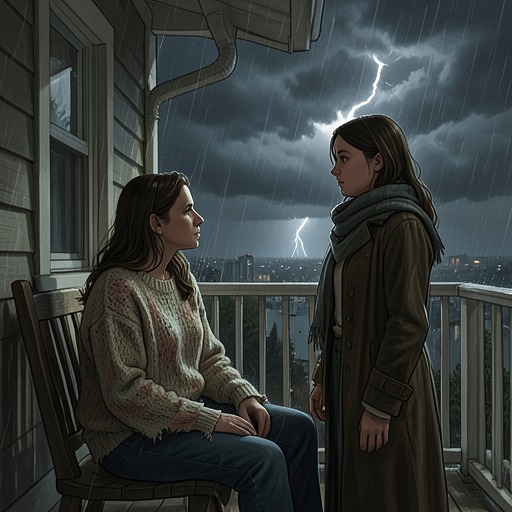
When Christa meets Wendy, she seems to have been expecting her for a long time. She wears sunglasses indoors, and the thick scars crossing her face are immediately visible. As she makes tea, she tilts her head to the right; the damage reaches from her forehead to her neck. The narrative first presents her through Wendy’s reaction, then gives Christa the space to describe her own past and explain how the injury happened. That shift matters: she is not only the striking evidence of an old event, but also the person who can give it a history.
Christa tells Wendy that she is contractually obligated never to discuss what happened. Despite that constraint, she recounts the incident in considerable detail. The account makes clear that the harm has remained part of her life: she still lives in the house where it took place, and the physical consequences are visible during the conversation. Her story moves between what she understood at the time and what she learned afterward, distinguishing immediate confusion from later knowledge.
Work, Study, and Life in the House
At the time of the incident, Christa had graduated the previous year and was completing a master’s degree in comparative literature. She describes herself as a financial-hardship student who, like Dan Mercer, worked while attending school. Dan did laundry in the men’s physical-education department; Christa worked for Dean Slotnick, babysitting his children, doing household chores, and filing. Because Slotnick was divorced and she got along well with his children, she lived in a room at the back of the house. She says that she still lives there when she speaks to Wendy.
The house was therefore both her workplace and her home, not merely the setting of a college prank. On the night of the incident, Slotnick was away on a speaking engagement, and his children were staying with their mother in New York City. Christa had gone to dinner with her fiancé, Marc, a second-year medical student. He had a chemistry test the next day, so after dinner he dropped her off and went to the medical library. Christa returned to her own schoolwork, bringing her notebook to the kitchen table. Her account pauses over these ordinary arrangements and the choices that might have changed the evening, but she presents them as what-ifs, not as explanations for what followed.
The Scavenger-Hunt Incident
Christa heard a noise and went to investigate. At first, she could not identify what was happening. Then she heard whispers and laughter and concluded that students were playing a prank on the dean. She went upstairs toward the bedroom where she had earlier thought the voices came from. When the room appeared empty, she waited for her eyes to adjust, then reached for the light switch. A loud crash followed, and the resulting injury left her unable to understand what had happened in the moment.
Christa recalls that someone ran past her. She reached out, tripped the person, and grabbed his leg; he kicked free. Only later did she understand that a shattered mirror had caused the injuries, and that the kick had worsened them. She lost consciousness and did not wake for three days. After that, she spent weeks in and out of consciousness and underwent repeated surgeries. The account is precise about the sequence while also marking its limits: Christa says that the kick was the last thing she remembers before passing out.
Campus police heard her scream and caught Phil Turnball in the dean’s front yard. Christa says her blood was on his shoes. She also remembers hearing other students, but Phil said he had been alone and his friends supported his account. She was in no condition to contradict them and did not know enough then to challenge their version. The scavenger hunt had included the dean’s boxer shorts as a prize worth sixty points. In the account Christa gives Wendy, the students’ prank and their presence are clear, but the other participants’ role was obscured while she was incapacitated.
Wendy’s Visit and Christa’s Decision to Forgive
Christa’s conversation with Wendy takes place after Dan Mercer’s death has become part of the story surrounding Wendy. Wendy describes herself as the person who exposed Dan, whether rightly or wrongly, and says that the consequences have taken on a life of their own and continue to claim victims. Christa’s old injury thus enters a larger account of harm and responsibility, but she does not claim that her story settles the questions around Dan. Instead, she gives Wendy the history of the event that left her visibly injured and explains why the scavenger hunt remains consequential to her.
At the end of the conversation, Christa says that she forgave the students. She explains that they were college students participating in a scavenger hunt and did not intend to hurt her. This does not make the injuries less severe or undo the years that followed. Rather, her distinction between intention and consequence defines her response: the harm was real, while her judgment of the students rests on her belief that they had not meant to cause it. The narrative presents forgiveness not as forgetting the event, but as Christa’s own conclusion about the people involved.
Narrative Role and Significance
Christa’s testimony turns an image of physical aftermath into a chronological account: the house, the empty rooms, the interrupted attempt to switch on a light, the long period of treatment, and the conflicting accounts given after the incident. Her recollection also exposes the imbalance between what she heard and what she could later prove. Other students backed Phil’s claim that he had been alone, while Christa was recovering and could not counter them. The distinction between knowledge gained in the moment and knowledge reconstructed later is central to her telling.
Her presence also places the scavenger hunt’s playful premise beside its lasting consequences. A prize worth sixty points helps explain the students’ immediate objective, but it cannot measure what the event cost Christa. Yet the story does not reduce her to the injury: she is a student, worker, former fiancée, resident of the house, and witness who chooses to speak despite a contractual restriction. Her forgiveness provides a final contrast to the surrounding cycle of accusation and retaliation. It is not presented as proof that the harm was minor; it is the position Christa arrives at after living with its consequences.