Flair Hickory
CaughtFlair Hickory is the celebrity lawyer defending Dan Mercer at an evidentiary hearing that could determine whether crucial evidence from Mercer’s home remains usable. His striking courtroom persona draws attention, but his questioning is directed at a precise vulnerability in the prosecution’s case: Wendy Tynes entered Mercer’s house without a warrant, and, as Hickory argues, the material found there is what connects Mercer to criminal conduct.
Identity and Courtroom Persona
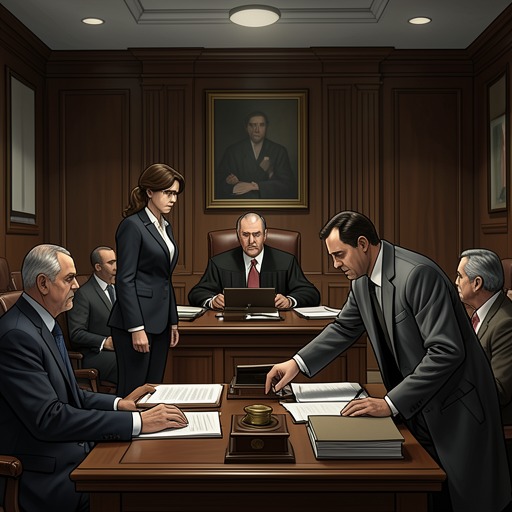
Wendy Tynes recognizes Hickory as celebrity counsel for the defense and wonders how Mercer can afford him. Hickory’s appearance makes him conspicuous before he asks a question: he wears a gray suit with thick pink stripes, a pink shirt, and a pink tie. His entrance is described as theatrical, with an extravagance likened to Liberace. The passage also presents his flamboyance as part of how he performs in court, comparing that manner to Harvey Fierstein and Liza-style jazz hands. The result is a lawyer who commands attention through presentation as well as argument.
That visible performance unfolds in a room already charged with scrutiny. Tynes takes the stand and sees four sets of parents whose children were victims of Mercer. They have attended every day. At first they brought photographs of their children, but the judge ordered them to stop; now they watch in silence. Tynes, accustomed to being onstage as a television news reporter, nevertheless finds testifying uncomfortable. Hickory begins with a welcoming smile and a polite greeting. The contrast between the cordial opening and the hostile implications of his later questions gives his examination its courtroom shape: courtesy at the surface, pressure underneath.
The Hearing and the Evidence
Hickory’s work takes place at an evidentiary hearing, not a proceeding Mercer is required to attend. Tynes wonders why Mercer is absent, then recognizes that attendance is not required for this kind of hearing. Hickory is seeking to persuade the judge to exclude the material police found on Mercer’s computer and concealed throughout his house. The material is described as sickening, and Tynes understands the stakes in stark terms: if it is excluded, the case against Mercer may collapse and a dangerous predator may go free. The defense’s immediate objective is therefore procedural, but its possible consequence is the loss of the prosecution’s central evidentiary foundation.
Hickory presses Tynes on how she identified the person at the other end of the online conversations. When he asks whether she knew Mercer, she says yes; he then asks whether she broke into Mercer’s house. These questions connect her undercover investigation to the later search and make her own conduct part of the hearing. Hickory’s approach does not simply dispute what the police found. It directs attention to how the evidence was obtained and to the possibility that the case is compromised by the actions of the people pursuing Mercer.
Challenge to Tynes and the Prosecution
Hickory frames the case as dependent on the police search. He asks whether, without the evidence found there, Tynes would have nothing tying Mercer to anything illegal. She answers that Mercer showed up at the house that night. Hickory narrows the point: the sting house had no underage girl living in it, he argues, so the case—and Tynes’s reputation—rests on the materials recovered from Mercer’s home. He then suggests that she had both the means and a compelling reason to plant that evidence. This is an accusation made as part of his advocacy, not an established finding in the passage.
The question provokes Lee Portnoi to object that Hickory’s argument is for a jury. Hickory responds by returning to the warrantless entry, stressing that Tynes has admitted entering the house illegally. The exchange exposes the competing focus of the hearing: Hickory wants the judge to examine the search and the reliability of the evidence, while Portnoi resists turning that dispute into an accusation about Tynes’s motives. The judge has already reminded Hickory that the transcripts are available for the court to assess, rather than accepting counsel’s characterization as proof.
Narrative Role
Hickory functions as the advocate who makes the case against Mercer look vulnerable at the very moment its evidence appears most damning. His flamboyant style gives him a memorable public presence, but the substance of his role lies in shifting scrutiny from Mercer’s alleged conduct to the search, Tynes’s credibility, and the possible consequences of excluding the recovered material. The novel also places his argument against the silent attendance of the victims’ parents, whose daily presence makes the legal question feel inseparable from the human stakes.
His defense has a clear limit in the available scenes: Hickory can challenge the connection between Mercer and the evidence, but Tynes’s account that Mercer appeared at the sting house remains part of the exchange. The hearing thus presents him neither as a mere showman nor as the final authority on what happened. He is a forceful courtroom advocate whose performance and legal strategy sharpen the central conflict between the prosecution’s evidence and the means by which it was obtained.