Charlie
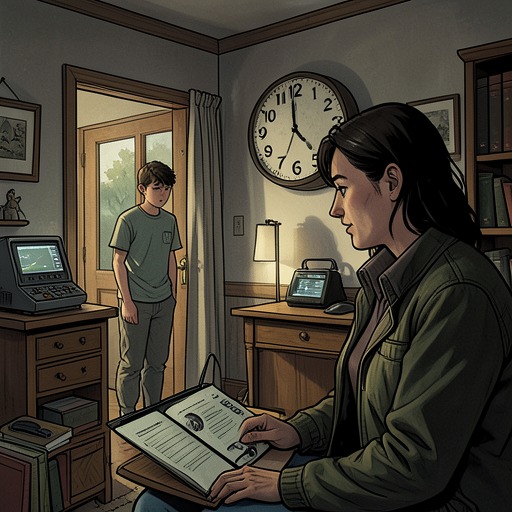
CaughtCharlie is Wendy Tynes’s only child and the center of her life after the sudden death of his father, John Morrow. At seventeen, he is a senior at Kasselton High School, accepted to Franklin & Marshall in Lancaster, Pennsylvania, and approaching the departure his mother dreads. His importance lies both in that family bond and in a modest but consequential role in Wendy’s investigation: while looking through Facebook photographs, he brings her attention to an image whose sofa she recognizes.
Identity and Family Background
Charlie was born while Wendy Tynes and John Morrow were juniors at Tufts University. Two years later, they scraped together a down payment on a small starter house on a busy road in Kasselton. Wendy took a job at a local television station while John worked toward a Ph.D. in psychology. Their plans ended abruptly when John died, leaving Wendy and Charlie in the house and forcing the family into a life shaped by loss.
By the time Charlie is seventeen, he and Wendy have spent twelve years as a single-parent household. Wendy sees him as beautiful, moody, and exasperating, and thinks of him as the person who has made the house a family home. Her daily wish that time could hold him at his present age gives his coming transition a particular weight: his acceptance to college is welcome news, but also a step toward the solitude she fears.
Adolescence and Leaving Home
Charlie is nervous about the substantial change ahead, though Wendy is even more anxious about it. Their college search has ended with his acceptance to Franklin & Marshall, but the end of the search does not resolve the emotional question of leaving. The book presents this transition through the difference between mother and son: Charlie faces the uncertainty of a new stage, while Wendy anticipates the loss of their familiar two-person household.
Their everyday contact carries both affection and teenage terseness. When Wendy calls at three-thirty in the afternoon to check whether he is home, she uses his cell because he never answers the house phone. He picks up on the fourth ring with a curt greeting. Later, a text from him about Pops wanting to know where the nearest adult-entertainment venue is gives Wendy a laugh and reassures her that Charlie is fine. Charlie is good about keeping in touch, though he often does so in his own brief, comic style.
His relationship with Pops is openly warm. When Charlie hears that Pops has arrived, having spotted the Harley in the driveway, he rushes into the room with a wide smile to greet him. The welcome offers a glimpse of family closeness beyond Wendy and Charlie’s household, and of a teenager whose affectionate responses can emerge more plainly than his phone manner suggests.
A Teenager in Wendy’s Public Crisis
When Wendy fears that rumors may spread through town and make Charlie a target for schoolmates, she asks Pops to take him somewhere else for the next couple of days. She cannot say whether Charlie is in danger; she is trying to anticipate the social consequences of a crisis that has reached their community. The request shows how quickly Wendy’s professional and personal troubles become a parental concern: even before anything happens to Charlie, she is weighing what he may face at school.
The school setting also places him within a wider argument about adolescent risk and adult responsibility. At a school event, Wendy encounters booths promoting slow driving, drug-free homes, and an alcohol-awareness campaign called Not in Our House. Drinking-pledge contracts ask teenagers not to drive drunk or ride with someone who has been drinking, while promising that a parent will pick them up at any hour. Later, Jenna Wheeler tells Wendy that seniors had been driving to the Bronx to drink and says Charlie could tell her about it. Jenna describes hosting a party as an attempt to channel that behavior into a supposedly safer setting. Her reference places Charlie near the social world under discussion, but does not establish that he attended the club or the party.
The Photographs and Wendy’s Investigation
Charlie’s most consequential contribution comes during a quiet moment at home. Wendy, feeling alone and close to leaving him to his privacy, asks what he is doing. He says he is looking through Facebook. That ordinary activity changes the direction of the investigation: Charlie uses the computer to bring up photographs of Kirby Sennett, and Wendy notices that Kirby and his friends repeatedly appear with Red Bull cans.
One photograph holds her attention. Kirby is seated in front, smiling, with two girls turned away from the camera. He holds a can of Red Bull, wears a New York Knicks T-shirt and a black baseball cap, and sits on the Yellow sofa with blue flowers. Wendy recognizes the sofa from an earlier encounter. Charlie has not set out to solve the case; his browsing places the image before her, and her recognition makes the familiar piece of furniture a clue. The scene gives his routine digital life a direct, limited effect on the investigation without making him its investigator.
The Letter from Ariana Nasbro
Near the end of the story, Wendy hands Charlie a letter from Ariana Nasbro and tells him he can talk with her if he wants to. Ariana is connected to the death of Charlie’s father, so the letter brings that family history into the present without explaining its contents. Wendy leaves her bedroom door open and waits. Charlie eventually comes to the doorway and says he is going to bed; the exchange does not reveal whether he has read the letter or what he makes of it.
That unresolved ending fits Charlie’s place in the novel. He is not given a separate investigative arc or a fully narrated response to his father’s death. Instead, his story is carried through ordinary exchanges, his mother’s fear of losing him to adulthood, and the moments when he is drawn into events larger than himself. His brief appearance at the computer helps Wendy see what she had missed; the letter leaves a different kind of discovery to him.