Pops
CaughtPops is Wendy Tynes’s former father-in-law and Charlie’s grandfather, but the relationships persist beyond the loss that made the first title technically past tense. He turns up when Wendy is exhausted, shares ordinary domestic space with her and Charlie, and eventually reveals that forgiveness has become part of his own life. His importance lies less in any formal authority than in the steadiness of his presence: he arrives, embraces, cooks, jokes, and offers protection when the family is under pressure.
Identity and Continuing Family Bonds
Pops remains connected to Wendy through her late husband, John, and to Charlie as his grandfather. The book makes that continuity explicit when Wendy, after thinking of him as her former father-in-law, decides that the former no longer captures their bond. Her parents died before Charlie was born, and John’s mother died two years earlier from cancer, leaving Pops as Charlie’s only surviving grandparent. His visits therefore bring more than company: they make a family connection that loss might otherwise have reduced to a title physically present in Wendy’s home.
His manner is substantial and unmistakable. Wendy recognizes his Harley-Davidson in the driveway, its fading decals displaying an American flag, an NRA membership, and a VFW logo. Pops is described as a large Vietnam veteran with a gray, tobacco-stained handlebar mustache and labored breathing. The Harley and its worn insignia give his arrival a visible, familiar signature; Wendy’s small smile at the sight of it registers how welcome that familiar presence is, even after a day marked by exhausting questioning and violence.
Support for Wendy
Pops’s care is expressed through showing up rather than through formal reassurances. When he visits Wendy after she has lost her job, he embraces her deeply and listens as they talk. His response to the news is direct, but the scene’s emphasis falls on the reunion: the physical embrace and the ease of speaking in the home they share through Charlie. On another visit, he is already in the kitchen scrambling eggs when Wendy returns. These domestic acts place him inside the family’s daily life, not at its margins.
He also accompanies Wendy into less settled moments. At Ten-A-Fly, while Wendy is trying to leave so she can get home and research information connected to Princeton and Farley, Pops is distracted by a tipsy woman who appears interested in him. He gestures toward her rather than immediately following Wendy. On the way home he grouses that he had the woman in the palm of his hand, then explains his use of current slang as an attempt to keep up with modern terms for women. The comic detour does not erase his place beside Wendy; it gives their relationship a conversational informality in which she can hurry him along and he can complain afterward.
That ease also appears in small exchanges at home. When Wendy changes into jeans and a green blouse and puts on glasses, Pops notices the glasses and teases her about looking old. He wears a red bandana himself, a choice the narration presents as a look he only just manages to carry off. Their mutual attention to such details makes their closeness legible without turning every encounter into a declaration of affection.
Grandfather to Charlie
Charlie’s arrival at home brings out the strength of Pops’s bond with him. Seeing the Harley in the driveway, Charlie rushes into the house and asks whether Pops is there; he then sprints into the den, smiling. The two embrace with their eyes squeezed shut. Charlie is still a boy but has grown taller than his grandfather, and their hug is nevertheless described as wholehearted. Pops hugs that way every time, holding nothing back. Wendy watches them and feels again the pain of the missing man in their lives, so the embrace is both a source of warmth and a reminder of the loss around which their family has formed.
Pops’s role is not limited to visits. He stays in the home while Charlie is still in bed, and he cooks breakfast there. Later, when Wendy believes some people may be after her, she tells Pops she wants him to take Charlie somewhere for the next couple of days. His immediate answer—that he is heavily armed—shows his readiness to protect them, though Wendy tells him there is no need for that. The exchange establishes the practical stakes of his loyalty: she entrusts Charlie’s safety to him when she fears for her own.
Forgiveness and the Ending
Near the end, after Wendy has been receiving messages from reporters, Pops reports that reporters keep stopping by his place too. When she tells him she is in a bad mess and that people may be after her, he responds with a joke about being armed, then agrees to the request concerning Charlie. His protectiveness is thus part of the same ordinary family connection that has already appeared in hugs, meals, and teasing; it becomes especially consequential when Wendy needs help keeping her son away from danger.
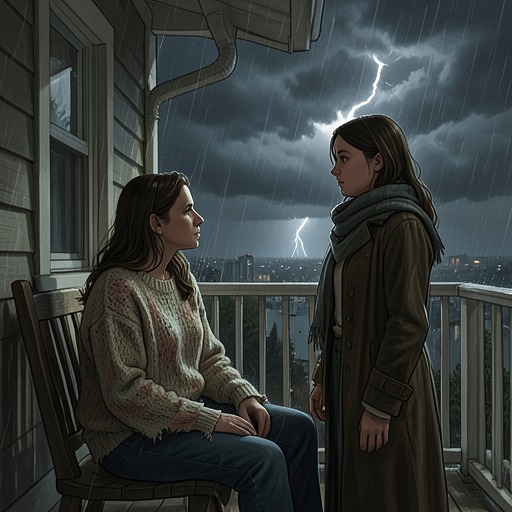
That night, after the events have run their course, Pops joins Wendy on the porch. Charlie is upstairs at the computer; Wendy drinks white wine and Pops has a beer. When he says he is ready to leave, Wendy points out that he still has a beer. The shared evening quietly holds together their different losses: alcohol killed John and Haley McWaid, yet both Wendy and Pops are drinking. Wendy recognizes the contradiction but leaves its deeper meaning unresolved rather than turning the moment into an explanation.
Pops then reveals why he returned to New Jersey: he had received a letter from Ariana Nasbro and had met with her more than once that week. He tells Wendy that he is forgiving Ariana, who killed John while driving drunk, because he no longer wants to hold on to the hurt and believes John would not want that for him. He frames compassion as something necessary to retain. Wendy cannot forgive Ariana, and she makes that difference clear. Pops does not demand that she follow his example; he respects her position and asks her to respect his. Wendy says she thinks she can.
The exchange makes Pops’s forgiveness an act of personal choice rather than a verdict on Ariana or a condition imposed on Wendy. His decision does not erase the death or require Wendy to feel what he feels. Instead, the book closes his arc around two forms of care: protecting Charlie when Wendy fears for him, and making room for Wendy’s refusal even as Pops lets go of his own resentment. Their relationship endures through that difference, as it has endured the change in family titles.