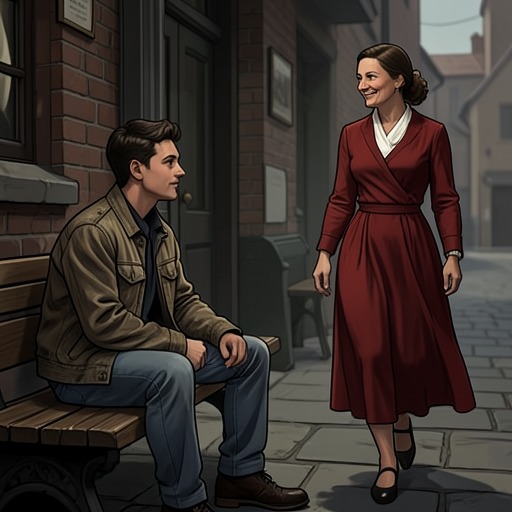
Narrator meets Emily and begins a relationship
CherryThe narrator meets Emily at eighteen, in an English class he keeps attending partly because she is there, and the attraction that begins between them develops into a first kiss and a relationship that later persists through addiction and criminal upheaval. Their beginning is neither a clean romantic choice nor a simple courtship: the narrator is shy, already attached to Madison Kowalski, and drawn to Emily before he knows what to make of her. The book’s later scenes preserve that early tenderness while showing how much harder it becomes to separate care from danger.
Meeting and first attraction
At the time, the narrator and Emily are both eighteen and have met at school. Emily first notices his gray wool cardigan, a three-button Gap sweater that she describes as an old, sad man’s garment. She tells him it was what caught her attention and prompted her to speak to him. The narrator, who spends seven dollars a day on cigarettes, remembers Emily as having money problems; the mismatch between her financial strain and his spending becomes one of the ordinary, concrete details through which their lives first come into view.
Emily’s presence unsettles him before they have properly begun to talk. She wears a white ribbon around her neck and speaks softly; he cannot decide whether her gentleness is a performance or simply who she is. He is intensely curious about her, but holds back because he has a girlfriend and is timid. That hesitation matters: the relationship does not start with an uncomplicated declaration of interest. Attraction arrives first as a question the narrator is reluctant to act on.
Classmates, conversation, and divided loyalties
The English class gives their attraction a routine place to grow. The narrator sometimes misses college classes, but he never skips English, despite thinking the course is poor, because Emily is there. They sit beside one another, and that is how they first speak. His habit of returning to the class turns an otherwise unremarkable schoolroom into the setting of their beginning.
Their conversations open onto Emily’s tastes and history. She likes Modest Mouse and introduces him to Night on the Sun; she also has him read two plays by Edward Albee, whose work leaves the narrator wondering about both the playwright and Emily. He listens as she describes the place where she grew up: abandoned factories, a cemetery, and the spots where she scraped her knees. Her green eyes seem bright and kind, but not wholly innocent, and her voice is what finally wins him over. Her stories give their early connection a sense of place even before the narrator fully understands the person telling them.
Emily comes from Elba, New York, which the narrator compares with Cleveland as a similar kind of lakeside town, though a little worse. She tells him she was educated by nuns and had never been in a class with boys, presenting herself as inexperienced around them; the narrator later qualifies that impression, without making it the defining fact about her. He is impressed by her account of his work selling drugs and working in a shoe store, and he likes her more than Madison Kowalski. Yet he remains emotionally divided: he still has feelings for Madison and even shows Emily a photograph of her. Emily responds by admiring Madison’s beauty. Their early closeness therefore includes an unusual frankness about the other relationship rather than a concealed, settled choice.
First kiss and immediate consequence
A later encounter brings the attraction into physical intimacy. At a party in a brick house on Inverness Road, the narrator arrives with young people from Shaker after meeting them outside Russo’s on Fairmount Boulevard. Beneath a garden trellis strung with small lights, he sees Emily in a white summer dress, laughing. The scene’s recognition is mutual, and the surprise of seeing her again gives the meeting a different charge from their repeated proximity in class.
They continue together and reach the bedroom where they kiss for the first time. The account does not present this as a formal commitment or explain the relationship through a single promise; instead, the kiss marks a change in what had until then been curiosity, conversation, and hesitation. The next morning, the narrator is due at work in two hours. The shoe store calls to tell him he has been fired; he says he understands, hangs up, and goes back to bed with Emily. The sequence places a practical loss immediately beside the new intimacy, without claiming that one caused the other.
A relationship carried into later crises
Later scenes show the relationship continuing beyond its beginning, now threaded through the narrator’s worsening circumstances. In one exchange, after the narrator apologizes for another man’s insulting way of speaking to Emily, she takes his hands and asks him to let it go. The gesture is small but distinct: she answers his anger not with an argument, but by holding his hands and trying to end the confrontation.
The contrast between the first schoolroom encounters and their later life is especially sharp around the university. While preparing to rob a downtown bank, the narrator speaks with Emily near the campus buildings. She tells him to be careful before returning to the university; he answers her affectionately. The same setting that first brought them together through an English class now places their tenderness beside his criminal plans.
In another later moment, the narrator explains that he needs to obtain heroin quickly and take it to Emily at the university because they are both beginning to feel ill. He has four hundred dollars, owes most of it to Pistol, and is pressed for time. His account makes the relationship’s care inseparable from the practical demands of dependence: he is trying to get the drug to her while managing his own need and the money owed to someone else. The story does not erase the attraction, the hand-holding, or the early attention to Emily’s voice; it shows those beginnings continuing in a life where affection must compete with addiction and danger.