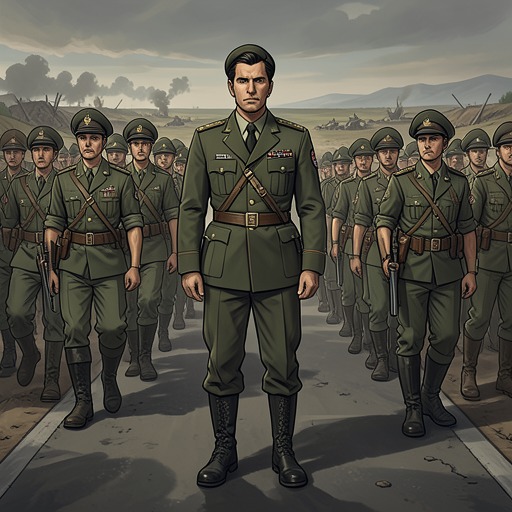
False report nearly triggers an airstrike on friendly forces
CherryThe near-friendly-fire airstrike during the search for missing paratroopers exposes how a false radio report, missing identification equipment, and a misplaced assumption about troop positions could turn American aircraft against their own forces. The danger is interrupted only after Hueso-Santiago recognizes the threat and Greene cancels the operation in time.
Background and mistaken identification
After waiting more than an hour, the force moved north past Checkpoint 9 and split into groups. Hueso-Santiago led a brigade into fields west of the road, while North directed a fire team northeast. The narrator, Evans, Hightower, and Castro went east. Aircraft circled overhead, and one reported a target house for inspection. The ground teams’ divided positions and the air operation’s dependence on radio confirmation formed the conditions for the near-disaster.
The brigade under Hueso-Santiago had no infrared beacon on its equipment. As Sullivan later explained, its soldiers had come from units normally assigned to Bradley fighting vehicles and were now being used as infantry. The aircraft could not identify them as friendly forces and mistook them for enemy fighters. The error was not simply a bad observation from above: the expected means of distinguishing the brigade was absent, while the radio channel supplied a false assurance that friendly troops were where they were supposed to be.
How the airstrike was nearly directed at friendly troops
The aircraft radioed the captain to confirm that all friendly soldiers were at their assigned posts. The captain was not in his truck, so Jeffries took it upon himself to answer that everyone was present and in position. That report gave the aircraft a misleading picture of the ground situation even as Hueso-Santiago’s brigade was out in the field.
Hueso-Santiago then radioed the company to warn that one of their own aircraft appeared to be preparing to fire on him. Greene understood what the warning meant, rushed to the captain’s truck, and removed Jeffries from the radio. He cancelled the operation just in time. The account establishes that the airstrike was authorized or under way as an operation, but that Greene stopped it before the attack hit the brigade.
Aftermath and significance
When the narrator returned to the road, Greene was dressing Jeffries down and threatening to kill him personally if he touched the radio again. The rebuke makes the immediate responsibility plain: Jeffries had answered without authority while the captain was absent. Sullivan’s explanation adds the larger failure behind the moment, as soldiers serving in an unfamiliar infantry role lacked the infrared equipment that would have helped aircraft recognize them.
The danger did not end the search. The force regrouped on the road; the target house had been inspected, and the soldiers had to continue looking elsewhere for the missing paratroopers. In that sequence, the near-strike is neither a separate battle nor a completed attack, but a sudden reversal within an ongoing operation: the aircraft overhead, intended to support the mission, become a threat to the brigade on the ground. The episode makes the fragility of coordination tangible, with the lives of friendly troops briefly resting on a correct radio picture and a warning sent in time.