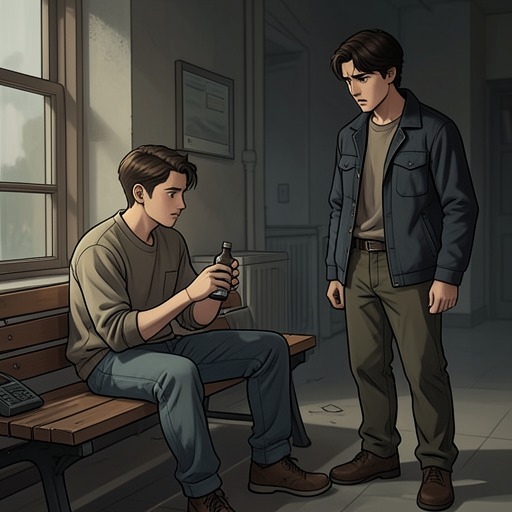
The Narrator Robs a Bank Again During Withdrawal
CherryThe Narrator Robs a Bank Again During Withdrawal is a desperate, improvised bank robbery driven by the immediate needs of heroin withdrawal. The narrator leaves Emily sick at home, enters a bank without a weapon or disguise, and walks out with money; within hours, a surveillance photograph makes the escape feel precarious. The episode’s sharp reversal is its measure of relief: cash briefly quiets the bodily crisis, while the image of the robber brings the law back into view.
Causes and Conditions
The robbery grows out of a cycle in which the day begins not with the morning but when the available heroin runs out and the couple must find more. The narrator and Emily have been injecting together, and the surrounding supply network is unstable. Manny, who had access to strong heroin, became an informant and had to expose two suppliers; later, he owed Cookie six hundred dollars for drugs advanced on credit, and his usual way of handling such debts was to inform on a dealer. These episodes make the drug economy a web of access, debt, and betrayal rather than a dependable source of relief.
The narrator’s immediate circumstances are more physical than strategic. Emily is on a mattress on the floor in another room, tangled in blankets. They cannot lie beside each other while trying to withdraw: both are sweating and vomiting into small plastic wastebaskets. The narrator stands at the kitchen sink for three quarters of an hour, drinking water that comes back up mixed with bile and mucus. More than twenty-four hours have passed since their last injection; they have no money, and he concludes that they are trapped.
The preceding day’s events show how each crisis renews the search for drugs. Mike has been robbed of twenty-eight grams of cocaine, a loss valued at about eight hundred to a thousand dollars. The narrator accompanies him to his blue Mercury, left with all its doors open near Coventry Boulevard, just north of Mayfield Road and on the edge of East Cleveland. Afterward, the narrator gives Mike another pill, then calls Black, who says he has found something. The narrator buys a gram from him without contacting Raul. These transactions do not solve the couple’s larger shortage; the next morning, the remaining heroin is gone and the need for money has become urgent.
The Improvised Robbery
The narrator dresses in secondhand clothes: gray trousers, an Oxford shirt, a baseball cap from his mother, false glasses, and a pea coat. He takes a small plastic wastebasket because he expects to vomit. His mood is described as melancholy but calm, and he tells himself that life is precious even as he prepares to rob a bank. The combination makes the decision neither a carefully organized plan nor a sudden scene of armed force: it is an attempt to act while sick, with Emily suffering at home and no money left.
He first drives past the bank and notices an empty police car parked across the street. Turning into a side street, he vomits into a small green wastebasket, continues to North Park, and parks halfway down a block. There is no plan, timing device, ski mask, or gun. He does not want to follow the usual preparations and decides to go in directly, without knowing how events will unfold. On the way to the entrance, he vomits again onto a planted strip beside the sidewalk. He then sees the officer associated with the parked car walking about a hundred meters away and turning into a bar.
Inside, the bank is busy, but several teller windows keep the line moving. The narrator has a paper message in an envelope. While waiting, he vomits into his shirt beneath the front of his coat; a woman behind him notices that he seems ill. When his turn comes, he unfolds the paper and shows it to the teller, presenting it as something received in the mail. The teller reads the message and places money in front of him. He takes both the money and the paper and leaves. The robbery’s central action is quiet and compressed: a message changes hands, the teller supplies the cash, and the narrator crosses back into the street.
Escape and Immediate Relief
Once outside, the narrator runs, turns around, vomits on himself, and drives toward North Park. At the junction, a right turn would take him back into Cleveland proper in about twenty seconds; he turns left into Cleveland Heights, where he laughs as he drives away. At Lee Road he believes he is safe, as though nothing has happened. That sensation lasts long enough for him to return home and empty the money from his pockets in front of Emily, who is on the couch with her eyes closed.
The cash is converted almost immediately into heroin. The narrator calls Raul and asks to meet at once; Raul names the Subway at the corner of Mayfield and Warrensville. After changing clothes, the narrator and Emily go there, with Emily riding in the back seat. Raul is on time for once. The narrator buys all the heroin Raul has in his pockets: seven grams. He and Emily leave and inject large amounts. Their hearts seem to beat slowly, and the narrator experiences the supply as a rescue. They are hungry, so they return to the Subway for sandwiches and cookies; he gives the sandwich maker a twenty-dollar tip. That night they inject heavily, reassured that they have enough heroin for the coming week and perhaps longer. The stolen money has purchased not security but a temporary extension of the same dependency that made the robbery seem necessary.
Exposure and Unresolved Ending
The first warning arrives by telephone from Joe, whom the narrator has not heard from in more than a year. Joe asks whether he robbed a bank that day because the news has shown a man who looks like him. The narrator denies it, then ends the call. After the local news has finished, he searches online and finds a clear photograph of himself taken by the bank’s surveillance system. The image contradicts the brief conviction, reached at Lee Road, that the escape had erased the event.
The narrator tells Emily that he is finished and fears prison, but immediately searches the report for a reason to doubt the identification. The news describes the suspect as six feet two, while he says he is six feet; he asks whether the photograph can really be identified as him. Emily reacts with alarm. He injects half a gram of heroin to calm himself, then looks at the photograph again. The account ends on that repeated act of looking, not on an arrest, a decision to flee, or any confirmation that the image will lead to capture. The robbery’s outcome therefore remains suspended between the temporary relief purchased with the money and the public evidence that may undo it.