Raul and the Others Make Repeated Plans to Rob Banks
CherryRaul and the narrator’s repeated bank-robbery plans turn preparation into a measure of the group’s instability: a first target is abandoned when police cars appear, and a later attempt yields money only after Raul bolts and leaves the narrator to finish alone. James and Rider are drawn into plans shaped by prison, drug use, uncertain loyalties, and improvised escape arrangements. What follows is not a progression toward mastery, but a sequence in which every contingency exposes another failure of coordination.
Causes and Participants
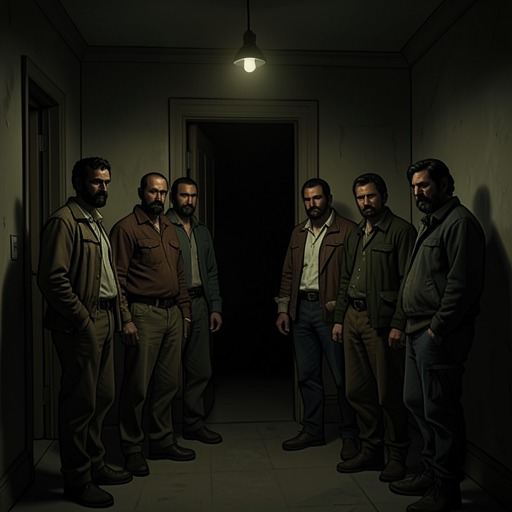
Raul proposes the robbery at the bank near Warrensville and Mayfield because he wants to set money aside before going to prison. The narrator joins him, James, and Rider in the car, hoping that having three people inside will bring in more money and allow someone to manage the doors. The group is unarmed, making the proposed division of labor part of the plan rather than a detail they can take for granted. The narrator asks James to drive and expects the attempt to go better than it does.
The four do not inspire equal confidence. The narrator is not concerned about James or Raul, but doubts that Rider can withstand the pressure. Rider is Raul’s protégé, and the narrator hopes Raul’s presence will give him courage. That hope is already a warning about the operation’s dependence on personal influence: the group has no formal discipline, and its confidence rests on whether one participant can steady another.
The First Plan Is Abandoned
The first signs of trouble come while the group is driving around the bank to inspect the area. Raul wants to go in immediately; the narrator insists on another look. They cross Mayfield and continue south on Warrensville, where the narrator sees four police cars parked behind buildings across from the bank. All are pointed in the same direction, apparently ready to pull out quickly. The cars change the meaning of the reconnaissance: what was meant to clarify the approach instead reveals a conspicuous risk. The narrator tells James to keep driving, and the robbery is called off before anyone enters the bank.
On Belmar Road, the group regroups rather than proceeding with the original plan. James trades twenty-eight grams of marijuana for a few grams of heroin, while the narrator takes Raul aside to ask about a plan in Bath that Rider keeps talking about and that seems to involve substantial money. The exchange places the aborted robbery among the group’s other negotiations and pursuits; the effort does not produce a payday, but the participants remain together and the possibility of another scheme is already in view.
A Second Target, a Missing Partner
When the group returns to the car, James asks whether they are going to do anything. Rider says he needs to go to Severance. The narrator proposes a bank on Chagrin Boulevard, and James agrees. Those in the group who use drugs take a dose before they leave, then they drop Rider off. The narrator is glad to be rid of him, a blunt reversal of the earlier hope that Raul’s presence might help Rider endure the pressure. The party is smaller for the next plan, but its internal confidence has not improved.
They inspect two branches on Chagrin and choose one in a shopping center. Because the branch is new, the narrator expects it to have a double-door vestibule. The narrator explains a specific escape procedure to Raul: one person is to keep the inner door open while the other handles the outer door, then hold that door so they can leave together. The concern is that being trapped between the doors would lead to arrest and prison. The elaborate instructions show how much the group’s thinking is fixed on the mechanics of getting out; they do not, however, ensure that the participants will act together when the moment arrives.
At the entrance, the narrator has pulled a neck warmer over the lower face and makes an exaggerated Pacino-style entrance, invoking Attica. Raul says nothing. The narrator looks back and discovers that Raul is not there. The employees are watching; the narrator tells them not to say anything, turns around, and leaves. James has waited in the car, while Raul is on the back seat. The scene collapses before a coordinated robbery can begin. Soon afterward, the narrator sees police cars approaching from the opposite direction and tells James to pull over. The account gives no full explanation for Raul’s absence or for the police cars’ arrival, but the narrator later confronts Raul angrily over what he has done, and Raul apologizes.
The Chagrin Boulevard Attempt and Its Cost
The group nevertheless returns to the bank. James and Raul make peace, and James lets Raul borrow his sunglasses to conceal his eyes. The narrator tells Raul to enter first and promises to follow. Raul goes inside; after counting to five, the narrator enters as well. It is a small branch with a single teller. Raul is standing against the back wall, facing the counter, dressed like a ninja in a parka despite the mild weather. The employee looks frightened. The narrator’s account presents the disguise and the teller’s reaction as concrete details of the scene, but does not describe a weapon or a spoken demand.
Raul suddenly runs past the narrator and out of the bank. The narrator is left inside, sees that the teller’s drawer is open, reaches over the counter, and takes the bills. A man entering the bank pretends not to notice the narrator on the way out. On the sidewalk, the narrator initially walks in the wrong direction, then remembers the instruction given to James and turns the corner. Raul is not in the car. The planned division of roles has now reversed: instead of a clean paired exit, the narrator has taken the money alone and must find the partner who has fled.
James turns around to look for Raul and drives slowly through a crowded area. The narrator describes the wait as lasting an eternity, but emphasizes that James keeps his composure rather than panicking. Raul eventually runs up from behind, climbs into the back seat, and urges them to leave. Once they are away, the narrator gives him the money to count. Raul reports a total of $1,300 and says he took nothing for himself. The narrator does not press him about the money and later suspects Raul kept it all.
The robbery’s aftermath makes its poor return plain. The narrator is tired of the whole affair, feels that the escape was narrowly achieved, and describes the role as resembling that of a pickpocket. James later reports that Raul dropped the borrowed sunglasses while running from the bank; they had cost James $300. The narrator goes to James and repays him that amount. In practical terms, the narrator loses $300 on the robbery, while James recovers the purchase price but not the additional costs of gas and a balaclava, which he considers negligible. The $1,300 taken from the teller’s drawer therefore does not become evidence of a successful partnership: the money’s final distribution remains uncertain, and the one definite reimbursement is for property lost in Raul’s flight.
Significance
Across the two targets, the plans repeatedly promise a controlled operation and deliver improvisation. The first is stopped by the visible presence of four police cars before the group enters; the later effort is undermined first by Raul’s unexplained absence at the entrance and then by his sprint from the bank. At both points, the narrator’s attention turns to practical contingencies—surveying the street, keeping doors open, choosing an escape route—yet planning cannot make the group dependable.
The repeated schemes also expose a mismatch between collective language and individual conduct. The robbery is discussed as a joint undertaking, with roles assigned and money expected, but Rider is dropped off, Raul disappears and runs, James is left to drive and search, and the narrator ends up taking the open-drawer bills. The ending is not a clean division of proceeds but an exhausted narrator’s assumption about Raul’s share and a $300 repayment to James. In that imbalance, the episode registers the distance between the imagined payoff and the actual cost of trying to work together.