Divine Indifference and Ineffectual Prayer
ChowringheeDivine Indifference and Ineffectual Prayer names a persistent conflict in the novel: people turn to God when humiliation, bodily difference, or fear leaves them with nowhere else to turn, yet no assurance comes that their appeals are heard. The contrast is embodied in Lambreta’s furious plea for condemnation, Nityahari’s image of prayers buried in an office, and Connie’s sacrifice-minded request that Harry be made taller. Together, these episodes make prayer less a reliable intervention than a record of need—and of the uncertain comfort people keep seeking despite silence.
Appeals Made Under Humiliation
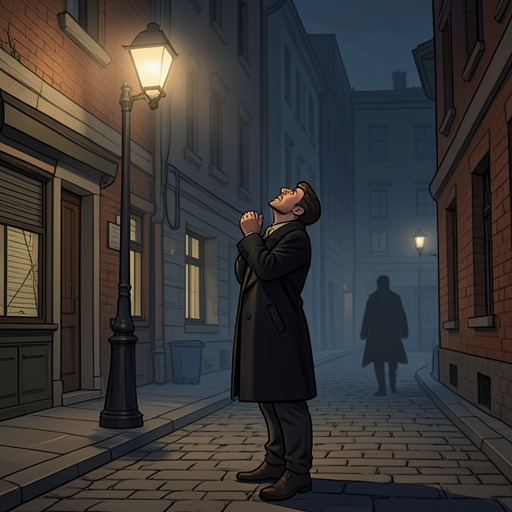
The narrator recalls Lambreta reaching toward God and calling for punishment to fall on those he despises like a ball of fire. The prayer is not calm or doctrinal: it rises from anger and humiliation, and the narrator remembers its speaker as a dwarf whose desperation gives the appeal its force. Yet the scene offers no confirmation that the Creator hears him. Looking back years later, the narrator still sees it vividly, but vividness is not an answer; the memory preserves the plea while leaving its reception unknowable.
The uncertainty widens beyond Lambreta. The narrator considers the many humiliated people across the world who, over thousands of years and in many languages, must have sent up similar prayers. Their repetition makes the question of efficacy harder to dismiss: if so many people have asked for justice, the persistence of suffering makes it impossible to treat prayer as a dependable remedy. The passage does not prove that no prayer is ever heard. Instead, it holds the human need to appeal against the absence of any visible assurance that the appeal changes what happens.
The narrator’s later imagined future for Connie and Lambreta extends that doubt into time. Connie’s youth, which sustains their livelihood as performers, will eventually fade; the pair will leave Hotel Shahjahan and disappear from cabarets. In the narrator’s bleak projection, another Connie will perform with another dwarf, greet drunken customers, and be scratched by a spectator. Another injured performer may then pray for justice, only for that plea to become another unanswered application. The scenario is explicitly imagined rather than reported as a later event, but its repetition matters: suffering returns, and so does the prayer, without any visible resolution.
God as an Unresponsive Office
Nityahari gives the uncertainty a concrete bureaucratic form. He compares God to a government official whose office receives thousands of applications each day. Employees stamp the papers as requiring no action and remove them from view; famous people’s files, he says, have not moved even a fraction. In this analogy, prayer is not rejected through a dramatic act of judgment. It is processed into neglect: a petition becomes a file that no one has time to read.
The image also gives the passage its bitter contrast between youth and experience. Nityahari tells the narrator that a young person can still laugh, but that eventually only tears will remain, and then his words will be understood. His account makes divine indifference feel like one more institutionally familiar powerlessness: the petitioner may submit a case, but access to the office does not mean access to attention. The narrator does not simply adopt Nityahari’s certainty. Instead, that comparison shadows the scenes that follow, making each renewed appeal carry both hope and the expectation that it may be filed away.
After leaving Connie and Lambreta backstage, the narrator imagines Lambreta’s prayer being deposited in God’s office. The thought immediately qualifies itself: perhaps even that comparison says too much, because the prayer might die with its file. Lambreta and Connie would remain waiting for a reply, while the passage’s imagined future supplies none. Their waiting is not portrayed as a single moment of disappointment but as a condition stretched across time, bound to Connie’s aging and to the fragile income her performance provides.
Connie’s Plea and the Promise of Ritual
Connie’s appeal for Harry is more intimate than Lambreta’s curse and more painful in its specificity. She offers everything she owns in exchange for Harry becoming taller. Happiness, wealth, and property are not what she asks for; she wants him to be short without being called a dwarf. Her words distinguish the bodily difference itself from the cruelty of the name imposed on him, while showing how completely social humiliation has shaped what she hopes to change. The narrator, hardened by years of witnessing suffering, says the prayer still makes his hair stand on end. It is the moment that allows him to understand Connie and makes him ready to leave everything and accompany her home when she wishes to go.
At Shibdas Debsharma’s intervention, that desperate request is redirected into a ritual. He describes the vamanavatar yagna as complex work requiring a priest to perform rites for seven days and seven nights. The narrator recognizes the prospect of a costly demand as an attempt to take advantage of Connie and refuses to remain a silent witness to what he sees as a fraud. The ritual’s solemn structure cannot itself establish that it will help Harry; in the scene, its immediate practical effect is to place Connie’s vulnerability within the reach of a religious intermediary.
When Shibdas Debsharma warns that Harry will not live long after the sacrifice and that no one he has seen has survived it for more than six months, Connie recoils. The promised transformation now carries the threat of Harry’s death, and she rejects the sacrifice. Shibdas Debsharma then offers an amulet, claiming extraordinary power and instructing her to wear it on her bare foot after bathing, while avoiding drink and debauchery on that day. Connie gives him ten rupees and asks whether Harry will find peace if she wears it. He assures her that the amulet has special powers. The passage establishes the assurance and the payment, not that the amulet works.
Waiting, Work, and the Limits of Consolation
On the journey back to Hotel Shahjahan, Connie remains silent and somber. She has lost her last hope that Harry will become normal, and her only spoken reflection is that perhaps she too will find peace. The line does not resolve whether the amulet comforts her or whether peace means accepting what cannot be changed. Its weight comes from the contrast between the earlier plea, which asks for a different life for Harry, and the return journey, on which Connie has no further request to make.
The narrator’s response to these prayers is shaped by his position at the hotel. After leaving the performers backstage, he reminds himself that he is a receptionist with work to do; a tired dancer’s brief rest away from curious eyes does not release him from his duties. He must return to the microphone and announce Connie’s performance with practiced courtesy. The hotel does not pay him to brood, and his ability to carry out the cabaret host’s responsibilities determines whether his livelihood continues. This practical interruption does not disprove the prayers or settle the question of God. It shows the pressure exerted by ordinary work: even after witnessing another person’s anguish, the narrator must resume the performance that keeps bread on his table.
Across these episodes, prayer persists because the need behind it persists. Lambreta asks for vengeance, Connie begs for Harry’s acceptance and safety, and Nityahari gives the narrator a language for imagining why such petitions may go unanswered. The novel places religious appeal beside humiliation, ritual expense, and the demands of paid performance without offering a visible divine resolution. Its central ambiguity is therefore not whether people pray, but what prayer can mean when the answer remains beyond their knowledge: it may be a demand for justice, an expression of love, or a final attempt to endure a world that does not promise change.