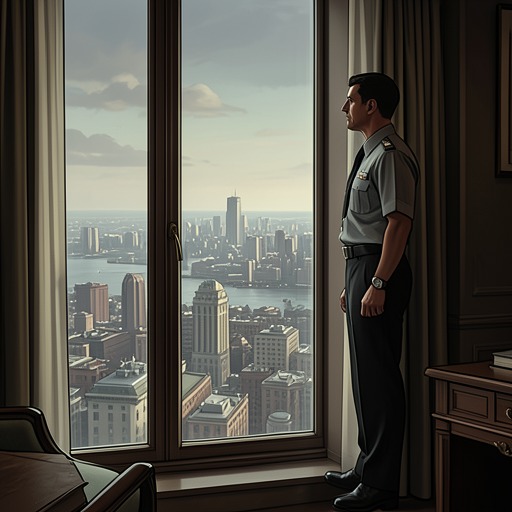
The Hotel as a Window on the World
ChowringheeThe Hotel Shahjahan becomes a window onto the world not because it offers a complete or impartial view, but because its counter, corridors, and banquet rooms bring distant lives into close proximity. Sata Bose describes the receptionist’s position as a rare vantage from which to encounter travelers and hear complaints; the narrator’s experience confirms the breadth of that view while exposing its boundaries. The hotel gathers a world together, but does not make every part of it equally visible.
A Window Behind the Counter
When Sata Bose begins teaching the narrator the principles of reception work, he reframes the long hours spent standing before the counter and listening to complaints from hundreds of people. The desk, in his account, is not merely a barrier between staff and guests: it is a viewing point. Passports from a hundred countries have passed before him, and he boasts that he has seen people of every race on earth except the cannibals of the jungle. The claim conveys the scale of his experience, though its sweeping language also shows that this window is shaped by the speaker’s own way of classifying the world.
The narrator’s first response is to question whether this is all the world contains. Bose’s answer insists on the value of the hotel’s particular perspective: a receptionist sees people arriving from elsewhere, crossing paths, and presenting themselves at a counter. The image is both practical and figurative. The desk is where the hotel’s global traffic becomes legible, but the employee who watches that traffic remains at work, listening to complaints and managing the demands of service. What looks like a privileged view is also a job performed for hours at a time.
The Hotel as a City in Miniature
The building extends the metaphor beyond the reception desk. It is so large and intricate that it resembles a city, with numerous rooms, corridors, passages, and connections that take years to learn. Even then, complete knowledge remains uncertain. A carpeted second-floor corridor ends at a closed door that seems to lead to another room; instead, it opens into a narrower passage in the hotel’s older section, built by Simpson, who still visits it more often than the newer parts.
That passage offers glimpses rather than a tour. Doors stand partly ajar, allowing the narrator to catch the shadows of ceiling fans and the faint sound of radios, but not to see fully into the rooms. In quick succession, he notices two Japanese gentlemen holding beer, an American family, a Sikh airing his turban and beard net, and a resident whose clothes suggest that he is Burmese. Snatches of Indian languages and languages from elsewhere pass through the corridor, overlap, and disappear. The impressions resemble the changing frequencies of a shortwave radio: distinct voices briefly emerge, then blend into another stream of sound.
The scene also resists turning the hotel’s many residents into an orderly catalogue. A Chinese child, concentrating as he tries to remove his shorts, takes the narrator’s hand with a smile; his gestures make clear that he has wet his clothes and part of the carpet. The intimate, awkward incident sits beside the larger spectacle of international variety. The hotel’s world is not made only of national identities or striking differences. It includes ordinary needs, embarrassment, and the accidental contact between strangers sharing a building.
Public Display and the Work Behind It
The banquets at the Shahjahan reveal another dimension of this miniature world: social life organized as an elaborate public performance. Seating arrangements require careful calculation because official precedence and the unwritten social hierarchy of Calcutta both govern who may sit where. A small mistake can damage the hotel’s reputation. The staff therefore carry responsibility for judgments that would more properly belong to the host, and Bose recognizes how much can be risked by a seemingly minor arrangement.
At the Sociedad Filantrópica banquet, the organizers welcome guests at the counter in different styles of dress: Agarwalla wears a bandhgala and churidar, Langford a formal Western suit, and Khan Bahadur Huq clothing that acknowledges Mughal tradition. The gathering presents itself as a sacrifice of personal pleasure for humanity, society, and the nation. Yet Bose warns the narrator that Calcutta’s charitable banquets repeatedly draw the same people, invited from familiar lists and moving from hotel to club to private home. The next day’s newspapers will report speeches and summaries prepared before the banquet; the printed account will not disclose what actually took place that evening. The hotel’s window thus looks onto public benevolence while also showing how public accounts can be staged in advance.
The same tension between performance and labor appears when Connie’s act begins. The lights go out, a restless spotlight searches the stage, and the audience’s anticipation gathers before the performer is clearly revealed. The spectacle depends on controlled illumination and carefully managed expectation. When the first act ends, the narrator signals the electricians to extinguish the lights so that Connie’s modesty can be preserved. She is then found backstage, wrapped in a robe and breathing hard, asking where Harry has gone. The star seen by the audience and the exhausted performer behind the curtain belong to the same hotel, but occupy different sides of its display.
What the Window Cannot Show
The narrator’s account explicitly distinguishes what can be observed from what has been entrusted in confidence. The hotel’s quiet corners contain private stories that the writer might wish to tell, but the human obligation not to expose them limits the narrative to what he witnessed directly. The window metaphor therefore does not promise total access. Proximity to other lives creates knowledge, but it also creates a responsibility to withhold some of it.
Nor is the hotel’s social world governed chiefly by feeling. The narrator characterizes the environment around him as one in which people are familiar with two objects: the purse and the checkbook. That stark image qualifies the apparent openness of the Shahjahan’s international traffic. Guests may arrive from many places, and banquets may invoke humanity, but money and status shape the relationships the hotel can display. During Connie’s performance, the narrator privately considers the contrast between the large fee paid to the performer, the higher charges placed on food and drink, and the employees whose labor makes the event possible. The view from inside the hotel includes the people who serve its spectacle, even when the public gaze is directed elsewhere.
Taken together, the counter, corridors, and stages make the Shahjahan a window with several panes: each frames a different portion of the world, and none provides an unfiltered view. Travelers’ languages and habits pass through the old wing; social rank determines banquet arrangements; charitable reputations are shaped by advance publicity; and a performer’s public image gives way to backstage fatigue. The hotel’s reach lies in bringing these scenes into one working building, while its limits lie in the hierarchies, commercial demands, and private boundaries that determine what can be seen.