Stage Performance and Private Reality
ChowringheeStage Performance and Private Reality is a recurring contrast in the hotel’s public spectacles and private encounters. Connie’s performances turn her into a carefully advertised attraction, but backstage and in the rooms above the stage she is a sister negotiating the limits of that role. The difference is not simply between an artificial show and a truthful self: the show is also her chosen profession and a means of supporting her family, while the private realities it conceals cannot be neatly separated from it.
Public Roles and Prepared Spectacle
At a philanthropic banquet in the Hotel Shahjahan, public virtue appears as a performance before it becomes a newspaper story. The organizers and prominent hosts present themselves as people who have set aside personal pleasure to serve humanity. Sata Bose tells the narrator, however, that Calcutta’s charitable parties repeatedly draw from the same invitation lists, while the next day’s press will report speeches and summaries already delivered to newspaper offices before the banquet takes place. The event’s public account is thus prepared in advance: what looks like spontaneous civic devotion has a rehearsed script and an audience.
The same tension between advertised identity and what appears onstage governs Connie’s introduction. The narrator is instructed to present her as an exceptional embodiment of womanhood, although no women are present in the banquet hall. Then the lights go out, a spotlight searches the stage, and the audience’s anticipation gives way to confusion: the performer who appears is Harry, a diminutive man in evening clothes, an oversized top hat, and carrying a cane. He begins to introduce himself as Connie, falters over whether he is the man or the woman, and finally claims the name Connie, the Woman. The audience, expecting the advertised woman, jeers and demands Connie. The act makes the gap between a promised persona and a performer’s actual body impossible to ignore.
Connie’s Act and the Audience
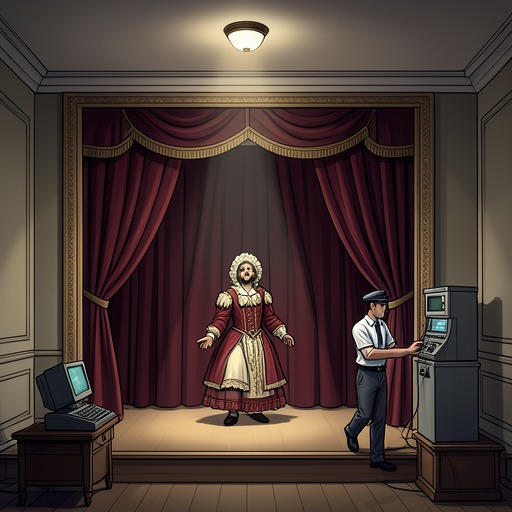
When Connie takes the stage, the performance supplies what the audience believes it was promised. She removes her heavy robe, dances to the music of Gómez’s orchestra, sits on a customer’s lap, and uses another man’s handkerchief to wipe away her sweat. At the Mumtaz, her dance is likewise designed to stir the spectators’ animal desires. Lambreta’s conspicuous passion for her intensifies their interest, while the women in the audience react with apparent disapproval even as their indulgent smiles show that they are enjoying the spectacle. The audience’s response is part of the act: desire, embarrassment, and amused disapproval coexist, all directed toward a woman whose body is being made into entertainment.
The show also depends on precise backstage control. At the end of the first act, the narrator signals for the lights to go out so Connie can preserve her modesty; when they come back on, she is behind the scenes, wrapped in a robe and panting. The same body presented as a public attraction is, for a moment, a tired performer who needs to catch her breath. Yet the boundary between stage and private life is porous. Harry’s feelings about what Connie must do onstage spill into the performance, and the audience’s appetite turns his love and jealousy into additional entertainment.
The Private Cost of the Role
The contrast becomes stark when Connie appears on the rooftop late at night. Earlier she had entertained Calcutta’s male elite as a sensual, fierce figure; now she comes through the door in a nightgown and silk sleeping cap. The narrator observes that the woman from the stage seems transformed: this Connie has no fire and is no longer Connie, the Woman. The scene does not expose a single hidden identity that makes the performer false. Instead, it shows how the same person is read differently when the costume, lights, and audience disappear.
Harry’s distress exposes another cost of the public act. In tears, he says that others blame him although someone has called him a chimpanzee and nobody defended him. He shuts the door on Connie, leaving her standing alone on the rooftop, crying and wiping her eyes with her sleeve. The insult reduces his visible difference to a spectacle even away from the stage; his pain is private, but it is shaped by the same audience’s power to mock and judge. Connie’s public desirability and Harry’s public humiliation are unequal experiences, yet both are bound to the way other people look at them.
The Sibling Bond Behind the Show
A photograph allows Connie to explain the family history beneath the performance. It shows her mother holding a newborn Connie, with Harry as a child beside them. Harry never grew, but, as Connie tells it, he became the family’s provider. Unable to reach restaurant tables, he was put at the door to welcome customers and open the swinging doors; people found him amusing and left tips. That work supported his widowed mother and sister in Scotland. His stage appearance and his earlier employment both put his body before an audience, but the consequences differ: the restaurant’s customers’ amusement helped sustain the family, while his later performance alongside Connie becomes bound up with distress and conflict.
As Harry grew older, he became difficult and began drinking. His mother would sometimes go out at night to bring him back from bars. Connie had no opportunity to attend school; she learned to sing from Harry, who also taught her how girls danced in restaurants. Others laughed at his extravagances, but Connie and her mother did not. Her career is therefore not an independent performance from which Harry is excluded: it grows partly from what he taught her and from the family’s shared need to survive. At the same time, he cannot bear what her role requires, and he does not understand that she regards the stage as acting and work.
Choosing Family Over the Contract
When Connie decides to leave, she says she cannot continue performing while Harry is gone. She has asked the hotel to keep the circumstances from him, fearing that if he learns she has sacrificed her prospects for him, he will lose his struggle to improve his life. She plans to tell him that, in anger after an argument, she cancelled her contract. Her explanation protects him from knowing how much his departure has cost her, even as she recognizes that outsiders may see her decision as irrational.
Connie later explains why she brought Harry into the show: she could not abandon him in Scotland and had nowhere else to find peace. But he cannot endure what she has to do onstage. Her final choice makes the distinction between performance and private obligation consequential rather than merely thematic. The contract offers a professional future; the sibling bond demands that she leave with Harry. Connie does not reject the stage as mere deception. She calls it the profession they chose, while acknowledging that Harry cannot accept its terms. The story’s central tension remains unresolved between them: the performance can be work, skill, and family livelihood, yet the audience’s gaze and the demands of the act make its consequences intimate and real.