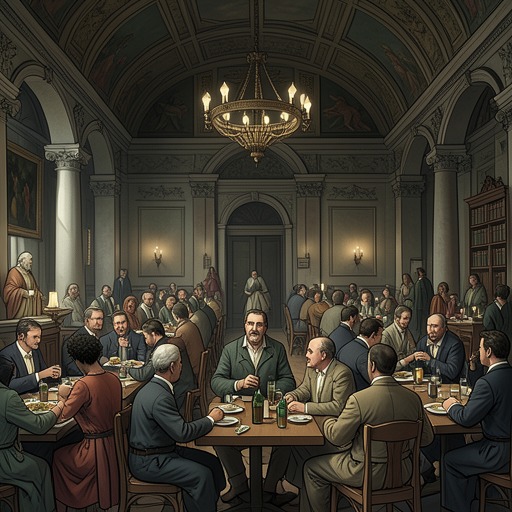
The Performative Hypocrisy of Charity Banquets
ChowringheeThe charity banquet organized by the Sociedad Filantrópica at the Hotel Shahjahan exposes the distance between humanitarian ideals and the social machinery built to display them. Its guests present themselves as sacrificing personal pleasure for society, the nation, and the world; yet the evening’s repeated rituals, managed publicity, private arrangements, and commercial entertainment make charity look less like self-denial than a polished performance.
An Evening Staged for Public Virtue
The Sociedad Filantrópica is described as an international organization that has recently opened a Calcutta branch. Its representatives, Agarwalla, Langford, and Khan Bahadur Huq, stand at the entrance to welcome guests. Their clothes make visible the different cultural traditions gathered under the organization’s banner: Agarwalla wears a bandhgala and churidar, Langford formal Western dress, and Khan Bahadur Huq attire associated with Mughal tradition. The scene initially seems to embody a meeting of cultures in service of humanity.
That unity is also a managed impression. The narrator watches Agarwalla whisper to Langford over the guest list; Langford laughs and leans against him, and the laughter reaches Khan Bahadur Huq. The moment appears to bring three distinct cultures together, but it unfolds as a social gesture among the organizers, not as evidence of any wider transformation. The banquet’s charitable purpose provides the setting in which these men can display fellowship as well as benevolence.
The hotel’s preparations give the ideal a material form. Satyasundar Bose has the hall ready, with 350 boar heads prepared by Nityahari awaiting the guests. Staff members, too, are drawn into the display: the narrator and Satyasundar Bose wear freshly laundered suits, and Bose adjusts the narrator’s bow tie, insisting on a presentable appearance. The event depends on hospitality workers’ attention to detail even as its public story centers on the sacrifice of its prominent guests.
Repetition, Publicity, and the Prepared Story
Satyasundar Bose punctures the impression that this is an exceptional gathering. Calcutta’s banquets, he explains, repeatedly draw from the same invitation lists: the same people dress for dinner night after night, changing only the hotel, club, or private home. The charitable assembly is therefore part of an established circuit of elite social events, rather than a spontaneous departure from ordinary pleasure.
The public account is similarly prepared in advance. Bose observes that newspapers will report speeches and summaries, but the essential material has already reached the newsrooms before the banquet begins. Journalists sit apart taking notes, yet their presence does not guarantee that the evening will be recorded as it happens. The event’s public meaning is partly manufactured before its speeches are delivered. Its polished record can preserve the language of service while leaving the circumstances and contradictions of the gathering outside the frame.
The speech itself demonstrates how easily that language can be adjusted to suit the room. The guest of honor praises the assembled citizens for their time and effort, then invokes a universal humanist principle to broaden the appeal beyond national concerns. When the writer Nagen Pal quietly corrects his attribution of a poet’s connection to Calcutta, the speaker pauses and redirects the argument: the poet may not have been associated with the city, but a Bengali figure was born in Bengal, and Bengal cannot be considered without Calcutta. The applause is moderate. Rather than abandoning the appeal, the speaker reshapes it to keep Calcutta at the center of the moral address.
Sacrifice with Exceptions
The banquet’s central demand is material as well as rhetorical. The speaker identifies food, especially rice, as a world problem and argues that scarce resources should be distributed according to need. He calls for sacrifice, announces that rice will not be served at the society’s banquets, and names twenty members who have pledged not to eat rice at home in the years ahead. The declaration turns dietary restraint into a public credential: private consumption is presented as a measure of concern for humanity.
Karabi Guha reveals a more personal circumstance behind Agarwalla’s pledge. He is diabetic; she keeps syringes and insulin in her room because he injects himself when he spends the night there. This does not erase the possibility that he observes the pledge, but it complicates the speech’s presentation of abstention as chosen sacrifice. For Agarwalla, rice is already constrained by a medical condition, while the audience hears the choice described as an exemplary contribution to global welfare. The moral performance makes unequal circumstances sound like a shared act of renunciation.
The bar dispute exposes another limit. Phokla Chatterjee objects that the menu contains no drinks and accuses Agarwalla of claiming to help humanity while making other creatures suffer. Agarwalla says the organizers had wanted to serve cocktails, but the guest of honor refused to speak if any alcohol were served. The prohibition is thus presented not as a general philanthropic rule but as a condition imposed by the evening’s principal speaker. Phokla rejects the public restraint and heads to Mumtaz to drink in private, asking Agarwalla to put the expense on his account. The exchange makes the banquet’s moral discipline look selective: alcohol is excluded from the official table, while the hotel’s bar remains available to a disgruntled guest.
Charity beside Commercial Spectacle
The evening’s entertainment extends the same concern with presentation into the hotel’s theatrical space. The narrator introduces Connie to the guests with extravagant language, calling her the sole woman of her kind in the century, even though no women are visible in the hall. The introduction turns her into a promised attraction before she appears. The lights go out; a wandering spotlight searches the stage, and a figure seems to emerge from the darkness. When the light intensifies, Connie is nowhere to be seen. Instead, a half-metre-tall performer in evening dress struts beneath a tall top hat, carrying a cane.
The delayed appearance makes the audience’s expectation part of the act. Connie’s first act later ends with the lights being switched off to preserve her modesty; she waits backstage in a robe, breathless, and asks where Harry has gone. The hotel thus manages not only the charity guests’ polished public image but also the visibility and concealment of performers. The contrast between the grand introduction and the backstage interruption shows how the banquet’s supposedly elevated occasion shares its stage with entertainment whose appeal depends on turning a person into a spectacle.
What the Banquet Reveals
The episode does not simply contrast sincere charity with selfishness: it shows how benevolent language can be absorbed into familiar systems of status, publicity, and hotel business. The same guests circulate among social functions; speeches are prepared for newspapers; a public pledge is complicated by private medical circumstances; and a ban on alcohol is imposed for the sake of the speaker’s appearance rather than shared as a universal practice. Meanwhile, hotel workers prepare the room and maintain the event’s finish, while Connie’s performance supplies another attraction for the assembled audience.
The banquet’s hypocrisy lies in the gap between what it announces and what it makes visible. Its rhetoric treats sacrifice as common purpose, but the details reveal different degrees of choice, privilege, labor, and exposure. By placing speeches, menus, private arrangements, press routines, and stagecraft in the same evening, the narrative makes philanthropy itself look like a performance: not necessarily empty of all intention, but carefully arranged so that public virtue can be seen while inconvenient particulars remain backstage.