Human Brutality and Dehumanization
ChowringheeHuman Brutality and Dehumanization takes shape in the novel through a recurring animal metaphor: Calcutta’s people appear as beasts, while the hotel’s entertainment and labor systems make human bodies available for use. The image links a night walk through the city to the treatment of Connie in the cabaret, and finally to the narrator’s bleak projection that the same injury will happen again. What begins as a way of seeing the city becomes a way to expose the conditions that strip people of dignity.
A city seen as wilderness
After a night he has not enjoyed, and without having eaten, the narrator leaves the hotel on an impulse. Public transport has stopped; the city seems sedated and asleep. In that unfamiliar quiet, he recalls a poem that Satyasundar Bose had asked him to read repeatedly. Its vision makes the metropolis resemble a Libyan forest, populated by animal-like human beings who wear clothes only from shame. The poem does not simply place nature outside the city: it makes the city itself seem like a wilderness, unsettling the distinction between supposedly civilized life and animal existence.
The narrator’s remembered question about whether this is really Calcutta, or whether he is alone in a Libyan forest, registers disorientation rather than a settled judgment. The animal image gives form to his perception of the city at night, but the novel later gives that image a harder social meaning. At the hotel, animality is not only a poetic description of people; it is also the language through which anger answers humiliation and through which the narrative imagines the consequences of treating people as bodies rather than persons.
Lambreta’s accusation
Lambreta makes the animal metaphor explicit when he condemns Calcutta’s inhabitants as animals and says that no one’s parents were human. His outburst follows his warning to the narrator not to invite anyone to sit on Connie’s lap. The warning connects his general denunciation to the specific vulnerability of his sister, whose performance places her body before hotel patrons. His language is furious and sweeping, but its immediate target is a world in which Connie is touched and mistreated while those around her are expected to carry on.
The narrator’s response reveals the pressure on hotel workers from another direction. He says that his job depends on satisfying the whims of the people in the salon; if they lose interest and stop eating and drinking, the workers will go hungry. Lambreta counters with the disparity he sees: when customers fast, the staff starves, but when customers feast, they feast on Connie. The contrast makes the cabaret’s transaction brutally clear. The patrons’ spending sustains the hotel and its employees, yet Connie’s body is also made part of the spectacle for which those patrons pay. The narrator is not indifferent to her treatment, but his livelihood depends on maintaining the customers’ appetite and attention.
The performance and its costs
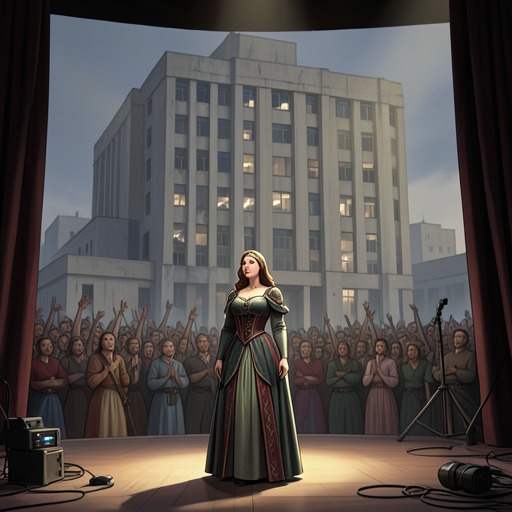
The show’s staged form makes that conflict visible. At the end of the first act, the narrator signals the electricians to switch off the lights to preserve Connie’s modesty. When the lights return, she is backstage, wrapped in a robe and gasping for breath. The brief protection offered by darkness does not undo the conditions of the performance: it marks a pause between acts, while the narrator remains responsible for bringing the audience back to the show.
He thinks angrily that Lambreta is paid a fortune and that the hotel charges customers more for food and drink because of that expense. Yet this calculation does not resolve the narrator’s own position. He is one of the employees whose bread depends on the hotel, and he must announce the next appearance and encourage guests to order drinks while Connie rests. His work requires courteous presentation even as he recognizes the arrangement’s cruelty. The motif of dehumanization therefore reaches beyond the patrons’ handling of Connie: the narrator, too, is constrained by a job that turns his voice and attention into instruments of the business.
Prayer, repetition, and the limits of redress
The narrator’s later recollection holds together Connie’s beauty and Lambreta’s appearance without presenting their difference as a simple opposition between good and evil. He remembers Lambreta raising his hands toward God and praying for condemnation to fall on those who humiliate them. The prayer gives his anger a direction beyond the room, but the narrator cannot know whether it reaches an impartial Creator. His uncertainty expands the scene from one performer’s mistreatment into a question about the repeated pleas of people who have been humiliated and whether those pleas accomplish anything.
Nityahari’s comparison of God’s office to a government department sharpens that doubt: petitions pile up, are stamped as requiring no action, and are filed away. The narrator imagines Lambreta’s prayer entering such an office, while Connie and Lambreta wait for an answer that may never come. He then projects a future repetition: Connie’s youth fades, her livelihood is affected, and the pair leave the Shahjahan. Elsewhere, a new Connie performs with a new dwarf partner; a drunken man scratches her with his nails, and the injured partner may send up another unanswered prayer. This is the motif at its bleakest. Animal imagery describes a society that permits predatory conduct, while the imagined recurrence suggests that the performers can be replaced without the conditions that injure them changing. The narrator finally turns back to his duties as a hotel receptionist and cabaret presenter. His return to work does not settle the moral question; it shows how the hotel’s ordinary routines continue alongside it.