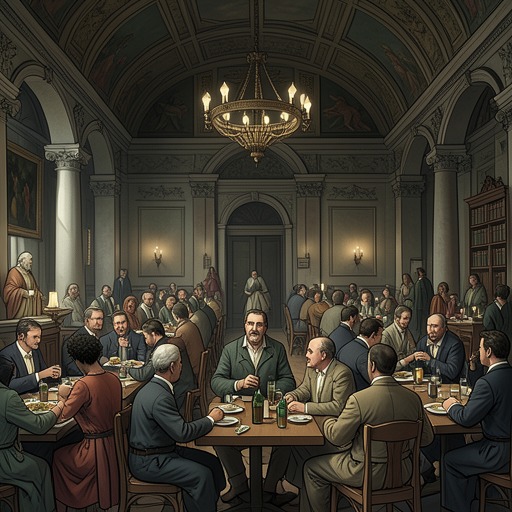
The Four Acts of a Cocktail Party
ChowringheeThe Four Acts of a Cocktail Party is Sohrabji’s wry account of a gathering’s decline from formal sociability into drunken disorder. At Mrs. Pakrashi’s party in the Hotel Shahjahan, his four-hour sequence makes the cocktail party seem like a small theatrical performance: the guests begin by observing their roles, grow increasingly comfortable, abandon restraint, and leave the workers to manage the wreckage. The framework is comic, but it also exposes the hierarchy and hypocrisy beneath the evening’s polished manners.
The Four-Hour Sequence
Sohrabji explains the pattern to the narrator in a whisper while the party is under way. Each of the four acts corresponds to roughly one hour, and each brings a change in what guests feel able to say and do. The first is devoted to breaking the ice. At this stage, people appear docile and ordinary; greetings, compliments, and remarks about absent acquaintances keep conversation within familiar social limits. Mrs. Pakrashi declines a drink for orange juice, urges Banerjee not to let her abstention stop him, and promises that champagne will also be served. The opening act is thus not free of gossip or display, but its social forms remain intact.
In the second act, the formal surface loosens. Guests complain about their clothes and ties, imagine dancing all night, and call for drinks. One order is for Rob Roys made with Scotch, brandy, and vermouth. Conversation also turns toward Mrs. Anindo, whose appearance is openly appraised. The change is not simply that people drink more: they begin to treat the party as permission to speak and look with less restraint. The courteous greeting gives way to appetite, and the guests’ language makes that transition audible.
Drunken Candour and Social Performance
The third act begins when whisky loosens talk about spouses and families. Guests complain about their wives, repeat judgments about Madhab Pakrashi’s marriage, and make sweeping claims about which women make suitable drinking companions. The remarks mix intimate grievance with social prejudice, as if intoxication had freed the speakers from decorum while leaving their assumptions untouched. The party’s supposedly relaxed atmosphere therefore reveals not an escape from social convention, but the conventions’ harsher underside.
Drinks become part of this performance. Guests ask for a Paradise, made with gin, apricot, and orange, and discuss a White Lady with gin and lime. A woman sitting alone is imagined as heartbroken and in need of a Pink Lady, which a speaker recommends as though a cocktail could make her more attractive. Another guest urges someone to drink a glass of champagne costing twelve rupees rather than refuse an invitation. Such talk turns drinking into a test of sociability and women into objects of speculation: their looks, feelings, and presumed availability are discussed by others as ingredients in the evening’s entertainment.
The party also has a public face beyond its guests’ private conversations. Elsewhere in the hotel’s social world, charitable banquets are presented as service to humanity, while Bose-da observes that invitations circulate among the same familiar guests and that newspaper accounts report speeches prepared before the event. That contrast sharpens the four-act scheme’s irony. The formal gathering may advertise philanthropy or respectable sociability, but its public account cannot capture what happens after the speeches, as the guests’ conduct changes with each round of drinks.
The Last Act and Its Cost
By the fourth act, the cast has diminished: many guests have already left, while others resist the hosts’ attempts to end the evening. Some hold on to their glasses in drunken stupor; others behave with the destructive confusion of an elephant in a glass shop. Glasses break, empty bottles are thrown, and the room becomes difficult to control. The neat progression Sohrabji described culminates not in a graceful farewell but in disorder that the party’s hosts cannot simply dismiss.
Mrs. Pakrashi and her husband have gone, but Madhab Industries’ public-relations officer remains to settle the bill and, if necessary, negotiate with the police. The guests’ departure therefore does not end the work created by the party. Its last act transfers the burden from the people who hosted and consumed the evening to the staff member left to handle its financial and possible legal consequences. When he says that it is time to close the bar, the request is practical, not merely ceremonial: the party has passed from hospitality into cleanup and control.
Form and Significance
The four-act model gives the scene a comic architecture, but the joke depends on accurate observation. Each stage has its characteristic speech, drinks, and behaviour; the party moves from conventional greetings through flirtation and complaint to a near-empty room where broken glass and bottles make the consequences visible. The structure lets the reader recognize the pattern before the evening is over, while the specific incidents show what the pattern costs those who must keep the hotel operating.
The framework also sets public performance against private conduct. At the beginning, the guests present themselves as gracious participants in a social occasion; by the third act, alcohol has made their judgments and resentments more explicit; by the fourth, the performance of respectability has largely collapsed. Yet the hotel staff cannot abandon their own roles when the guests do. Sohrabji’s account turns a cocktail party into a compact portrait of status, gendered scrutiny, and unequal responsibility: those who drink and damage the room can leave, while someone else remains to pay, negotiate, and close the bar.