The Hotel's Transience and Forgetfulness
ChowringheeThe Hotel's Transience and Forgetfulness is the tension between the Shahjahan Hotel’s durable presence and the fleeting lives that pass through it. Guests arrive from across the world and leave within hours or days; employees serve through successive shifts, only to be replaced in the building’s continuing routine. The hotel can preserve traces of earlier Calcutta, yet it does not remember the people who make its present possible. Its rooms and records hold history unevenly: the past survives as sketches, clippings, and stories, while the lives of ordinary workers recede.
A hotel built from arrivals and departures
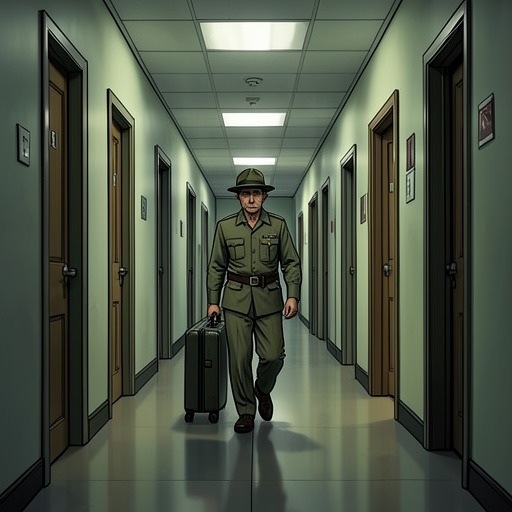
The Shahjahan’s everyday rhythm makes transience seem almost like a rule of nature. Guests stay, on average, about three days, according to Satyasundar Bose. One extra night can make a guest seem to have been there for an age; someone who remains a month may begin to feel like part of the staff’s world. Most visitors, however, pass through so quickly that welcome and farewell become paired motions of the same work. Arrivals bring at least a brief anticipation. Departures, Bose observes, bring none.
Connie’s departure tests whether this routine can make room for attachment. She is not merely another guest: her life, like that of the hotel employees, has revolved around the people staying there. Her absence might therefore be expected to leave a mark. Instead, the hotel’s life resumes as before, and for most people she might never have existed. The contrast is sharper because Connie’s presence had been made so conspicuous through performance. During her act, the lights go out, anticipation gathers in the banquet hall, and a moving spotlight searches the stage before finding the figure in the darkness. The spectacle briefly commands the room; once Connie is gone, that public visibility offers no protection against erasure.
The building’s indifference to its workers
Bose gives the hotel’s forgetfulness a material form. While shaving on the roof, he tells the narrator that the employees may seem indifferent, but the building is colder still: it will not remember Connie, the narrator, or Bose. They can serve silently from early morning until late at night; after their deaths, the hotel will remain, newly covered in paint and mortar, receiving another unending line of visitors. The image sets human time against architectural time. The building changes its surface and function without mourning those whose labor has kept it running.
Bose makes this pattern concrete through the hotel’s recurring roles. Other Nityaharis have carried pillows from room to room; other Satyasundar Boses have stood behind the counter day after day and night after night; countless Connies have fascinated customers with their dances; and other Gómezes have filled quiet nights with music. The names suggest distinct lives, but in the hotel’s routine each can be replaced by another person performing the same recognizable task. The repetition preserves the job while dissolving the worker’s particular identity. Even the employees’ schedule participates in this erasure: the present day ends with its residue left in the dining room as staff prepare for tomorrow, without noticing precisely when today has become yesterday.
This forgetfulness is not confined to employees. Customers who see a newspaper announcement for a new dancer begin making inquiries, but none asks where Connie has gone. The telephone starts ringing as soon as the advertisement appears, and callers welcome the hotel’s decision to hire a belly dancer. A new promise of entertainment takes the place of the absent performer before her departure has become a question. The hotel’s commercial present does not need to resolve the past; it needs only to prepare the next attraction.
Records that preserve—and exclude
Against this institutional amnesia, the novel sets objects that carry fragments of memory. Sketches in the hotel lobby, made by artists whose names are unknown, welcome strangers and signal that the establishment has a long history as an old hotel east of the Suez Canal. A drawing of the Hotel Sajan in a newspaper clipping likewise makes an earlier version of the hotel visible. These images preserve the institution’s age and character, but not necessarily the lives of the people who moved through it. The distinction is central: the hotel can advertise its own continuity more readily than it can retain the histories of its workers.
Hobbs’s collection of old newspaper cuttings offers a more explicit counter-archive. In a notebook, he keeps evidence of the Shahjahan’s past, including an advertisement announcing the arrival of Marian Booth and Jane Grey at Kidderpore. The advertisement boasts that the two women would serve the guests’ pleasure and comfort, then says they would be locked in during the day and after their night work. The clipped wording exposes a history of control that the hotel’s polished self-presentation might otherwise conceal. Hobbs also retains the account of a period when the building was neglected, crumbling, and short of supplies. Gregor Apkar’s complaint to Silverton, then the manager who would eventually buy the hotel, survives as a specific episode of institutional decline. The record gives later readers access to what the hotel itself has no reason to remember.
Yet preservation is selective even when an archive exists. The narrator imagines the dramatic meeting of Vidyasagar and Michael Madhusudan Dutta and envies the hotel receptionist who witnessed it: that receptionist is remembered, while thousands of others have fallen into oblivion. Bose distinguishes between history that is written in detail and the unwritten history that people know but do not put into words. The hotel’s old clippings and stories can bridge past and present, as they do for Hobbs, but they cannot recover every unnamed life or make every witnessed event part of the official record.
The present repeatedly overwrites the past
The concept’s force comes from the coexistence of evidence and erasure. The hotel is not simply without a past: its drawings, advertisements, and anecdotes make earlier periods legible. Nor is the archive complete. It preserves the hotel’s public image, its episodes of decline, and dramatic encounters, while the repeated, mostly invisible labor of attendants, receptionists, dancers, and musicians remains difficult to distinguish from the roles they performed. A permanent building and a transient population therefore create opposing kinds of continuity: one endures by replacing its surfaces and occupants; the other depends on recollection and fragile records.
The banquet scenes sharpen this contrast. Three hundred and fifty boar heads prepared by Nityahari wait in the hall as organizers welcome guests and present their charitable purpose. Satyasundar Bose warns that the city’s recurring social gatherings draw from the same lists of invitees, while newspapers report speeches and summaries already prepared before the banquet begins. Public events thus arrive pre-shaped for the next day’s account, even as the hotel workers’ labor remains behind the polished occasion. What gets recorded is not necessarily what happened most consequentially, but what fits the established public narrative.
The Shahjahan’s daily operation makes that imbalance enduring rather than exceptional. Guests depart, dancers are replaced, and employees prepare tomorrow’s rooms and meals while the building remains ready for another arrival. Its history is visible in fragments, but visibility is not the same as remembrance. The hotel’s transience is the swift passage of people through its doors; its forgetfulness is the longer process by which their particular lives disappear beneath the continuing name and function of the institution.