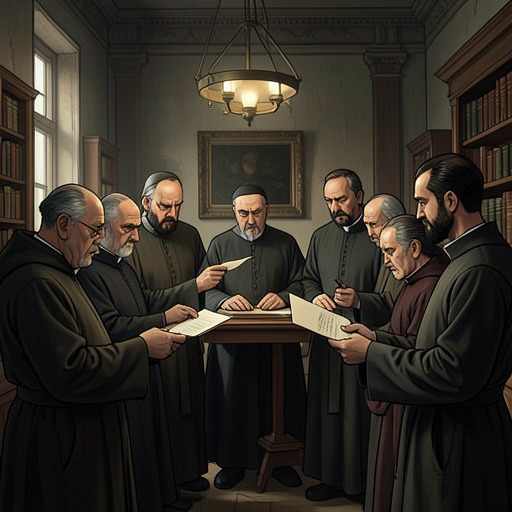
Apostolic Constitution’s Conclave regulations
ConclaveThe Apostolic Constitution’s Conclave regulations are the formal framework governing the papal election: they determine who may vote, how voting is conducted and verified, and what the electors can do when proceedings stall. In the novel, the rules are neither a distant legal backdrop nor a self-executing answer to every problem. They constrain the cardinals, provide grounds for Lomeli’s decisions, and turn the prospect of a drawn-out election into a measure of the damage a deadlock might cause.
Scope and authority
The Constitution supplies procedures for both routine voting and exceptional circumstances. Lomeli refers to its provisions as the conclave faces questions about the official account of the late Pope’s death, the arrival of an elector not on the original list, whether the first ballot should proceed, and the rules for counting and resolving votes. The regulations also establish that a conclave’s internal processes are not simply matters of custom: choices about participation, timing, and the handling of ballots are presented as governed by specific provisions.
That authority does not remove the need for interpretation. The late Pope’s unexpected death makes accuracy in the public account important to preventing later rumours, and Lomeli proposes adding the Pope’s attendance at vespers to the document while preparing a fuller account of his appointments for possible use. His cautious compromise treats documentary precision as a practical responsibility, though it is not itself described as a specific electoral regulation. More directly, the rules become consequential when the cardinals must decide who is legally entitled to enter the election and how to respond to disagreement within it.
Eligibility and the late elector
When Raymond O’Malley reports that a cardinal has arrived whose name never appeared on the list, Lomeli initially suspects an impostor. The man says he was created in pectore, meaning that his appointment had been kept secret. Lomeli answers the uncertainty by citing paragraph thirty-nine of the Apostolic Constitution: a cardinal-elector arriving re integra—before the new Pope has been elected—is to be permitted to join the election at the stage it has reached. On that basis, Lomeli argues that the newcomer is legally a cardinal and may participate.
The episode shows how the regulations can settle a dispute without making the unusual circumstances disappear. The newcomer’s absence from the list and the secret nature of his appointment create a factual and procedural problem; the Constitution supplies the condition that matters for participation, namely arrival before the election is complete. Lomeli’s reading therefore makes the rule an instrument of inclusion, while also exposing how much depends on recognizing the relevant provision and applying it to a case the initial list did not anticipate.
Ballot procedure and safeguards
Before the first ballot, Lomeli asks whether anyone objects to proceeding that evening. He explains that, under the Constitution, voting may be delayed if a member of the conclave objects. No one asks for a postponement, and the cardinals agree to vote. The sequence presents the rules as permitting a pause, not requiring one: Lomeli raises the option after an exceptionally long day and a contentious meditation, but leaves the decision to the assembled electors.
He then explains the ballot itself. Each elector is to write one candidate’s name in the blank portion of a paper headed in Latin with the words “I elect as Supreme Pontiff,” keeping the vote concealed and the handwriting unidentifiable. More than one name invalidates the ballot. Lomeli directs the cardinals to the relevant chapter and paragraph before reading the prescribed sequence aloud: the elector folds and raises the ballot, carries it to the altar, swears that the vote is given to the person he believes before God should be elected, places the ballot on the plate and drops it into the receptacle, then bows and returns to his seat.
The oath gives the act a religious seriousness, while the concealed paper and standardized sequence protect the integrity of the count. Lomeli checks that the electors understand the procedure and calls the scrutineers to their positions. Chosen by lot the previous week, they are Cardinal Lukša, Cardinal Mercurio, and Cardinal Newby. Lomeli then votes for Bellini, following the same public ritual while shielding the written name from view. The rules thus regulate not only the count but the visible conduct through which each elector makes a private choice within a collective ceremony.
The first ballot produces an unusually scattered result. Thirty-four cardinals receive at least one vote, described as a record, and Lomeli records five votes for himself. The scrutineers confer, and the totals are checked before the official results are announced. Three revisers, also chosen by ballot before the conclave, must recount the tallies. The novel presents this layered checking as a safeguard against manipulation: rigging the election would require a conspiracy of at least six men. After the review, O’Malley burns the paper sacks and threaded ballots in the stove; at 7:42 p.m. the temporary chimney above the Sistine Chapel sends up black smoke.
Deadlock, suspension, and resolution
The result confirms that no candidate is close to the required two-thirds majority. Bellini finishes third, behind Tedesco and Adeyemi, with Tremblay only two votes behind him; Lomeli concludes that no one is anywhere near the seventy-nine votes needed to win. The rules turn that arithmetic into a longer institutional horizon. Under paragraph seventy-four, the electors must continue balloting for as many as thirty ballots across twelve days before they may use a different system in which a simple majority can elect the new Pope.
The same timetable returns when Lomeli asks Bellini to stop soliciting votes for him. Bellini argues that the conclave is balanced on a knife edge and describes the potential sequence: if no decision is reached the next day, voting must be suspended for a day, followed by two days of further voting, then another pause, with the pattern continuing until the twelve-day, thirty-ballot limit. Only then would election by simple majority become available. His concern is the harm a prolonged process would do to the Church. The regulation is therefore both a mechanism for continuing deliberation and a source of pressure: it prevents an immediate resort to a lower threshold, but permits an impasse to persist long enough to threaten institutional unity.
The regulations also create room for collective action in a crisis. When a crisis arises during the conclave, Lomeli seeks the electors’ authority to speak, citing paragraphs five and six, which permit certain matters or problems to be discussed in special circumstances if a majority of those assembled agree. He puts the question to a vote; scores raise their hands in favour, while Tedesco, Krasinski, Tutino, and roughly a dozen others oppose. Lomeli declares the motion carried and makes clear that anyone unwilling to hear the information may leave. Nobody does. Here, procedure authorizes disclosure and gives the assembly a legitimate way to hear material that could affect its deliberations.
Institutional meaning
The regulations give the election a structure strong enough to preserve order but not strong enough to eliminate judgment. They specify a condition for admitting the secret elector, allow a vote to be postponed, prescribe the form of the ballot and its oath, require scrutiny and recounting, and lay out the difficult route from repeated deadlock to a simple-majority election. At each stage, the rules shape what the cardinals may do; their application still depends on people such as Lomeli explaining a provision, calling for a decision, or securing the assembly’s consent.
Their dramatic force lies in this combination of constraint and discretion. The ballot ritual makes a private choice answerable to a shared procedure, while the recount and the destruction of ballots guard the count and its secrecy. The twelve-day timetable, meanwhile, makes continued legality costly: the electors may be required to persist even when delay itself threatens the institution they are choosing to lead. In the novel, the Constitution is thus not merely a technical handbook for electing a Pope. It is the framework through which legitimacy is defended, contested, and exercised under pressure.