Conclave Isolation and Secrecy Rules
ConclaveConclave Isolation and Secrecy Rules are the procedural and physical safeguards that separate the cardinal-electors from outside influence and bind them to secrecy during a papal election. They shape not only the conditions under which the vote takes place, but also the Dean’s authority to manage arrivals, preserve order, and bring exceptional questions before the assembled cardinals. The novel presents the rules as both a framework for legitimate election and a system whose meaning depends on interpretation and collective consent.
Isolation and Controlled Access
The practical boundary of the Conclave is established before it begins. The Casa Santa Marta is scheduled to close its doors at six, and Lomeli instructs the cardinals to arrive early because nobody will be admitted afterward. They must surrender mobile telephones and computers at the front desk and pass through a scanner; he urges them simply to leave their devices behind, to speed registration. The requirements turn seclusion into an administered process, not merely a private choice by the electors.
Once checked in, the cardinals are to have no communication with the outside world. The building’s windows are sealed, and its televisions and radios have been removed. The stated purpose is to ensure that no person or news can influence the cardinals’ meditation while the election lasts. The resulting separation is deliberately comprehensive: even the view beyond the shutters is inaccessible, leaving the electors physically enclosed and informationally cut off from the world beyond the election site.
The rules operate within the novel’s wider account of an election conducted amid serious security concerns and intense political competition. Before the cardinals arrive, security personnel prepare for what the Italian Minister of the Interior describes as an imminent terrorist threat. Meanwhile, the electors bring varied regional and linguistic ties into the enclosure, and their relationships and allegiances continue to matter inside it. Isolation therefore limits external access without dissolving the internal networks through which candidates seek support.
The Oath and the Duty of Secrecy
At the opening of the Conclave, the electors publicly undertake obligations that govern their conduct inside it. Lomeli administers an oath requiring them to observe the prescriptions of the Apostolic Constitution faithfully and scrupulously. They also promise that whoever is elected will carry out the Petrine Primacy as pastor of the Universal Church. The procedural pledge thus links the mechanics of the election to the responsibilities of the office it will fill.
The oath separately binds the electors to keep secret everything relating to the election and what occurs at the place of election. Lomeli takes the same vow individually, placing his palm on the open Bible and calling God and the Gospels as witnesses. His position as Dean does not exempt him from the rule: he administers the collective undertaking and then places himself under it. The scene makes secrecy a shared obligation, not simply an instruction imposed by the presiding official.
That obligation governs the election’s aftermath as well as the ballot itself. The oath encompasses what happens in the election site, while the isolation rules prevent the cardinals from receiving outside communications during the proceedings. Together, these measures seek to protect deliberation from interference and to constrain disclosure. The narrative’s attention to internal maneuvering, however, makes clear that secrecy does not mean the absence of politics: competition and coalition-building continue within the protected space.
Interpretation, Exceptions, and Collective Authority
The rules do not eliminate questions about who qualifies to participate. When Vincent Benítez arrives after the electors have assembled, Lomeli argues that the Apostolic Constitution permits a cardinal-elector arriving re integra—before a new pope has been elected—to join the election at the stage it has reached. He invokes the specific provision as a matter of canon law and concludes that Benítez is legally a cardinal. The rule of seclusion is therefore not treated as a simple prohibition on later entry; its application depends on the legal distinction between an election already under way and one already concluded.
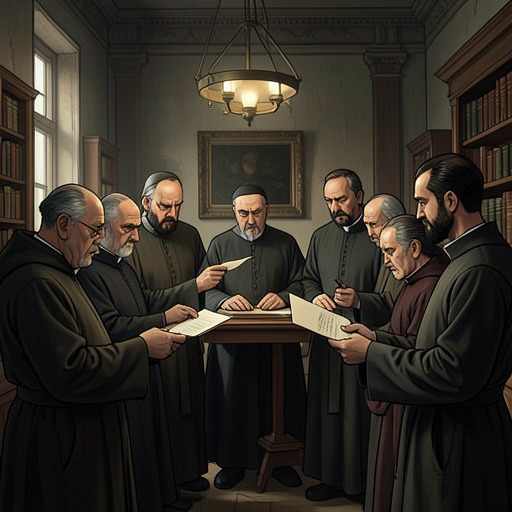
A different procedural question arises when Lomeli wants to disclose information during a crisis. Rather than treat his office as sufficient authority to speak, he asks the Conclave for permission under paragraphs five and six of the Apostolic Constitution, which allow certain matters or problems to be discussed in special circumstances if a majority of the assembled cardinals agrees. He proposes a vote on whether the Conclave should receive the information. Scores support disclosure; a smaller group, including Goffredo Tedesco, votes against. The motion carries, and Lomeli makes clear that anyone unwilling to hear the information may leave. Nobody does.
These episodes show procedure working through more than confinement and silence. Lomeli proposes a reserved second document listing the late Pope’s full-day appointments, to be held in readiness if circumstances make it necessary; elsewhere, he relies on legal text to establish Benítez’s eligibility and on a vote to secure authority to address the electors. In each case, the rules shape what can be done, but judgment and consent determine how they are applied. Their force lies partly in the written provisions and partly in the participants’ willingness to recognize the process.
Political Practice Within the Enclosure
The novel sets formal restrictions against the informal practices that emerge among the electors. Although the papal constitution forbids agreements, promises, or commitments among cardinal-electors on pain of excommunication, the election quickly becomes a matter of counting who can reach the required seventy-nine votes. At dinner, candidates and supporters approach different regional groups: Tremblay speaks with South-East Asians, Adeyemi joins conservative archbishops from Eastern Europe, and Bellini describes his plans to North Americans. The protected setting contains political negotiation rather than preventing it.
The cardinals’ social geography also persists under sequestration. At first they arrange themselves by native language, with Italians near the kitchens, Spanish-speakers together, and English-speakers nearer reception. They later mingle more freely, but when a crisis comes they unconsciously return to their original pattern. The detail underscores the limits of isolation as a force for unity: the electors can be removed from outside news, yet their communities and divisions remain present in the room.
The rules’ significance is therefore double. They offer a formal means of safeguarding the election—controlling entry, excluding external communications, and establishing a binding duty of secrecy—while also defining the procedures through which the electors can address disputes and extraordinary developments. In the novel, legitimacy depends not on rules alone, but on officials interpreting them and the electors accepting decisions made in their name.