The Two-Thirds Majority Rule for Papal Elections
ConclaveThe Two-Thirds Majority Rule for Papal Elections makes the conclave a contest not simply to lead the count but to assemble a sufficiently broad coalition. The threshold is seventy-nine votes in this election, and its force reaches beyond arithmetic: it defines which candidacies remain viable, whether opponents can block a result, and how long the electors may be required to continue voting. As support shifts among candidates, the rule becomes both a legal condition of election and a pressure shaping strategy, compromise, and appeals to divine guidance.
The Threshold and Its Procedure
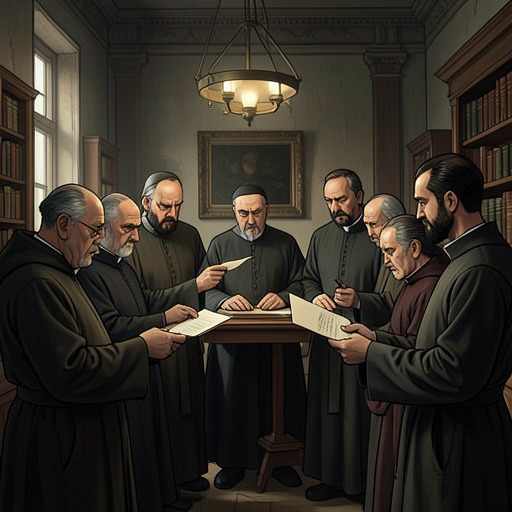
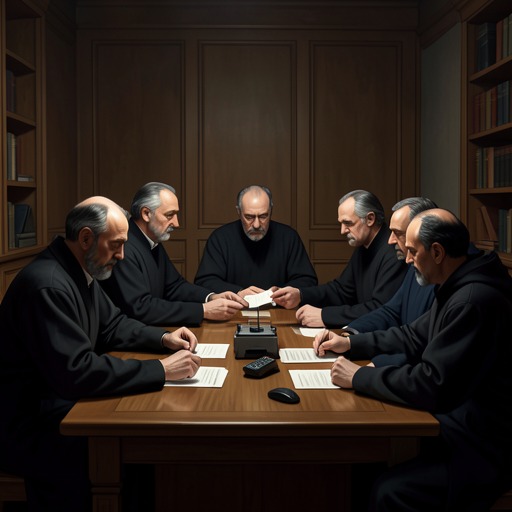
The electors must continue balloting until one candidate secures two-thirds of the votes. At dinner, Lomeli estimates the necessary total at seventy-nine, making clear that a strong first-ballot showing is not itself a path to election. The numerical requirement converts individual preferences into a problem of collective agreement: a candidate needs not merely a leading position but support broad enough to cross the prescribed line.
The rule also provides for the possibility that agreement will not come quickly. Lomeli consults paragraph seventy-four of the Apostolic Constitution and considers the prospect of as many as thirty ballots over twelve days. Under the procedure as he understands it, the electors would continue seeking a two-thirds majority through that period; only at its end could they use a different system in which a simple majority would suffice. The exception is therefore delayed rather than immediate: the rules preserve the higher threshold through repeated rounds before allowing a lower one.
This timetable gives the threshold a consequence beyond the outcome of any single ballot. When the electors are far from agreement, each new round tests whether the leading candidate can expand a coalition or whether opponents can hold a blocking minority together. The possibility of twelve days of voting makes deadlock a concrete institutional risk, not merely a temporary setback in the count.
First Ballots and a Crowded Field
The first ballot illustrates how difficult it is to read a conclave before votes begin to consolidate. Thirty-four cardinals receive at least one vote, a record, and the initial distribution is so scattered that even Lomeli’s own name appears repeatedly. He marks the results as they are read, while the tally gradually distinguishes the principal contenders from the many candidates who cannot sustain support.
At the end of the first ballot, the figures leave no one close to the required seventy-nine. Tedesco has twenty-two votes, Adeyemi nineteen, and Lomeli five; Bellini is behind Adeyemi, with Tremblay only two votes behind Bellini. Thirty-eight votes go to others. The total underlines the distance between leading the field and winning: even the strongest candidate would need a substantial transfer of support, while the fragmented vote leaves several possible coalitions open.
The rule also unsettles expectations formed before the count. Bellini’s campaign manager, Sabbadin, had expected him to lead with as many as twenty-five votes and predicted no more than fifteen for Tedesco. Instead, Bellini finishes third, Adeyemi places ahead of him, and Tedesco leads. The two-thirds requirement gives those reversals immediate strategic weight: a disappointing first ballot may weaken a candidacy, but it does not elect anyone or eliminate the need to negotiate for a much larger bloc.
Changing Coalitions and the Prospect of a Winner
By the second ballot, the distribution begins to change. Adeyemi gains sixteen votes from candidates who have fallen away, a striking endorsement, while Tedesco adds seven to his first-ballot total. Bellini and Tremblay move little. Benítez, previously almost unknown among the electors, rises from one vote to two. Lomeli’s account of the results emphasizes that these small beginnings and large transfers matter differently: some votes demonstrate a candidate’s growing reach, while others leave a prominent candidacy in danger of fading.
Adeyemi’s rise becomes dramatic in the third ballot. As votes are read, Lomeli counts fifty-seven for the Nigerian cardinal. That is not yet a two-thirds majority, but it places Adeyemi within twenty-one votes of election and only three short of a straight majority. The numbers rapidly alter the atmosphere of the race. Lomeli judges that Adeyemi could be elected before the day ends, even if Tedesco temporarily gathered enough support to deny him the threshold, because the opposition might not hold together in another round.
That forecast turns on both coalition arithmetic and the perceived cost of obstruction. Lomeli thinks few electors would risk a schism by resisting what could appear to be a powerful expression of divine will, and that they might also hesitate to alienate a likely incoming pope. The two-thirds rule therefore does not operate in isolation from the electors’ expectations about what follows a successful or failed blocking effort. A candidate’s momentum can make continued resistance harder, even before the required number has been reached.
The prospect of agreement changes sharply after the pause for lunch. Adeyemi loses thirty-two votes—more than half his support—while Tremblay gains eleven, Bellini eight, Lomeli six, Tedesco four, and Benítez three. Lomeli connects the reversal to news spreading among the cardinals after an incident in the dining hall. Once the reported change in understanding reaches the electors, the coalition that had appeared likely to carry Adeyemi to the papacy breaks apart. The rule remains constant; what changes is which candidate can plausibly gather the necessary votes.
In response to the altered count, Lomeli calls for an immediate fifth ballot because no candidate has secured a two-thirds majority. His announcement shows the rule at work as an operational requirement: a leading candidate’s setback does not end the process, and the electors return to voting until a candidate meets the threshold or the longer timetable intervenes.
Bargaining, Deadlock, and Legitimacy
As the ballots continue, the threshold encourages candidacies to be assessed in terms of their ability to attract other candidates’ supporters. After one ballot, Bellini has fifteen votes and Lomeli twelve. Sabbadin argues that even a transfer of all fifteen Bellini votes to Lomeli would leave him in third place behind Tremblay and Tedesco. He then calculates a possible coalition: Bellini’s and Lomeli’s combined twenty-seven votes, added to Tremblay’s forty, would give Tremblay sixty-seven—twelve short of the required seventy-nine. The calculation presents Tremblay as a viable option not because he has already won, but because a broader alliance might carry him across the line.
Bellini accepts the force of the arithmetic despite his lack of enthusiasm for Tremblay. He reasons that if the Holy Spirit works through the conclave, the electors must accept that even an improbable outcome may be the one God wills. His response makes the rule a point of tension between practical coalition-building and religious discernment: the figures help identify a possible route to election, but they do not, by themselves, settle how the electors should interpret that route.
Lomeli, meanwhile, urges that support for his own candidacy stop. He cites both his perceived lack of spiritual depth and the damage a prolonged impasse could do to the Church. His appeal gives the timetable a moral as well as procedural dimension. If the electors fail to decide the contest promptly, the rules require repeated suspensions and renewed voting, extending the uncertainty toward the limit of thirty ballots and twelve days before a simple-majority method becomes available. The prospect of delay becomes one reason to resist treating a personal candidacy as an end in itself.
The first ballot’s tally records Lomeli with five votes, and a later count gives him nine; after Adeyemi’s support collapses, he gains six more. These changing totals show how a cardinal’s support can reflect the electors’ changing assessment of the field rather than a settled personal alliance. Yet even as votes move, the threshold keeps the decisive question fixed: whether any candidate can turn a collection of separate blocs into the broad agreement the rules demand.
A Rule Framed by Crisis and Outcome
The novel sets this contested election against the memory of the previous pope’s reforms and the conflict they provoked within the Curia. Bellini recalls the late Pope’s insistence on financial transparency, professional scrutiny of accounts, and more accountable procedures. He also describes the opposition, leaks, and isolation that followed. That context gives the conclave’s insistence on a legitimate, sufficiently broad choice an institutional resonance: the electors are selecting a successor amid disputes over the Church’s governance, and the voting rule disciplines how that choice is made.
The importance of procedure appears elsewhere in the conclave as well. When the legitimacy of Benítez’s secret appointment is challenged, Lomeli argues that the revised canon law and paragraph thirty-nine permit a cardinal-elector arriving before the election of a new pope to join the process at the stage it has reached. This is a distinct rule, but it reinforces the same procedural world in which decisions depend on the interpretation and application of written provisions. The two-thirds threshold likewise cannot be reduced to a figure detached from the law that establishes how the election proceeds.
The final result recorded in the evidence shows Benítez with ninety-two votes, above the seventy-nine-vote threshold, while Lomeli has twenty-one and Tedesco five. The contrast between that decisive margin and the first ballot’s scattered field completes the rule’s narrative arc: after rounds of shifting support, a candidate finally assembles more than the required two-thirds. The threshold has governed not only who can be elected, but the sequence of reversals and bargains through which the electors arrive at a result.