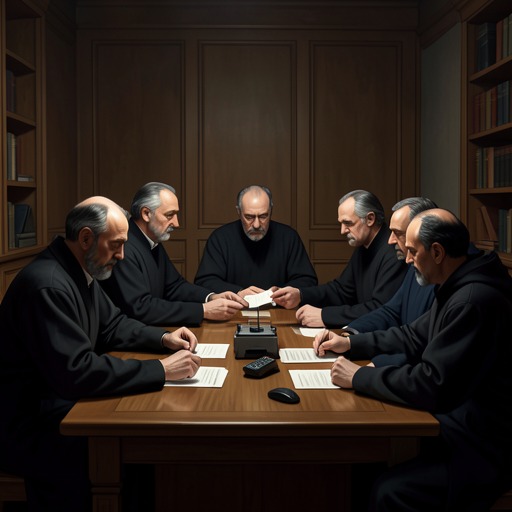
Majority Threshold Rules for Papal Elections
ConclaveThe Majority Threshold Rules for Papal Elections set the standard a candidate must meet to become pope and determine how long the cardinals must continue voting when no one reaches it. In the conclave, the two-thirds requirement makes the election a test not merely of who leads, but of whether a candidate can gather sufficiently wide support; its possible later relaxation into a simple-majority procedure becomes a source of pressure over both the election’s duration and its legitimacy.
The threshold and the first ballots
The rule operates through repeated ballots until a candidate reaches the required two-thirds majority. After the first ballot, the tally showed a fragmented field: Tedesco had 22 votes, Adeyemi 19, while Lomeli had five and 38 votes went to others. No candidate was near the 79 votes required to win. The threshold therefore made clear that a lead, even among the four principal contenders, was not the same as a mandate to be elected.
The second ballot shifted support without resolving that problem. Adeyemi gained 16 votes from candidates who had fallen away, and Tedesco added seven; Bellini and Tremblay scarcely moved, while Benítez rose from one vote to two. The figures illustrated how votes could migrate as the field narrowed, but also how a candidate’s progress remained relative until it brought him within reach of the fixed majority.
Deadlock and the prospect of a simple majority
The rules made deadlock consequential because the cardinals could not simply elect whoever led. When a later ballot again produced no two-thirds winner, Lomeli announced that they would proceed immediately to a seventh ballot. His announcement treated continuation as the required procedural response, even as the ballot count and his own uncertainty made the choice of candidate increasingly pressing.
The possibility of a different threshold lay further ahead. Lomeli’s reading of the election rules indicated that voting could continue for as many as 30 ballots over 12 days; only after that period could the cardinals use a system in which a simple majority would suffice. The prospect of waiting that long alarmed him. It also gave the two-thirds rule a double effect: it guarded against an election by a narrow plurality, but threatened to extend a deadlock until the exception became available.
That prospect surfaced openly when Benítez addressed the cardinals. He warned that they should not continue day after day until they were permitted to elect by simple majority, and urged them instead to unite behind the apparent leader. His appeal framed the delayed fallback not as a neutral administrative convenience but as a danger to the purpose and credibility of the election.
Procedure, urgency, and legitimacy
The cardinals’ response showed that procedure could allow urgency without abandoning the governing threshold. Bellini proposed that they leave lunch and return to the Sistine Chapel to resume voting. Lomeli confirmed that the rules allowed two ballots that afternoon if needed and required the following day to be set aside for meditation if they still failed to reach a decision. A majority supported returning immediately; only Tedesco opposed the proposal. The decision accelerated the process, but did not replace the two-thirds requirement with a lower one.
Bellini explicitly joined procedural compliance to the legitimacy of the result. The cardinals, he argued, should elect in strict accordance with the Apostolic Constitution, both to avoid doubt about the legitimacy of the man chosen and to act urgently in hope that the Holy Spirit would guide them. The episode distinguishes a permitted change of schedule from a change in the standard for election: the conclave could resume voting sooner while remaining bound by the same majority rule.
Coalition pressures and the rule’s limit
The threshold also shaped strategic calculations among the candidates’ supporters. After Lomeli and Bellini discussed the state of the contest, Sabbadin argued that Lomeli could not win: Bellini had 15 votes and Lomeli 12, and even a transfer of Bellini’s bloc would leave Lomeli behind Tremblay and Tedesco. He presented Tremblay as the viable alternative, calculating that a combined 27 votes from their side, added to Tremblay’s 40, would bring him to 67—12 short of the two-thirds majority. The arithmetic made alliance-building visible, while exposing its limit: an agreement could strengthen a candidate without itself completing the election.
The rule’s pressure did not end with Lomeli’s announcement of another ballot. When the eighth-ballot result was read, Benítez had 92 votes, with Lomeli at 21 and Tedesco at five. Benítez’s total crossed the required threshold, ending the immediate contest under the same rule that had prolonged it. The sequence gives the majority requirement its central narrative function: it resists a merely leading candidate, forces the electors through repeated attempts at agreement, and makes the eventual result depend on a coalition broad enough to satisfy the formal standard.