Re integra Rule for Joining the Election
ConclaveThe Re integra Rule for Joining the Election is the procedural provision that allows an eligible cardinal-elector arriving before a new Pope has been elected to take part in the conclave where voting currently stands. Its application becomes decisive when Jacopo Baldassare Lomeli argues that Vincent Benítez, whose elevation had remained secret, is legally entitled to enter the election already under way.
Definition and Legal Basis
The term re integra is presented as the condition of arriving before the Church has elected its new pastor. The relevant provision, paragraph thirty-nine of the Apostolic Constitution, states that cardinal-electors who arrive in that circumstance may participate “at the stage which it has reached.” The rule therefore accommodates a late-arriving elector without requiring the election to restart.
The question arises after it becomes known that the late Pope had revised canon law on in pectore appointments shortly before his death. Such an appointment allows a Pope to create a cardinal without publicly disclosing the person’s identity, even to close associates. Lomeli explains that the rule on joining the election applies to Benítez’s case and insists that the appointment makes him legally a cardinal; the argument distinguishes the legal status of the appointment from whether others had previously been told of it.
Application to Benítez
The rule is tested when the participants question whether the unknown man is genuinely a cardinal and whether the Pope could have made such a sensitive appointment without consulting the Secretary of State. Lomeli does not settle the matter by relying on consultation or custom. Instead, he grounds his answer in the Pope’s authority under canon law and in the explicit wording of paragraph thirty-nine.
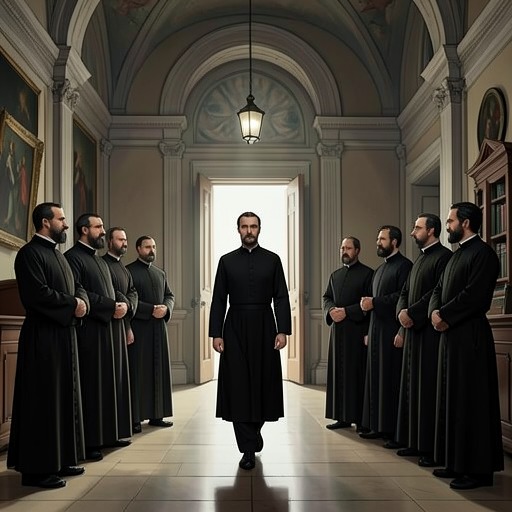
Lomeli presents the provision as controlling: because Benítez arrives before a new Pope has been elected, he may join at the election’s current stage. His response turns a dispute over a concealed appointment into a procedural question with a textual answer. The rule thus gives Benítez a route into the conclave without treating his late arrival as a reason to exclude him.
Electoral Consequences
Benítez’s participation becomes consequential in a contest whose first ballot is markedly fragmented. Thirty-four cardinals receive at least one vote, and no candidate approaches the seventy-nine required for election. Benítez receives one vote on that ballot, then two on the second; his support remains small, but his presence is registered in the count.
After a later ballot, a disclosure concerning Cardinal Adeyemi’s past precipitates a sharp redistribution of votes: Adeyemi loses thirty-two, while Benítez gains three, bringing him to five. The account does not attribute that shift to the Re integra rule itself, but it shows the electoral stakes of Benítez being present and eligible to receive votes. On the eighth ballot, Benítez is elected with ninety-two votes, while Lomeli receives twenty-one and Goffredo Tedesco five. The rule’s significance is therefore procedural rather than predictive: it secures Benítez’s participation, while the ballots determine the result.
Significance
The Re integra provision links a secret appointment to the formal continuity of the election. Its practical force depends on an interpretation of canon law at a moment when the ordinary participants have incomplete information about the late Pope’s decision. Lomeli’s citation of the precise paragraph supplies a basis for recognizing Benítez’s eligibility, even as the election continues without interruption.
The rule does not itself explain why Benítez wins or direct the electors toward him. Rather, it defines who may take part in the collective process through which the result emerges. In the novel’s election narrative, that distinction makes the provision consequential: a technical condition about arrival determines whether a newly disclosed cardinal can enter the contest that ultimately elects him.