Baghdad
ConclaveBaghdad is the distant but consequential setting behind Vincent Benítez’s arrival at the papal election: he is its Filipino archbishop, appointed by the late Pope and secretly elevated to the College of Cardinals. The danger associated with his post explains both the secrecy of that appointment and the precautions surrounding his journey to Rome. In the election’s later crisis, Baghdad also stands within the wider geography of violence that sharpens the cardinals’ disagreement over faith, security, and political response.
The archbishopric and the secret appointment
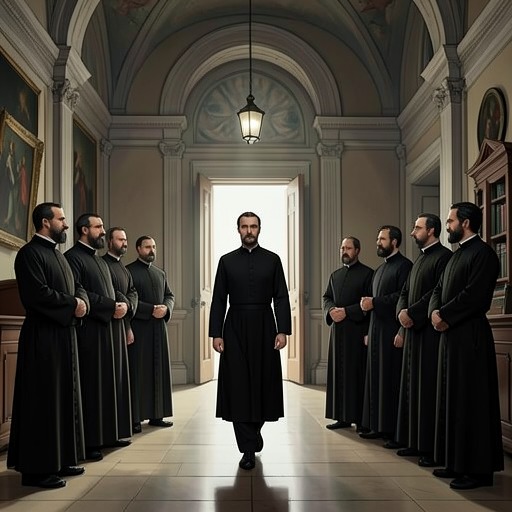
When Benítez arrives at the Casa Santa Marta, Archbishop Mandorff identifies him as the Archbishop of Baghdad. Lomeli is surprised both by the existence of an archbishop there and by the visitor’s identity: Benítez is Filipino, not Iraqi, and the late Pope appointed him the previous year. The exchange makes Baghdad more than a location in Benítez’s title; it marks a demanding and politically exposed posting entrusted to a prelate from far away.
Mandorff explains that the late Pope had raised the possibility of making Benítez a cardinal a couple of months earlier. Mandorff advised against it, fearing that a cardinal in Iraq could inflame militant Islamic opinion and put Christians in an already suffering region at greater risk. He also anticipated that the appointment would become known, since information routinely leaked from the Vatican. The late Pope proceeded despite those objections and kept the elevation secret, making Baghdad’s risks part of the background to Benítez’s concealed status.
A guarded journey to Rome
Benítez tells Lomeli that he deliberately went to Baghdad’s airport without luggage to disguise his intentions, because government people followed him wherever he went. He slept overnight in Beirut’s arrivals lounge and reached Rome two hours before the conversation. His spare, improvised travel arrangements convey the practical consequences of leaving Baghdad under scrutiny: he arrives without belongings and must rely on the officials at the Casa Santa Marta to supply toiletries, clothes, and choir dress.
The journey links Baghdad to the tightly controlled setting of the election without making the city itself a scene of action. Benítez has crossed borders under the pressure of surveillance, and his arrival reveals that the late Pope’s secret appointment has drawn him into the conclave despite the danger that had originally made the appointment controversial.
Baghdad in the election’s security crisis
Before the cardinals enter the conclave, the Italian Minister of the Interior briefs Lomeli that the threat of terrorism is considered serious and imminent. Security measures include surface-to-air missiles and snipers on rooftops, five thousand uniformed police and army personnel in nearby streets, and hundreds of plain-clothes officers among the crowds. These preparations establish a climate of threat around the election; they do not identify Baghdad as the source of any particular danger.
After explosions and reports of attacks, O’Malley tells Lomeli that a suicide bomber and a car bomb appear to have struck a place crowded with pilgrims at the Piazza del Risorgimento, near the Vatican City. At least thirty people are reported killed, and there has also been a shooting at San Marco Evangelista during Mass. Asked whether the attackers were Islamists, Mandorff reports that witnesses say the bomber shouted “Allahu Akbar.” Lomeli cautions against letting anger turn the attacks into a declaration of religious war, while Tedesco later invokes the violence to argue that the Church has been weak toward Islam. In this debate, Baghdad’s significance lies in the context already established by Benítez’s dangerous posting: the story places the Church’s presence in Iraq alongside a fresh crisis in Rome, while showing how quickly reports of violence can be made to serve competing political arguments.
A contested symbol, not a proven source of violence
The evidence connects Baghdad directly to Benítez’s ministry and the risks considered in appointing him; it does not connect the city to the attacks during the conclave. The distinction matters. Baghdad embodies the vulnerability that Mandorff cites when he questions the wisdom of a cardinal’s appointment in Iraq, whereas the reports of immediate violence concern Rome and a church elsewhere. The city therefore functions as a point of comparison in a wider argument about Christian presence, security, and the temptation to treat separate conflicts as a single religious confrontation.