Casa Santa Marta
ConclaveCasa Santa Marta is the Vatican residence that houses the cardinal-electors during the conclave, but in the novel it is more than a place to sleep: it is the election’s domestic and political interior. Its rooms and dining hall gather men from across the Church into competing networks, while its guarded doors and darkened windows make the election’s isolation visible. At the end, the cardinals’ collective departure from the building carries that enclosed struggle into public view.
Design and changing use
Before Casa Santa Marta was built, cardinal-electors stayed in the Apostolic Palace, where beds were crowded into old offices and reception rooms and curtains offered little privacy. John Paul II judged these conditions intolerable for a modern conclave and ordered a new residence in the south-western corner of Vatican City. The resulting six-storey grey-stone building consists of two blocks joined by a short central section; in aerial photographs its shape resembles an elongated H. Block A faces Piazza Santa Marta, while Block B overlooks the Vatican wall toward Rome.
The residence contains 128 bedrooms, each with an en suite bathroom, and is run by the blue-habited nuns of the Company of the Daughters of Charity of St Vincent de Paul. Between elections it serves as a hotel for visiting prelates and a hostel for priests working in the Curia. For the conclave, those regular residents are moved to another hostel half a kilometre beyond the Vatican, and the Casa is given over to the electors. This change of use turns a working residence into a temporary, controlled world: an everyday building is emptied, screened and repurposed for an exceptional political and religious process.
Arrival and enclosure
On the night the Pope dies, the Casa’s usually clinical, antiseptic lobby becomes the first gathering place for bewildered priests. A dozen stand in the white-marble space, some still in dressing gowns, unsure what to do. Jacopo Baldassare Lomeli arrives from the darkened Vatican cloisters and sees an ambulance waiting discreetly outside. The quiet scene, rather than any public announcement, makes the death’s practical reality apparent to him. He asks the Swiss Guard to ensure that the ambulance driver is not calling the media, then enters the lobby and proceeds toward the elevator. Too short of breath to take the stairs, he turns back to the waiting priests and gives them a simple instruction: to pray.
During the conclave the building is secured and sealed off from ordinary life. After the cardinals’ first evening prayer, the upper floors are black behind locked shutters; only the entrance remains lit. Through thick bulletproof glass, priests and security staff move in the yellow glow, visible but separated from the outside like creatures in an aquarium. The image makes the Casa seem less like a hospitable residence than a bunker. Its security does not merely protect the electors; it gives physical form to the conclave’s separation from the world beyond its doors.
That isolation is also spatially intimate. The electors’ rooms have been assigned by lot, and Lomeli’s is on the second floor of Block A. To reach it, he must pass the late Pope’s sealed suite. Red ribbon stretches between the door and its frame, fixed with wax bearing the Camerlengo’s coat of arms; fresh white lilies and two dozen votive candles mark the landing. The corridor, formerly busy as a seat of Church government, is now deserted. The Casa thus places the new election beside the visible, sealed absence left by the previous pontificate.
A meeting ground for factions
The Casa’s common spaces turn the cardinals’ arrival into a display of the Church’s breadth and its divisions. Electors come up the slope with wheeled suitcases, in groups and alone, while the Dean welcomes them. The Latin American cardinals, for example, include figures whose shared regional origin does not produce a shared front: Lomeli sees a Brazilian and a Chilean refuse even to look at one another after what he suspects was an attempt to coordinate over lunch. Their body language makes the limit of bloc politics plain before a ballot is cast.
The arrivals also expose the scale of the electoral networks taking shape. Thirteen Asian archbishops come from cities including Jakarta, Cebu, Bangkok, Manila, Seoul, Tokyo, Ho Chi Minh City and Hong Kong; another thirteen come from Africa. Joshua Adeyemi gathers African cardinals in the piazza and leads them over for their formal welcome, receiving visible deference even from older prelates. Lomeli expects substantial African support for him, but recognizes that a candidate reliant on regional and Third World backing would still need votes from beyond those constituencies. Europe, with fifty-six electors, remains numerically dominant. The Casa is therefore both a residence and a staging ground where geography, personal authority and electoral arithmetic meet.
Its dining hall becomes the election’s most revealing shared interior. The long room, open to the lobby, has a white-marble floor and a glass-covered atrium; the plants that once separated the Pope’s dining area have been removed. Fifteen round tables are set for eight, and the cardinals gather amid the noise of conversation and the service of the nuns. At these tables, the formal prohibition on electoral pacts sits uneasily beside the practical need to count votes and build support. Goffredo Tedesco uses the room’s seating to argue that cardinals have fallen into language groups: Italians near the kitchens, Spanish-speakers elsewhere, English-speakers near reception. He contrasts that arrangement with an earlier conclave in which Latin had enabled conversation across linguistic lines. Whatever the force of his argument, the room makes the divisions tangible: the electors share a meal and a building while clustering by language and political affinity.
The first ballot’s results sharpen this impression of the Casa as a political arena. Thirty-four cardinals receive at least one vote, an unusually dispersed field. The leading candidates are Tedesco, Aldo Bellini, Tremblay and Adeyemi, while Lomeli himself receives five votes. The tally leaves no one close to the seventy-nine required for election. At dinner, supporters begin the practical work of coordination despite the constitutional ban on agreements: Tedesco talks with South American cardinals, Tremblay listens to South-East Asians, Adeyemi meets conservative archbishops from Eastern Europe, and Bellini describes his plans to North Americans. The nuns serving the meal overhear these conversations; one later preserves a napkin marked with first-round voting figures. In the Casa, domestic service and electoral secrecy occupy the same room, and the supposedly private dinner becomes a source of information for the outside press.
Reversals within the residence
The election’s changing fortunes are registered through figures that Lomeli records and recalculates. In the first ballot, Tedesco leads with twenty-two votes, Adeyemi has nineteen, and Bellini finishes behind Adeyemi, with Tremblay close behind. Lomeli’s five votes trouble him because he suspects they may have been drawn from Bellini. After the second ballot, Adeyemi gains sixteen votes from candidates who fall away, while Tedesco adds seven; Bellini and Tremblay scarcely move. Benítez, an obscure arrival, rises from one vote to two. The Casa holds not only the rival camps but also the first hints of a result that no camp can yet control.
A later lunch break brings a more dramatic reversal. Adeyemi loses thirty-two votes, more than half his support, while Tremblay gains eleven, Bellini eight, Lomeli six, Tedesco four and Benítez three. The speed of the change shows how quickly news and impressions can move through the electors gathered in and around the residence. Adeyemi’s apparent path to the papacy collapses; Tedesco returns to the lead, and Benítez’s five votes seem remarkable for a man few had known only days earlier.
The same calculations eventually lead Bellini and Lomeli to accept that their own candidacies cannot prevail. Bellini has fifteen votes and Lomeli twelve; even a transfer of Bellini’s full support would leave Lomeli behind Tremblay and Tedesco. The arithmetic points toward Tremblay, but the apparent consolidation does not settle the election. Later, Lomeli confronts Bellini with evidence that Tremblay has allegedly paid cardinals for their votes, including cash payments made during the preceding year. The Casa’s meals and private conversations are thus not an escape from the election’s moral stakes. They are where strategy is assembled, where information circulates, and where the comfortable appearance of ordinary routine gives way to allegations that may invalidate the contest itself.
From refuge to public image
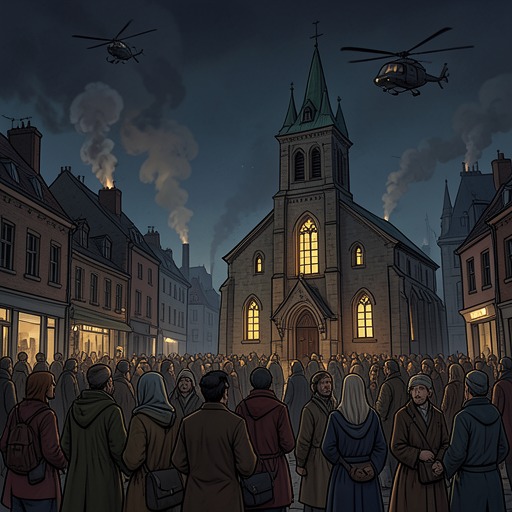
When reports of coordinated attacks reach the residence, its familiar interior fills again with alarm. Lomeli returns in a police car to find cardinals talking quietly in the lobby, officials gathered by the desk, and nuns waiting uncertainly in the dining room. He asks for privacy before the attack report is discussed. The events include a car bomb in Piazza del Risorgimento followed by a suicide bombing, and simultaneous gunfire at San Marco Evangelista during Mass. The news makes the Casa’s security and enclosure feel newly consequential: the violence outside has entered the election’s common space as information, while the cardinals must decide how to proceed together.
Most of the buses arranged for the electors are not needed. Those able to walk leave Casa Santa Marta for the Sistine Chapel in a phalanx, some linking arms. A news helicopter filming the blast damage captures their procession across Piazza Santa Marta and along the edge of the Vatican Gardens. Broadcast repeatedly, the images communicate resolve and unity to Catholics watching around the world, and pilgrims begin gathering at St Peter’s Square in anticipation of a new Pope. The route from the Casa therefore reverses the building’s usual function: instead of containing the electors behind guarded doors, it sends them into public view as a collective body. Their departure does not erase the rivalries and doubts housed within its walls, but it makes the residence the starting point for a moment of visible solidarity.