Vatican City
ConclaveVatican City is the physical and political enclosure for the conclave: a place of guarded entrances, emptied residences, and competing networks of cardinals. Its spaces make the election’s scale visible, from the austere accommodations of Casa Santa Marta to the crowds and security forces beyond its walls, while its international gathering exposes the limits of any simple factional or regional alignment.
A city reorganized for the conclave
More than twenty years before the story, John Paul II ordered Casa Santa Marta built in the south-western corner of Vatican City, at a cost of twenty million dollars to the Holy See. The change replaced the cramped arrangements in the Apostolic Palace, where earlier cardinal-electors had slept in fifteenth-century offices and reception rooms, separated by curtains and supplied with little more than a jug, basin, and commode. The new residence offered 128 bedrooms with en suite bathrooms. Between elections it served as a hotel for visiting prelates and a hostel for some Curia priests; for the conclave, its ordinary residents were moved to the Domus Romana Sacerdotalis, half a kilometre beyond the Vatican.
The building’s appearance complicates its solemn function. Lomeli sees a six-storey grey stone rectangle, arranged in two blocks of fourteen windows and joined by a short central section. In aerial photographs it resembles an elongated H: Block A faces Piazza Santa Marta, while Block B overlooks the Vatican wall and the city of Rome. The building is both institutional infrastructure and temporary enclosure, a modern accommodation designed to make the election practicable rather than an episode of what Cardinal Siri had called being “buried alive.”
Entrances, surveillance, and public pressure
The approach to the conclave is controlled at the threshold. Cardinal-electors are told that Casa Santa Marta’s doors will close at six, that no one will be admitted afterward, and that mobile phones and computers must be surrendered. Entrants pass through a scanner; arriving cardinals face passport checks, body searches, and luggage inspections. These procedures make isolation tangible before the formal election begins, even as complaints about the checks reveal how readily security can feel like suspicion or humiliation.
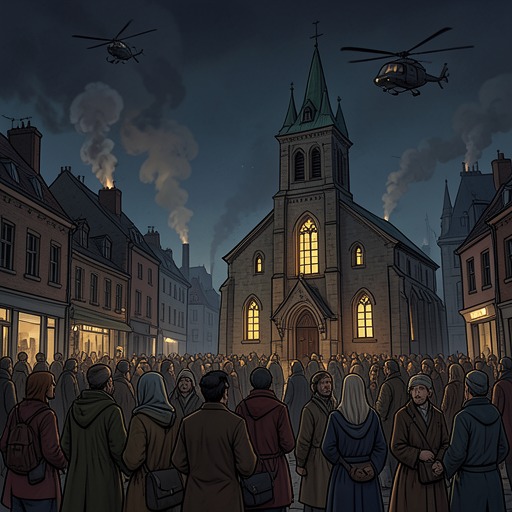
Outside, the city is anything but quiet. As Lomeli waits near the entrance in the November cold, a helicopter hovers overhead, its purpose uncertain: it may belong to a television network seeking aerial images or to the security forces. The threat of terrorism is described as serious and imminent. Surface-to-air missiles and snipers are assigned to surrounding rooftops, five thousand uniformed police and army personnel patrol nearby streets, and hundreds of plain-clothes officers mingle with the crowds. The vast protective apparatus is set against the human vulnerability of the election’s organizers; even the Italian Minister of the Interior, who briefs Lomeli on security, asks for his blessing.
Protesters gather beyond the controlled entrances, their competing demands merging into a cacophony that Lomeli cannot distinguish. The crowds include supporters of gay marriage and opponents of civil union, advocates of divorce, women demanding ordination, women demanding abortion and contraception, Muslims and anti-Muslims, and immigrants and anti-immigrants. The city’s perimeter therefore separates neither the conclave from politics nor the Church from public conflict. It gives those pressures a sound beyond the walls while concentrating the decision-makers inside.
A global college within the walls
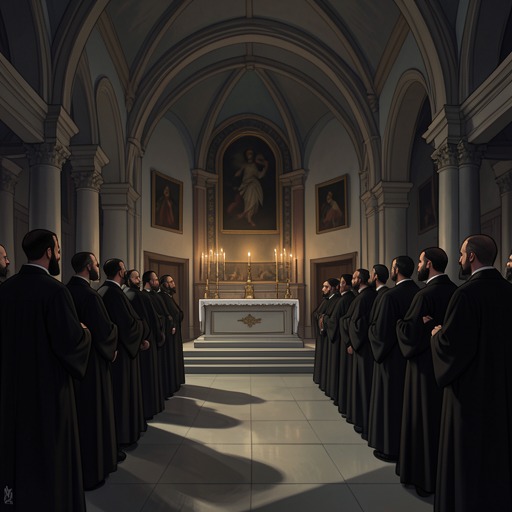
The cardinals’ arrival turns Vatican City into a meeting place for a worldwide institution. The procession up the slope from the Palace of the Holy Office combines the old and the contemporary: a Swiss Guard in a plumed helmet carries a halberd, while cardinals’ wheeled suitcases clatter across the cobbles. Lomeli recognizes that the ceremony’s historical appearance coexists with practical arrangements and modern security.
The electors arrive from across continents and church traditions. Maronite and Coptic patriarchs come from the eastern ministries; Indian major archbishops and an archbishop from Ranchi join thirteen Asian archbishops from cities including Jakarta, Cebu, Bangkok, Manila, Seoul, Tokyo, Ho Chi Minh City, and Hong Kong. Another thirteen African archbishops represent sees including Maputo, Kampala, Dar-es-Salaam, Khartoum, and Addis Ababa. This range makes the universal Church visible in the streets and rooms of the small city, but geographic representation does not automatically produce a common political front.
Lomeli reads the arrivals for signs of coalition and division. He suspects that the nineteen Latin American electors might vote together, yet the Brazilian Cardinal Sá and Chilean Cardinal Contreras refuse even to look at one another; Cardinal Hierra walks between them, and the hoped-for common front already appears implausible. By contrast, Joshua Adeyemi gathers African cardinals and leads them through the piazza, pointing out buildings as if he were their proprietor. Even older figures defer to him. Lomeli expects African support for Adeyemi but also sees the obstacle: to win, he must reach beyond Africa and the Third World, while his attacks on global capitalism and homosexuality may alienate electors in America and Europe. The fifty-six European cardinals still dominate the conclave numerically.
Language, factions, and the contest for votes
Vatican City’s election is shaped not only by geography but by overlapping networks of office, language, and political support. Aldo Bellini is the liberals’ longstanding intellectual hope, with a career as rector of the Gregorian University and Archbishop of Milan. Joseph Tremblay combines the office of Camerlengo with leadership of the Congregation for the Evangelisation of Peoples, giving him links to the developing world while seeming American without being one. Adeyemi attracts attention as a possible first black Pope. These candidacies carry different constituencies into the same enclosed electoral space.
The dining room makes linguistic division visible. Goffredo Tedesco points out that the cardinals have unconsciously arranged themselves by native language: Italians near the kitchens, Spanish-speakers at another table, and English-speakers near reception. He argues that abandoning Latin after the reforms of 1962 has made communication harder, though Lomeli distinguishes the particular difficulty of a conclave from the wider mission of the Church. The room’s arrangement gives Tedesco’s argument a concrete setting, while also showing that shared residence does not erase the boundaries among the electors.
After the first ballot, the residence becomes a site for the unofficial arithmetic of the contest. The papal constitution forbids pacts and electoral agreements on pain of excommunication, yet cardinals begin testing support and negotiating across tables. Tedesco, strengthened by placing first, jokes with South American cardinals; Tremblay listens to Southeast Asians; Adeyemi joins conservative Eastern European archbishops discussing social issues; and Bellini presents his support for greater autonomy for bishops to North Americans. The nuns serving dinner overhear these exchanges, and some later become useful sources for reporters reconstructing the conclave. In Vatican City, even a meal can become part of the election’s information network.
The city’s enclosed politics eventually reach beyond personal alliances to allegations of corruption. Lomeli tells Bellini that Tremblay’s first-ballot votes were bought, largely from cardinals in Africa and South America, and names the alleged recipients. He says Tremblay paid in cash during the final twelve months of the late Pope’s pontificate, making the money harder to trace; bank statements, he says, support the accusation. The claim transforms the election’s geography into part of its alleged mechanism: regional connections are not merely potential blocs but, in Lomeli’s account, channels through which votes were purchased. Vatican City thus holds together the conclave’s central tension: a formally universal election conducted amid real differences of language, region, ideology, and power.