Piazza Santa Marta
ConclavePiazza Santa Marta is the forecourt of Casa Santa Marta and a threshold between the Vatican’s private spaces and the public world beyond them. At the Pope’s death and the cardinals’ arrival for the conclave, its cobbled slope and open space become places where official control, public scrutiny, and the Church’s internal divisions are made visible.
Setting and Approach
In the early hours after the Pope’s death, Cardinal Lomeli hurries up the cobbled slope toward the piazza in light rain. The scene is quieter than the panicked telephone call that summoned him: an ambulance waits apart from the entrance, its interior light on, and Lomeli realizes that it has come to remove a body rather than take a sick man to hospital. At the glass entrance to Casa Santa Marta, a Swiss Guard receives him; Lomeli asks that the ambulance driver not contact the media.
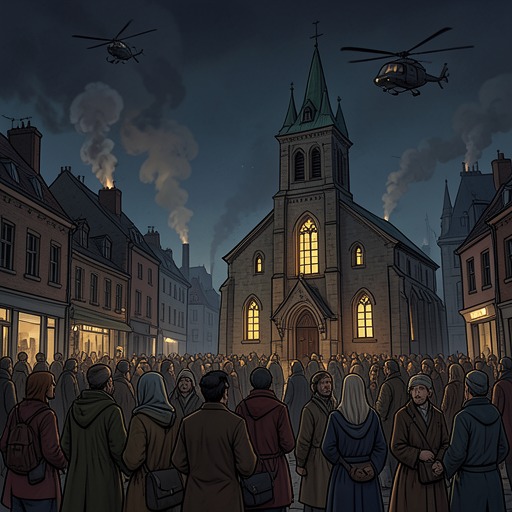
The piazza’s apparent calm cannot contain the consequences of the death. As the Pope’s body is brought out, the drizzle has stopped and the cardinals escort the stretcher through the square toward the ambulance. The procession passes between Swiss Guards under the attention of phone cameras, photographers, and television crews. St Peter’s looms beyond the competing lights, turning the piazza into a public stage for an event the Vatican had first tried to manage discreetly.
The Pope’s Death and Its Official Account
The piazza is bound to the question of how the Pope died and how that death will be represented. Lomeli is given a printed timeline headed “Timeline,” setting out the evening in precise intervals: supper with Archbishop Woźniak at 7.30 p.m., retirement to his apartment at 8.30, and bed at 9.30. Woźniak’s 11.30 check finds no vital functions; a doctor begins emergency treatment at 11.34, and the Pope is pronounced dead at 12.12 a.m. The document’s orderly sequence stands against the confusion and suspicion that can follow an unexpected papal death.
Woźniak later tells Lomeli that he found the Pope dead and summoned the doctor, who in turn summoned Cardinal Tremblay. He says that Tremblay took charge, then asked what the Pope had discussed at supper. Woźniak had withheld details, fearing he was not meant to know them, and recalls Tremblay speaking privately with Monsignor Morales afterward. The piazza’s early quiet and the later procession therefore frame more than a change of setting: the death is immediately subject to questions of procedure, information, and who controls the official account.
The Conclave Arrives
As the conclave approaches, the piazza becomes an entrance route for the electors. The first cardinals climb its slope from the direction of the Palace of the Holy Office, accompanied by a Swiss Guard carrying a halberd. Their red-trimmed black cassocks and skullcaps recall an older ceremonial world, while their wheeled suitcases clatter over the cobbles. The contrast makes the gathering both ritual and contemporary: an ancient institution arriving with the practical luggage of a modern assembly.
Lomeli watches the arriving cardinals and reads political divisions in their conduct. The Brazilian Cardinal Sá, the elderly Chilean Cardinal Contreras, and Cardinal Hierra of Mexico City walk together, but Sá and Contreras refuse even to look at one another. Their physical distance undermines the prospect that Latin American electors might vote as a unified bloc. The square thus serves as an arrival point and an informal observatory, where alliances can be guessed at before the formal voting begins.
By five in the afternoon, fourteen cardinals have yet to arrive; Lomeli counts 103 already present as the day darkens and cools. A helicopter has moved away, but demonstrators remain audible, their drums beating steadily. The piazza gathers the conclave’s participants within the Vatican while also registering the attention and unrest outside it.
A Threshold Between Institution and Public
The square’s recurring role is to expose the gap between the Church’s internal affairs and the world watching them. At the Pope’s removal, the cardinals’ controlled procession is punctuated by camera sounds and television lights; at the conclave’s approach, the electors enter through the same exposed space amid demonstrators and security. Private decisions and institutional procedures cannot remain entirely private once they pass through the piazza.
That tension echoes the wider conflict over the late Pope’s reforms. Cardinal Bellini recalls that the Pope demanded financial transparency, introduced accountants and management consultants, and faced resistance and damaging leaks within the Curia. The square itself is not where those investigations occur, but it is the public threshold of the institution whose authority and credibility are at stake. In its movement from ambulance to procession to arriving electors, Piazza Santa Marta makes the transition from one pontificate to the uncertain work of choosing another visible.