St Peter's Basilica
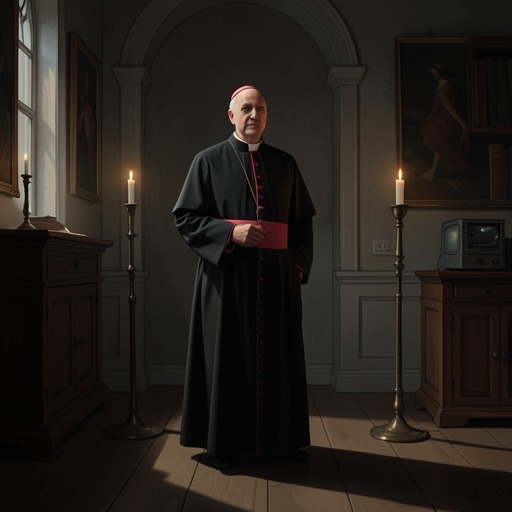
ConclaveSt Peter’s Basilica is the great public setting against which the novel measures the Church’s rituals and unsettled authority. At once a place of mourning, worship, and election, it draws the cardinals from their enclosed deliberations into the sight of a vast congregation, then frames the formal procedures by which they choose a new pope.
Setting and Public Presence
In the aftermath of the Pope’s death, the procession carrying his body leaves the Casa Santa Marta and moves through the October night toward the basilica. Religious of every rank line the route, but silence gives way to camera clicks and occasional sobs as the body emerges. The procession passes the Swiss Guards and the waiting ambulance, while the illuminated basilica rises behind the press lights and television crews. The scene makes the Church’s private grief a public spectacle: the body is escorted with solemnity, yet watched and recorded at every step.
The building also gives scale to the Church’s global reach. As the ambulance waits outside, Lomeli imagines people around the world following events on televisions and phones. The basilica is therefore more than a ceremonial destination: its image and the public rites around it connect the Vatican’s immediate crisis to a far larger audience.
The Election Mass
On the November morning of the election Mass, Lomeli walks with the cardinals from the Casa Santa Marta through the Arch of the Bells, across the piazza, and along the basilica’s portico. Security personnel bow as he passes; inside, the basilica is brilliantly lit for television, and a congregation of twenty thousand waits beneath the dome. The scale of the procession and gathering contrasts with Lomeli’s private effort to make room for prayer as he prepares to celebrate Mass.
The public ceremony does not reveal the full strain of its celebrant. Lomeli’s hands shake at points, and he hesitates over parts of the service, but his performance is otherwise composed. His established qualities—gravity, dignity, and steadiness—carry him through the rite even as the account distinguishes his outward control from his inner turmoil. At 11:52 a.m., he concludes the Mass with the final blessing and sends the congregation forth.
The Altar and the Ballot
The basilica’s altar also anchors the election’s procedural order. Before voting, Lomeli reads aloud the rule governing the ballot: each elector is to display and fold the paper, approach the altar, make an oath, deposit the vote, and bow before returning to his place. The wording makes the act both a formal procedure and a declaration made before God.
When the first ballot begins, the scrutineers take their positions at the altar. Lomeli writes “BELLINI” on his paper, shields it as he writes, then folds and raises it before carrying it forward. The scene locates a consequential political choice within a religious rite: the ballot is counted by designated officials, but the elector’s oath frames the decision as one for which he is accountable beyond the conclave.
Ceremony and Crisis
Later, during the conclave, news of coordinated bombings in Rome forces the cardinals to confront the danger of continuing their work as though nothing had happened. Lomeli sees the juxtaposition of black smoke from the explosions and black smoke from the Sistine Chapel as an image of the Church’s apparent helplessness. Suspending the election would prolong the leadership vacuum; accelerating it, he argues, would violate the Apostolic Constitution and risk leaving the next pope’s authority open to challenge.
The basilica’s public role throws this dilemma into relief. Earlier, it had offered a setting in which the Church could present continuity through procession and Mass. In the crisis, however, ceremonial visibility cannot settle the question of legitimate authority. Lomeli instead seeks the assembled cardinals’ permission to discuss the emergency under the Constitution’s special-circumstances provisions. The basilica’s significance lies in that tension: it embodies the Church’s public unity, while the events associated with it expose how much that unity depends on contested choices, rules, and trust.