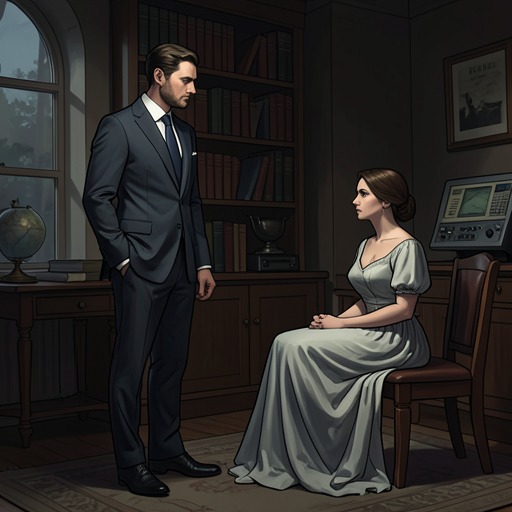
Barbara Franklin attempts to poison John Franklin
CurtainBarbara Franklin’s attempt to poison John Franklin is built around a calculated reversal: she prepares a fatal dose for her husband while making the planned experiment appear innocent, but the two cups of coffee are exchanged in effect, and Barbara drinks the poisoned one. Her earlier performance of devotion and anxiety had helped frame John’s possible death as the unintended consequence of scientific curiosity; the plan instead kills its intended perpetrator and leaves Hercule Poirot facing a choice between exposing what he suspects and protecting two innocent people from suspicion.
Preparation and Cover Story
Barbara first presents herself as deeply attached to John and distressed at the thought that her illness makes her a burden. She speaks of ending her life, a display that Poirot later judges too insistent to be convincing. That performance could make her appear a vulnerable wife rather than someone who might wish her husband dead, while also supplying a possible explanation for her own death should events take an unexpected turn.
She then introduces a different concern: that John might experiment on himself. This shifts attention toward his scientific work and prepares others to imagine that he could ingest a substance voluntarily. The contemplated poison is physostigmine, described by Poirot as a supposedly harmless alkaloid that might prove harmful after all. In that framing, John’s death would look less like a deliberate poisoning than a research experiment with an unforeseen result.
The plan depends on making the death seem plausible in advance, not merely on administering the substance. Poirot concludes that Barbara’s remarks and her suggestion of self-experimentation together prepared those around her for John to die in circumstances that could be mistaken for an accident. Her approach makes the proposed scientific explanation part of the cover story before the poisoning is attempted.
The Coffee and the Reversal
After a morning of nerves, Barbara moves to act quickly and arranges a gathering in her room. She invites the others upstairs and makes coffee with conspicuous fuss. As Hastings recalls the arrangement, Barbara’s own cup stands beside her, while John’s is placed on the other side of the bookcase table. The positions matter because the cups contain different preparations: one is intended for John and holds coffee laced with Calabar-bean alkaloids; the other is plain.
A distraction changes the course of the scene. Shooting stars draw everyone outside, leaving Hastings behind with his crossword puzzle and memories. To conceal his emotion, he turns around the bookcase to find a quotation in Shakespeare. When the group returns, Barbara drinks the coffee containing the alkaloids, while John drinks the plain cup that had been meant for her. The intended target therefore survives the arrangement, and the poison kills Barbara instead.
The reversal turns Barbara’s carefully prepared explanation against her. The talk of John’s scientific experiments had been designed to make his death look accidental, but the substance meant to kill him reaches Barbara. Poirot recognizes what has happened, yet recognition does not give him proof that he can safely present to others.
Motive and Immediate Consequences
Poirot’s retrospective account links Barbara’s haste to her hopes for a different life. She remains attractive to Sir William Boyd Carrington, but he is old-fashioned and not the sort of man to propose divorce; John, too, has no use for divorce. Barbara imagines that if John died she could become Lady Boyd Carrington and enjoy the life she desires. Poirot says Norton found her ready to be used, placing her attempt within the wider pattern of Norton’s influence without making Barbara’s plan any less her own.
A separate complication helps explain why the attempt occurs when it does. Barbara is displeased when Sir William has his fortune told by Nurse Craven. Nurse Craven is described as attractive and interested in men; she had tried unsuccessfully to attract John, disliked Judith, and was involved with Allerton despite knowing that he was not serious about her. She then turns her attention toward the wealthy Sir William, who is himself receptive to her attraction. Poirot treats this development as a fright that prompts Barbara to act sooner, hoping to become a charming, pitiable, but not inconsolable widow.
Instead, Barbara dies by the poison she had arranged for John. John receives harmless coffee and is not killed by her plan. Her death also leaves the truth difficult to establish: Poirot says he could not prove what had happened, and that a finding other than suicide would inevitably direct suspicion toward either John or Judith, both of whom he considers wholly innocent.
Poirot’s Intervention and the Case’s Irony
Poirot responds by emphasizing Barbara’s earlier remarks about ending her life and giving them the force of a suicide explanation. He believes he is uniquely able to make that account persuasive because his statements carry weight: he is experienced in committing murder, and others will accept his conviction that the death was suicide. His intervention does not undo the attempted poisoning; it controls how Barbara’s death is understood and shields John and Judith from suspicion.
The outcome gives the Calabar bean a grimly reversed function in Poirot’s telling. He says it spared the innocent and killed the guilty: the poison intended for John instead kills Barbara, the person who arranged the attempt. That result is not presented as a judicial resolution of the crime, since Poirot admits that he cannot prove the poisoning. It is the practical and moral consequence of his decision to shape the official interpretation around suicide rather than risk implicating the innocent.
The episode therefore holds two explanations in tension. Barbara’s preparation of the cups and her effort to make John’s death look like an experiment point to deliberate intent; Poirot’s account of her death as suicide is a knowing intervention, not his belief about what actually happened. The plan fails in its immediate objective, but the circumstances of its failure determine the story told afterward: John survives, Barbara dies, and Poirot suppresses the explanation he believes true to prevent suspicion from falling on others.