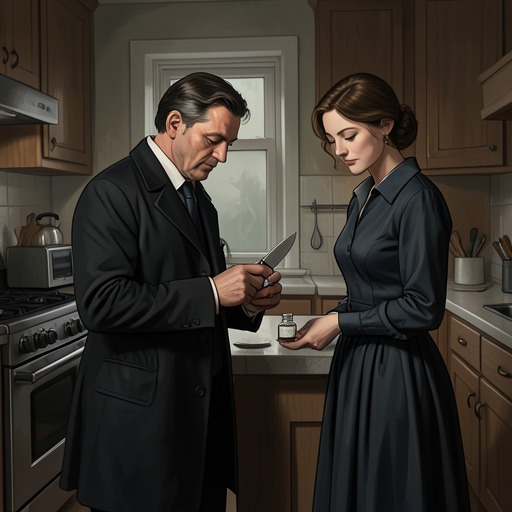
Hastings plans to poison Allerton
CurtainHastings plans to poison Allerton after discovering that his daughter Judith is involved with a man he believes intends to exploit her. He carefully prepares an overdose of Slumberyl in a whisky nightcap, but falls asleep before Allerton arrives. The plan is abandoned the next morning, when Hastings recognizes what he had contemplated and confesses to Hercule Poirot, who explains that the precautions meant to conceal the crime would instead have made Hastings a conspicuous suspect.
Discovery and Decision
Hastings’s intention takes shape after he sees Judith and Allerton kissing. Norton tries to restrain him, pulling him back around the corner of the house as he steps forward. Hastings then goes towards a summerhouse hidden among lilac trees and overhears Allerton telling Judith that she is to go to London the next day, while he pretends to be staying with a friend in Ipswich. Allerton proposes a private dinner at his flat and assures her she will not regret it. Hastings reads the arrangement as dishonourable pursuit, not a genuine commitment.
He lets Norton lead him back to the house and tells him that he has given up trying to control his daughter’s life. The reassurance is deliberate: Hastings says he will not interfere, while privately deciding to do exactly that by other means. The contrast between his spoken surrender and concealed resolve marks the turn from paternal argument to premeditated violence.
The Poisoning Plan
Alone in the house, Hastings reasons that Allerton will not meet Judith in London the next day. He goes first to his own room for a bottle of aspirin, then enters Allerton’s room and takes the Slumberyl tablets from the bathroom cupboard. Knowing that Allerton has described the toxic dose as low, Hastings calculates that eight tablets should be enough, although the stated dose is only one or two.
He handles the bottle with a silk handkerchief to avoid leaving fingerprints. The tablets are nearly the same size as aspirin, so he empties the bottle, puts eight aspirin in it, and replaces the missing tablets with Slumberyl. The bottle looks unchanged, while the substituted tablets are meant to make an overdose seem accidental. The label warns against exceeding the prescribed dose; Hastings notices it but treats the warning as confirmation that the quantity will be lethal rather than as a reason to stop.
Hastings next prepares the means of delivery. With whisky and soda in his room, he expects to offer Allerton a nightcap when he comes upstairs, then pass him the poisoned drink while pouring a second for himself. He tests the tablets in a little spirit: they dissolve easily and taste only slightly bitter. His scheme depends on the ordinary intimacy of a shared drink disguising a calculated dose.
The Plan Interrupted
Hastings sits waiting for Allerton, expecting that it may be an hour or two before he comes up. Instead, Hastings falls asleep in his chair. When he wakes, birds are twittering, daylight has come, and he is still in his evening clothes, cramped and with a splitting headache. The intended killing has not occurred: the prepared drink remains untouched, and Hastings has passed through the night without carrying out his decision.
In the morning, the interval of sleep brings a sharp change in judgment. Hastings sees the whisky glass, shudders, and pours its contents out of the window. He recognizes that he had made up his mind to kill another person and describes himself as overwrought and wrong-headed. After shaving, bathing, and dressing, he goes to Poirot and makes a full confession; telling the truth brings him relief.
Poirot’s Detection and the Plan’s Meaning
Poirot is glad that Hastings confessed, but reproaches him for not coming the previous night. Hastings admits he feared Poirot would stop him. Poirot answers that would-be murderers commonly think that way, then shows Hastings that his precautions would not have made the act safe or untraceable.
By wiping the bottle, Hastings would also have removed Allerton’s fingerprints. If Allerton were found dead of a Slumberyl overdose, the absence of his prints would be difficult to explain as either accident or suicide. Analysis would also reveal that nearly half the tablets had been replaced with aspirin. Poirot further points out that Hastings had a visible motive: he had quarrelled with Judith about Allerton the day before, and both Boyd Carrington and Norton could testify to his violent hostility. The bottle, the substituted tablets, and the witnesses would direct suspicion towards Hastings; someone might even have seen him tampering with the medicine.
The episode exposes the gap between Hastings’s self-image as a careful man and the violence of the act he plans. His precautions show that the intention was not merely an angry impulse: he has selected a poison, calculated a dose, altered its container, and arranged a plausible way to administer it. Yet the plan is interrupted not by a contest of wills but by ordinary exhaustion, and then dismantled by Poirot’s reasoning. Hastings’s confession and the poured-out whisky turn the episode into a moral reversal: the would-be killer becomes the person who acknowledges his intended crime, while Poirot’s explanation shows that secrecy would have produced evidence against him rather than mastery of the situation.