Hastings attempts to kill Allerton
CurtainHastings attempts to kill Allerton after Stephen Norton turns his love for Judith Hastings and his mistaken understanding of Allerton into a plan for murder. The attempt never reaches its intended victim: Hercule Poirot notices Hastings’s state of mind, discovers the sleeping tablets he has prepared, and secretly incapacitates him until morning. The episode both exposes Norton’s method of directing other people’s actions and makes Hastings’s danger a decisive reason for Poirot to intervene against Norton.
Causes and Manipulation
Norton’s scheme works through truths arranged to produce a false conclusion. He tells Hastings a story about Allerton that is factually accurate, but the account presents him as a man who ruins women and drives them to despair. The story confirms Hastings’s instinctive dislike and fear of Allerton, while also striking his conventional sense of what a father ought to do when his daughter appears at risk. Hastings therefore takes Norton’s account not as a provocation to examine, but as grounds for intervening in Judith’s life.
Norton intensifies the pressure by having William Boyd Carrington speak to Hastings as well. Hastings feels compelled to warn Judith; she replies that she will live as she chooses. Instead of reassuring him, her refusal makes him believe the worst. Norton has found several points of leverage at once: Hastings’s love for his daughter, his responsibility toward her, his loyalty to the absent judgment of his wife, a measure of self-importance, and a father’s jealousy toward the man he believes is taking his daughter away. The attempted murder is thus not a sudden, isolated impulse but the outcome Norton has engineered by making protective feeling seem to demand violence.
A staged encounter supplies Hastings with apparent confirmation. He sees Allerton and a woman kissing, but Norton pushes him back around a corner and takes him away before he can identify the woman. Norton knows Allerton is due to meet Nurse Craven in the summerhouse; Hastings does not see the woman’s face or hear her speak. Even so, he accepts the scene as proof that Judith has been with Allerton, and the next morning still believes it. The episode shows how Norton turns incomplete observation into certainty: Hastings’s willingness to accept appearances completes the manipulation.
The Attempt and Poirot’s Intervention
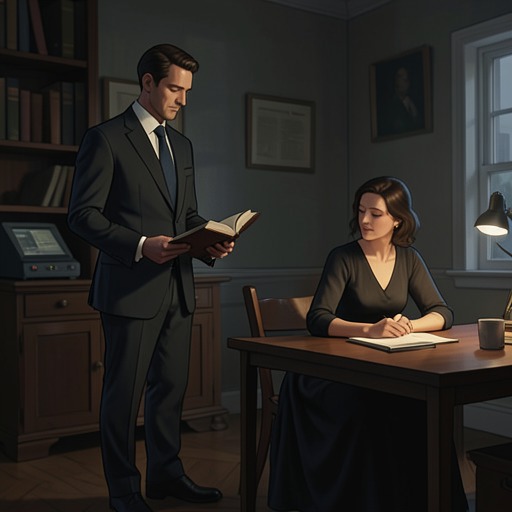
Hastings makes up his mind to murder Allerton. Poirot, already concerned about Hastings’s state of mind, hears him enter Allerton’s room that evening and becomes alert. He leaves his own room, crosses the passage, and looks through the bathroom keyhole. The door has a bolt on the inside rather than a key, allowing him to see Hastings handling sleeping tablets and understand what he intends to do.
Poirot acts before Hastings can carry out the plan. He returns to his room and prepares a cup of chocolate. When Curtiss fetches Hastings, Hastings arrives yawning and says he has a headache. Poirot makes a show of urging remedies; Hastings drinks the chocolate quickly, eager to leave. Poirot has put sleeping tablets in it. Hastings sleeps through the night and wakes in the morning restored to his senses, horrified by how close he came to acting on his intention. The immediate consequence is not merely delay: once the impulse has passed, he does not attempt it again.
Consequences and Significance
Poirot tells Hastings that he could never truly have been a murderer, but that he might have been hanged for a killing committed by another man who would, in the eyes of the law, be guiltless. The distinction gives the near-attempt its grim stakes: Norton can remain insulated from the intended crime while manipulating someone else into committing it. Hastings’s trusting nature, which Norton has used to make him accept a false interpretation, also leaves him exposed to the legal consequences of acting upon it.
For Poirot, discovering the plan becomes a turning point. He says the incident decided him to act against Norton: even where he might be uncertain about other people, he knows Hastings is not a murderer, yet sees how Norton could make him one in practice. The danger to Hastings also sharpens Poirot’s concern for Judith, whom he identifies as dear to both men and potentially vulnerable to Norton’s influence. The thwarted attempt therefore links the private crisis of a father nearly attacking his daughter’s supposed seducer to Poirot’s broader decision to stop the man who has been prompting others toward crime.
As a plot reversal, the episode transforms Hastings from Poirot’s trusted companion into the intended instrument of another person’s scheme, then reveals the detective’s quiet counteraction. Poirot does not confront Hastings openly or rely on argument; he observes, recognizes the tablets, and prevents the act before Hastings can complete it. The chocolate and sleeping tablets make the intervention concrete, while Hastings’s morning awakening supplies the recognition that the apparent certainty of the previous evening had been manipulated. His survival from the plan—and his return to his own judgment—establishes why Poirot regards the event as a warning that could not be ignored.