Narrator's London writing room
DeceptionThe Narrator's London writing room is the novel's charged intersection of work, intimacy, and authorship. A cramped, conspicuously exposed studio, it shelters Philip's affair with the Unnamed English woman while also supplying the setting in which her speech and experience become entangled with his writing. The room's defining tension is that it offers privacy only provisionally: its desks and typewriter make it a place of composition, but its open windows and the notebook left within reach expose how readily private life can become a story.
Setting and Arrangement
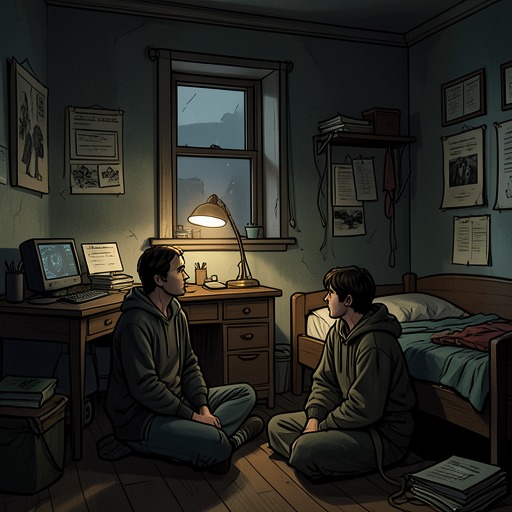
The room is introduced through an exercise in attention: Philip asks the Unnamed English woman to describe it. She judges it far too small for two people to conduct a love affair in, and asks whether they cannot find a house with a bed. The studio's proportions make their intimacy seem improvised, folded into a space primarily organized for work.
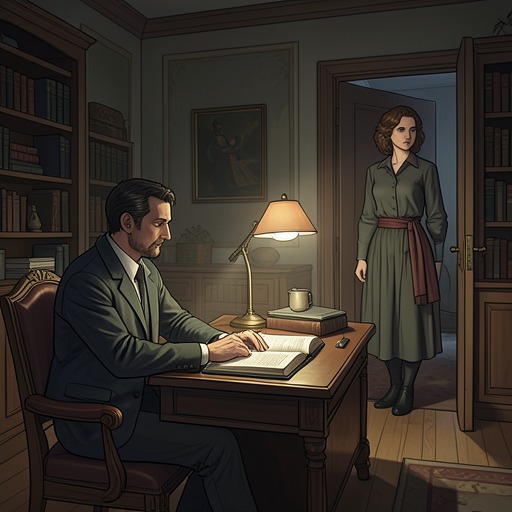
Two French windows look onto a green lawn and a flowering tree. There are no shades or curtains, so people in the houses across the garden could see into the room. Philip answers that they mostly see someone typing or reading; if they see anything more interesting, he says, they deserve it. The windows therefore make the room's privacy less a matter of physical concealment than of what its occupants choose to do in view of others.
The furnishings give that working life precise form. A woman sits in a comfortable black leather chair, while Philip, in a leather desk chair, listens and continually bends and twists paper clips, with two rubber bands around his wrist. His desk measures roughly three by five feet and has a gray metallic pedestal and pale Formica top. Its disorder is legible to him: among the uneven piles are unfinished manuscript, unanswered letters, and newspaper clippings about Israel that he cuts out to demonstrate British antisemitism. At a separate typing desk stands a black IBM Correcting Selectric Two, fitted with a Prestige Pica Seventy-two golf ball. The room's visible clutter thus records the parallel demands of composition, correspondence, and his effort to interpret the culture around him.
Work, Secrecy, and Intimacy
The room functions as a refuge for the lovers, but not as a world entirely apart from their obligations elsewhere. On a snowy day, the Unnamed English woman describes the pleasure of lying together while snow moves around the trees. That quiet scene is set against the practical strain of the affair: she explains that she has to go home before her husband becomes curious, and that maintaining a sense of truth while avoiding discovery requires constructing numerous small deceptions. In the studio, physical closeness and the labor of concealment occupy the same conversation.
The writing routine also gives the room a role in Philip's life as a cultural outsider. He describes spending the day in his room with his typewriter, then attending social and cultural events that remain opaque and English to him. Dinner parties are especially uncomfortable because he is seated next to other men's wives. The studio is consequently both his work base and a retreat from social situations that make his displacement palpable; at the same time, the affair makes the room a place where the lives and marriages of those wives become subjects of intimate conversation.
Conversation as Material
Talk in the room does not remain separate from Philip's literary work. Ivan accuses him of entering other people's lives chiefly to keep conversation going, and of being captivated by women whose painful or unsettled experiences supply narratives. In Ivan's critique, Philip listens to stories that have not yet taken a finished shape, then rushes to write them down and distorts them through fictional plotting. The room's arrangement—the speaker in a chair, the writer at his desk, papers accumulating nearby—gives material shape to the ethical question of who gets to turn an intimate account into a literary one.
Philip asks Ivan to explain what he does wrong as a writer, invoking the respect he has for Ivan's taste. The request keeps the exchange on the terrain of literary judgment even as Ivan insists that Philip's interest in literature follows his betrayal of a friend. In another confrontation, Philip defends his right to follow an imaginative impulse without censoring himself out of fear of disapproval. He argues that merely being present in a story is not enough for him: he fictionalizes himself as implicated because compromising the writer makes the indictment more powerful. The room is thus not simply where a story is composed; it is where the writer's claim to transform experience is argued over by people who may recognize themselves in that transformation.
The Notebook and the Room's Double Life
That conflict becomes concrete when the Unnamed English woman discovers Philip's notebook, which he has left outside his briefcase. She says that she picked it up and wishes she had never opened it. The object turns the studio's ordinary work surface into a point of exposure: writing that might have remained private becomes readable to the person whose life and voice it concerns.
Philip distinguishes a figure sketched in conversation in a notebook from a major character entangled in the plot of a book. He also explains that he portrays himself as implicated in the imagined betrayal of Ivan because self-compromise intensifies the fictional indictment. The dispute is not resolved simply by separating the real woman from the character: the Unnamed English woman presses him on how he knows the details of English life his studio conversations attribute to her, and Philip replies that he has lived in England, paid attention, and learned from Nathan's former lover Rosalie Nichols; the fictional woman is, he says, the repository of that knowledge.
Years later, Philip tells the Unnamed English woman that she was the person behind the woman in his book. He says that writing gave him an imagined life with her during the hours when she was absent, alongside the time they actually spent together, and that the experience was powerful. Her response draws the boundary the room's history has repeatedly unsettled: a person cannot live an imaginary life and a real one simultaneously, and a writer cannot simply take down everything someone says. The studio remains significant because it is where that double life was practiced—in intimate conversation, in writing, and finally in the exposure of what the writing had taken from it.