Cryptanalysis and decryption
DecodedCryptanalysis and decryption in the novel demand more than the recovery of a hidden message: they require the solver to infer the limits, habits, and possible errors of an opposing intelligence. The work is measured in seconds and inches, yet its decisive opening may arrive as a leap that no amount of routine effort can guarantee. The contrast between method and chance comes into sharpest focus in Rong Jinzhen’s long struggle with BLACK, whose apparent defenses concealed an unexpected absence: its key was zero.
The Work of Elimination
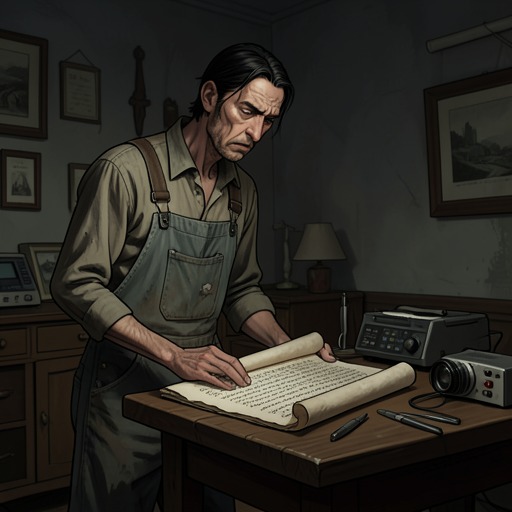
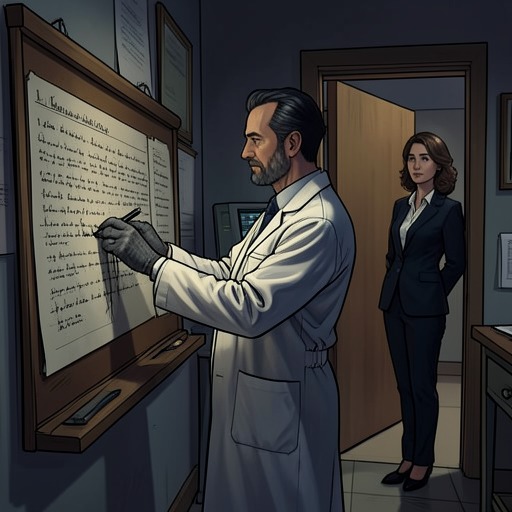
The ordinary method begins with collected intelligence and proceeds by testing hypotheses. The cryptanalyst constructs possible keys and corresponding doors, then tries them against the material available. The search can become immense: its scale depends on how much information has been gathered and on how sensitive the solver is to the particular cipher. The novel describes this procedure as simple and even stupid, but also as the safest, most secure, and most effective approach, especially against a high-level cipher. Its reliability rests not on elegance but on patient reduction of possibilities.
That method requires close attention to the cipher’s behavior. A cipher may seem like a seamless net, but once used, it can betray itself through slips: small failures of consistency that offer a crack in an otherwise closed system. Detecting such an opening demands the patient use of every second and every inch. For years, Rong Jinzhen waited for a flaw in BLACK, but found none. His failure to find errors was not treated as an ordinary setback; at Unit 701 it became an anomaly requiring explanation.
The organization considered whether the adversary had become more careful after the cracking of PURPLE. That success, the account suggests, could have taught the opposing side to communicate with greater caution and avoid revealing usable mistakes. A second possibility was that Jan Liseiwicz, who understood Rong Jinzhen’s abilities, might have warned BLACK’s creators and helped them prepare countermeasures. The possibility was shaped by the men’s former closeness and their later political division, but it remained an explanation considered by Unit 701, not a proven account of how BLACK had been made resistant to analysis.
The Bird and the Solver
The book figures decryption as an attempt to catch a bird in flight. Reaching into the sky is not impossible, but the odds are remote; most people who make the attempt spend their lives with only a few feathers. The image preserves the difference between labor and success: effort can bring a solver near the target without placing it in his grasp. The bird is always present, yet its movement cannot be compelled.
The comparison also separates kinds of intelligence. John Nash is imagined as capable of catching the bird itself, though the timing of his movement cannot be predicted. Jan Liseiwicz, despite genius said not to be inferior, is described as more likely to study Nash: his line of sight, the instant he moves, and the speed, precision, and force of his attempt. By observing those details and the birds’ number, direction, and changing motion, Liseiwicz might judge when Nash would reach out. The passage makes decryption both an act of direct insight and an act of reading another mind at work.
This distinction gives the metaphor an adversarial edge. A cryptanalyst does not only confront a system; the solver must also consider what its creator expects, conceals, or has changed in response to previous attacks. The novel’s compact rule, “You only need to prove yourself,” is followed by a second proposition: “When you do so, your opponent will assist you.” The opponent assists not by cooperating, but by making a cipher whose choices and uses can be studied. If the solver cannot prove the case, the opponent’s own success will instead be demonstrated. Decryption therefore joins inference to exposure: each side’s performance supplies evidence about the other.
BLACK and the Zero Key
Rong Jinzhen’s years of unsuccessful work on BLACK end in an abrupt reversal. In the early hours, after waiting until three in the morning, he uses the calculator capable of more than forty thousand calculations that Headquarters had given him to test an assumption. Once the cipher yields, he runs from the underground office in the mountain cave, falls to the ground, and cries out before dawn. The physical intensity of the reaction marks how completely the discovery breaks with the prolonged, silent labor that preceded it.
The explanation is startlingly spare: the key to BLACK is zero, and the cipher has no real lock. The account locates the key in a leather attaché case, turning an object associated with the cipher’s surrounding world into the image of its concealed answer. The apparent barrier had been a false façade; it seemed locked, but required only a push. This does not make the earlier waiting pointless so much as expose its danger. A searcher can assume that an elaborate obstacle must have an elaborate key, while the decisive fact may be that the expected lock is not there at all.
The discovery also unsettles the boundary between method and luck. Rong Jinzhen describes the opening as so bizarre that it was difficult to believe even after he had seen what lay beyond it. The episode does not establish that decryption can be reduced to chance. Instead, it shows why a solver cannot treat every apparent obstacle as proof that a conventional key must exist. The breakthrough is an insight into the form of the problem itself: the supposed lock, rather than merely its combination, was the deception.
Secrecy, Records, and What Can Be Known
The novel places cryptanalytic work inside systems that restrict access to information, including information about the work itself. When Jan Liseiwicz writes to Rong Jinzhen urging him to return to artificial-intelligence research, the letter travels through Unit 701’s ordinary route but is opened by its surveillance team. Because the letter is in English, the team treats it with suspicion and requests a translation before deciding whether Jinzhen may read it. The episode makes clear that even personal communication within the unit is subject to inspection; the analyst’s informational world is bounded by institutional secrecy as well as by the cipher.
The surviving record of Rong Jinzhen’s work is similarly controlled. From 1956 to 1970 he filled twenty-five notebooks. Di Li holds them as his wife, but most remain restricted: twenty-four are kept in an iron cabinet secured by two locks requiring two keys to turn at once, one carried by Di Li and the other held by her section chief. She has custody without permission to treat those notebooks as her own. The arrangement turns the record of a solver’s thought into another protected object, inaccessible even to the person responsible for its safekeeping.
The one notebook Di Li does provide is also incomplete. Its photocopy contains seventy-two pages, while notebooks of that type contain ninety-nine; the top-secret markings and page numbers have been removed. Di Li explains that some pages were blank and that others held private secrets between husband and wife. The missing pages therefore cannot simply be read as evidence about a cipher, but their absence establishes a limit on what later readers can verify. In this account, decryption seeks to make an opponent’s hidden system legible, while the cryptanalyst’s own methods and records remain partly concealed. The work’s central tension persists beyond any single solution: a secret may be broken, yet knowledge of how it was reached can remain locked away.