The cost of secrecy
DecodedThe cost of secrecy in Rong Jinzhen’s story is measured not only in concealed information but in a life divided from its family, its past, and even the ordinary means of understanding its work. Recruited into cryptography without the right to refuse, he disappears into Unit 701 and leaves his family with an address that misleads them and letters that reveal almost nothing. At the same time, the profession itself demands isolation: its practitioners are warned away from history, watched in their movements, and made to suspect even the people they once trusted.
Compulsion and Departure
Rong Jinzhen’s departure begins with an obligation he cannot explain. When his family asks what kind of work could require him to go, he says he has no right to refuse and is not allowed to tell anyone; he has sworn an oath. The prohibition reaches into the family home: even his mother cannot be told. Secrecy is therefore present before he reaches the workplace, already shaping what he may say to the people closest to him.
At five o’clock on the morning of 11 June 1956, Rong Jinzhen leaves N University, where he had been a fixture and the mathematics department’s star for ten years. Before departing, he asks the old couple’s permission to take the name Rong Jinzhen. His farewell is physical and intimate: he kneels, kowtows, and tells them he remains their son even if he goes to the ends of the earth. The family’s grief is sharpened by not knowing where he is going. A jeep carries him away at dawn, and the only address they have is Box No. 36 in the provincial capital.
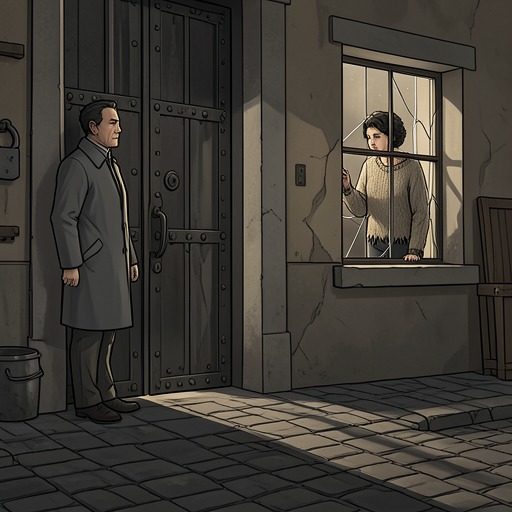
The address makes apparent closeness serve as camouflage. The first letter is written three days after Rong Jinzhen leaves but takes twelve days to arrive. There is no return address and no postmark from the place of sending, only the receiving sorting office’s mark. On the envelope, a red calligraphic slogan occupies the space where a sender’s address would normally appear. Later letters follow the same pattern, taking roughly eight or nine days; at the beginning of the Cultural Revolution, the slogan is replaced by a popular song lyric. The regularity of these peculiarities offers the family a pattern, but not a location. Their attempt to learn what Box No. 36 serves yields no answer, and the family comes to understand that its apparently local address is designed to mislead.
A Family Kept Outside the Secret
The secrecy does not end with the departure. In a later family account, the speaker says that even after years had passed, the family still did not know what unit Rong Jinzhen worked for, where he was, or what he did. The unknown is not presented as a temporary gap that a relative might solve by asking the right person. The family recognizes the secret as belonging both to Rong Jinzhen and to the country, and accepts that it may remain inaccessible for his entire life.
That acceptance is a hard-won moral compromise. The family account acknowledges the unfairness of asking someone to conceal his work from his closest relatives for decades, perhaps for life, but sets this private injury against the danger that disclosure might bring to the country. The speaker concludes that the public risk outweighs the family’s claim to know. Yet the justification cannot restore what secrecy has taken: a shared history and an intelligible domestic life. Life with Rong Jinzhen comes to seem like a waking dream, a long experience that even his gift for interpreting dreams could not make comprehensible.
The same separation is imposed on Rong Jinzhen from the other side. On the journey away from the university, he does not know that the man beside him is the head of the cryptography section of Unit 701, or that this man will become his immediate superior. He is driven beyond the city limits after having been made to wear dark glasses during an earlier trip, and realizes from the national highway that he is being taken far away. The local-looking postal address and the obscured route belong to one system: his family cannot locate him, and he cannot openly describe where he is.
The Secret as an Institution
Unit 701 enforces secrecy through controlled space and communication as well as oaths. Even personal mail is inspected before it reaches Rong Jinzhen. When Jan Liseiwicz writes to him, the letter arrives by the ordinary route, but surveillance staff open it first; its English text is enough to put them on guard and require an official translation. Whether Rong Jinzhen is allowed to read it depends on its contents. The private letter is thus made subject to institutional judgment before it can function as private correspondence.
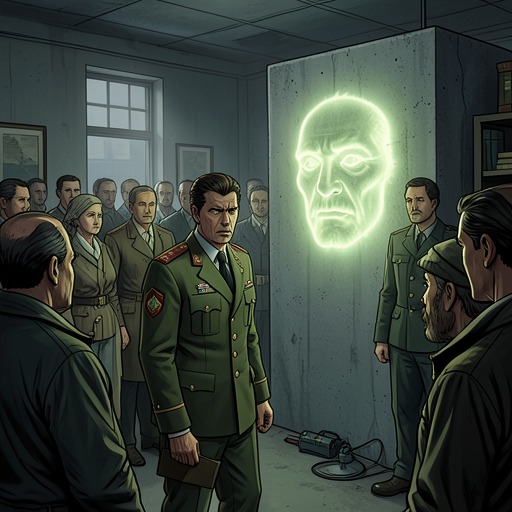
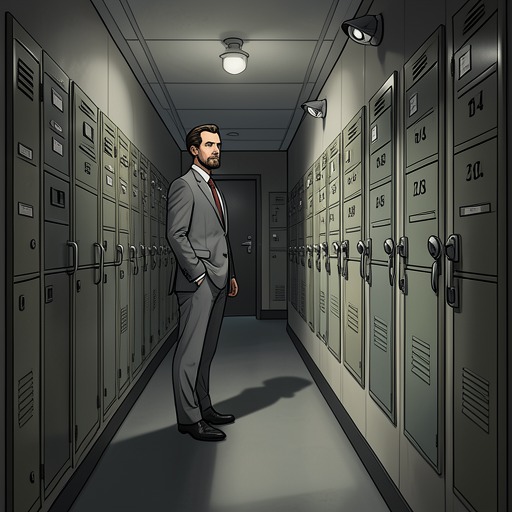
The narrator’s own passage through the complex makes the machinery of access visible. Escorted through three security checkpoints, the visitor passes armed police, then People’s Liberation Army guards behind barbed wire, and finally a plainclothes guard carrying a walkie-talkie. Yet the layers of security do not clarify what kind of organization Unit 701 is. The narrator remains unsure whether it belongs to the military, police, or local government; inquiries are discouraged or met with claims of ignorance. Secrecy obscures not only the unit’s work but its institutional identity.
Its controls extend beyond the gates. After BLACK is broken in the second half of 1970, those under scrutiny are placed under strict house arrest; even before that, from around the breaking of PURPLE, they have been shadowed outside and their telephone monitored. The restrictions make surveillance part of daily life, not an exceptional response confined to the moment a cipher falls. Jan Liseiwicz dies of illness in 1979 while the house arrest is still in effect. The record of what happened between him and Rong Jinzhen becomes available through conversations during that confinement, when there is little else to do but talk. Secrecy limits movement and contact even as the forced proximity allows some buried history to be told.
Cryptography’s Isolation and Its Ironies
The profession reproduces this isolation intellectually. Cryptographers are said to follow an unwritten rule to avoid history: earlier work might offer clues for breaking modern ciphers, but entering that accumulated past risks becoming trapped in its theories. The history of cryptography is imagined as a silent, lonely forest without guides or open paths. Each generation is cut off from the experience of those before it; practitioners cannot safely build on a shared inheritance, and even knowledge that might help can become a danger. Secrecy thus protects methods while depriving their users of community and intellectual continuity.
The ordinary process of cryptanalysis also shows how painstakingly information is gathered and tested. Agents collect relevant material; analysts develop hypotheses and make possible keys for possible locks, a slow method described as safe and effective, especially against high-level ciphers. A cipher can seem seamless, but its use may produce errors that offer an opening to a codebreaker. After PURPLE is cracked, the adversary becomes more cautious, leaving Rong Jinzhen unable to find comparable slips in BLACK. The work demands attention to every second and every inch, while the information needed for success is deliberately kept scarce.
The decisive irony comes when BLACK’s apparent barrier proves not to require a conventional key at all. Rong Jinzhen discovers that its key is zero, and that the answer was in a leather attaché case. The discovery makes the cipher seem to have been locked only by a false façade: what looked like an impenetrable secret opened when the supposed lock was recognized as something else. This does not erase the cost of the search or the years of isolation. Instead, it gives that cost a sharp formal counterpart: secrecy can make an accessible truth appear unreachable, while the labor of concealment leaves the people doing the work unable to know what they have lost until the secret finally opens.