Cryptography and ciphers
DecodedCryptography and ciphers are more than devices for hiding messages in the novel: they are systems that make intelligence vanish and can blind the people trying to recover it. Their work is figured as lonely, painstaking movement through a forest without a usable map, but also as a struggle to notice the small errors that give a hidden message away. The contrast between methodical elimination and Rong Jinzhen’s unorthodox search through cryptographic history makes the field a test of how knowledge is acquired—and of how readily an apparent lock can conceal the absence of a key.
A lonely forest of knowledge
The novel describes the history of cryptography as a silent, lonely forest. Its practitioners cannot freely ask those who came before them for directions, nor simply continue along a path already cleared by earlier work. The usual inheritance of knowledge is denied: rather than climbing on the shoulders of predecessors, cryptographers encounter closed doors and traps, and must find side roads. The result is a profession deprived of the historical community that allows other disciplines to share methods and build on established discoveries. In this account, the obscurity of the field is not just technical difficulty; it separates its practitioners and helps explain why so many of its geniuses remain buried within it.
That isolation shapes the work itself. The conventional approach begins with intelligence agents collecting relevant information. A cryptographer uses the available material to form hypotheses, then constructs possible keys and doors and tests them by elimination. The image conveys the scale of the search: there may be a seemingly limitless number of both, and the amount of usable material and the solver’s sensitivity to the particular cipher determine how far the process can go. The method is described as simple, even crude, but also as safe, effective, and especially dependable when the target is a high-level cipher. Its strength lies not in a sudden revelation but in controlled reduction of possibilities.
The codebreaker’s work
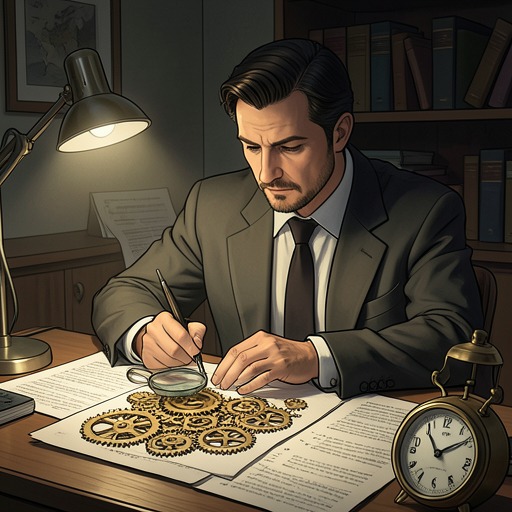
The novel also figures cryptography as a demand to make use of every second and every inch. A cipher appears like an enormous, seamless net, almost unreal in its completeness. Yet once used, it behaves like a speaker: errors can slip through. Those mistakes become openings through which a codebreaker may enter the cipher’s inner labyrinth. The image makes the work a matter of attention and patience. The hidden system may seem closed, but its use can leave traces; the solver waits for those traces to reveal a route inward.
The possibility of such errors does not mean they will be easy to find. Rong Jinzhen spends years waiting for openings in BLACK, through countless days and nights, without detecting a mistake. The failure is presented as irregular and troubling precisely because the model of the cipher seems to promise that some gap may appear. His experience shows the difference between knowing that a system can betray itself and being able to identify the moment when it does. Patience alone cannot guarantee access.
A separate parable makes the obstruction more bodily. The codebreaker is like a rat trapped in a barn full of millet that it cannot eat because every grain has a protective coating. The intelligence sought is present, but inaccessible. Ciphers both make needed intelligence disappear from sight and blind the observer, so that reaching toward the message does not restore understanding. The difficulty is therefore not simply a lack of information: the concealment alters what can be perceived in the first place.
History, risk, and BLACK
Rong’s approach departs from the safest procedure. Rather than restricting himself to the information-led process of hypothesis and elimination, he immerses himself in the history of cryptography, entering territory his profession treats as forbidden. The risk is that historical knowledge may expose him to the traps built by earlier cryptographers instead of helping him solve the present problem. But it may also narrow the search. If there were ten thousand byways, the historical route might eliminate half of them, or fewer; even that reduction could change the prospects of success. Its value depends on how much of the possible field it can remove.
The account connects this risk to the consequences of cracking PURPLE cipher. That success made the adversary more cautious and deliberate, reducing the chance of leaving any telltale error. Within Unit 701, the result had fostered a sense of invulnerability, but it also helps explain the difficulty of BLACK: the people constructing it might have been warned about Rong’s skill. Jan Liseiwicz knew Rong well enough to understand his abilities and could have helped those behind BLACK develop countermeasures. Their former closeness, described as resembling that of father and son, had been overtaken by a spiritual gulf created by opposing political positions and beliefs. When Unit 701 learned that Jan Liseiwicz was Weinacht, its members wanted to tell Rong about the deception and urge caution. Rong’s angry response made clear that the personal breach did not soften his hostility.
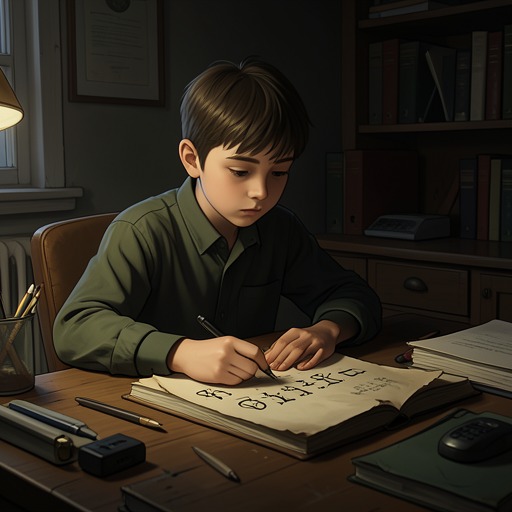
The eventual solution to BLACK overturns the expectation of a hard-won key. In the account, the narrator checks an unlikely assumption at three in the morning with a calculator capable of more than forty thousand calculations, a gift from Headquarters to Rong. The offices are underground in a mountain cave. After deciphering the cipher, the narrator rushes outside before dawn, falls to the ground, and wails in a gesture of overwhelming release. The discovery is that BLACK’s key is the number zero, held in Rong’s leather attaché case. The apparent lock has no real lock: what seemed firmly secured is a false façade that yields when pushed.
The solution is not described as a triumph of manufacturing or patiently finding the right key. The narrator reflects that no key had been made or searched for; had the door truly required one, it would have remained impossible to open. Even after the door swings open, the result seems difficult to believe. BLACK therefore turns the usual promise of cryptanalysis inside out: the obstacle appears formidable, but the crucial discovery is that the expected obstacle was not there in the first place.
Seeing, treating, and destroying
The novel extends its account of concealment through a military image associated with Douglas MacArthur. On the Korean peninsula, he gestures toward the unseen intelligence around him and assigns his cryptographers the task of restoring his vision. His later recollection that they never once let him open his eyes, and that he was lucky to return alive, gives the image a bitter reversal. Cryptographers are asked to make the invisible visible, but their work cannot promise that those who rely on it will see clearly or safely.
Another comparison casts the codebreaker as a doctor and ciphers as patients. The doctor takes them along a road that might lead to heaven for the solver but to hell for the cipher; the work may destroy more than it achieves. The image complicates the idea of deciphering as straightforward recovery. A cryptographer does not merely uncover a message without consequence: the act of solving changes or breaks the system being examined, and success for one side may mean loss for the other.
The novel also distinguishes ideas that people create for themselves from ideas that have stood the test of time. Self-made assumptions can feel more real because they are familiar and powerful, even when they are mistaken. Applied to ciphers, this observation cautions against mistaking the solver’s own model for the cipher’s actual structure. The BLACK solution gives that warning a concrete form: the belief that a formidable lock must have a key can itself become a barrier to seeing that the door is only a façade. Across its images of forests, nets, blind observers, protected millet, patients, and doors, cryptography emerges as both a technical search and a discipline of questioning what appears to be hidden, what may be seen, and what the search itself may destroy.