Cryptography’s two-paths theory
DecodedCryptography’s two-paths theory is Rong Jinzhen’s proposal that the history of cryptography can offer a route into the decryption of modern ciphers. It turns a professional taboo into a method: follow both the disguises a cipher adopts and the refinements of its inner structure, and their development may point toward a way to break it. Its promise is inseparable from its danger, since the same historical ideas that might illuminate a cipher could also entrap the codebreaker who studies them.
The two paths
Rong’s starting claim is that ciphers are living organisms, connected across time even when their makers try to sever those connections. Ciphers used in different historical periods may share an invisible relation, while those developed in the same period may be intimately linked. The answer to a present-day cipher, he proposes, may therefore be concealed in an earlier one. This is not simply a search for an identical mechanism: even efforts to erase a cipher’s history create another kind of connection among ciphers.
He explains change through an analogy with faces. Human faces can change in appearance while remaining faces; a cipher, by contrast, can be made to resemble a human face and later transformed into a horse’s, a dog’s, or something else. Its external form has no fixed parameters. Yet beneath that changing disguise, the cipher’s internal features are continually refined and clarified. Those paired tendencies—changing what is seen and advancing what lies within—form the two paths. If a codebreaker can trace them through the forest of cryptographic history, Rong argues, they may lead toward the principles of a new cipher and aid its decryption.
A method against the professional taboo
The theory challenges the unwritten rule to avoid history. Cryptographers are warned away from earlier theories because ideas can attract the mind like magnets: once attention fixes on a historical concept, it may distort present work. Ciphers must not have intrinsic similarities that make them easy to crack, and an investigator drawn too far into past models risks mistaking resemblance for a usable guide. The history of the field is thus imagined as a lonely forest filled with traps, closed doors, and paths from which there may be no return.
That prohibition reflects a specific fear, not ignorance of history’s possible value. Earlier work might contain pointers to modern ciphers, but the risk of becoming trapped among its theories has traditionally outweighed the information to be gained. Cryptographers consequently lose the reassuring continuity other disciplines can find in their predecessors: they cannot safely climb on the work of those who came before. Rong’s theory would enter precisely this dangerous territory. The proposed method seeks to reclaim historical connections while accepting the danger that makes them taboo.
The contrast is especially sharp with the conventional approach described in the account. Codebreakers gather relevant intelligence, form hypotheses, and proceed by eliminating possibilities—a slow process likened to making a limitless number of keys for a limitless number of doors. Its scale depends on the quantity of available material and the investigator’s sensitivity to the cipher. Though described as simple, this method is considered safe, secure, effective, and particularly dependable against high-level ciphers. Rong is not interested in proceeding only by that cautious elimination; his historical method tries instead to narrow the field by tracing deeper patterns. Even if it could eliminate only some of the many byways open to an investigator, that reduction might alter the prospects of success.
Rong’s working demonstration
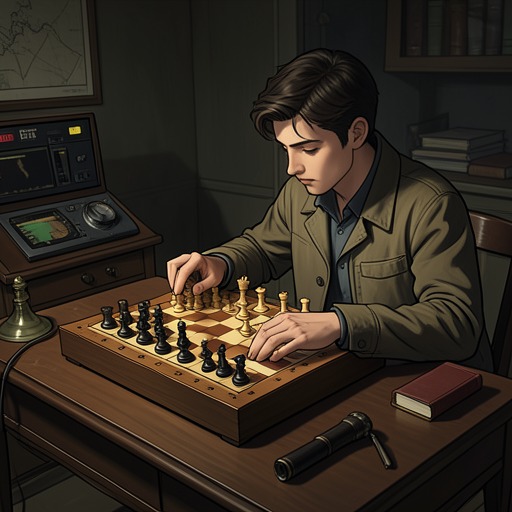
Rong’s theory takes shape in a room where he has put a massive book on cryptographic history, described as three million Chinese characters, and covered the walls with diagrams and columns of figures. His annotations reduce the book to a few lines of numbers. The observer says that, without those notes, the diagrams would have been incomprehensible: Rong seems able to recover a whole structure from a fragment, as though a single finger bone could disclose an organism. That compression embodies his characteristic preference for the crux and the result over an explanatory process that others can follow.
Rather than approach a cipher as a mountain to be climbed directly, Rong is compared to someone who climbs a different mountain and searches from its summit for the first mountain’s secret. The unusual route is the point: he looks for a way to see the target indirectly, through a structure that would not occur to an ordinary investigator. While explaining the two paths, he points to the figures on the walls, sometimes moving his finger and sometimes holding it still, as if working his way toward the concealed center. His diagrams make the historical argument a physical presence in his room, joining study and decryption in his daily surroundings.
Reception and risk
Rong had spent fewer than six months in the cryptography unit when his approach became apparent. His interlocutor recognizes that he has broken a cardinal rule, but does not dismiss the work as ignorance. The inference is that Rong knows the prohibition and proceeds regardless. The response is silent admiration, mixed with jealousy: he seems to be far ahead of his colleagues. That reaction establishes the theory as both intellectual provocation and a measure of Rong’s unusual independence.
The danger is not merely professional disapproval. To pursue the two paths would mean passing through successive layers of cryptographic evolution, each offering theories attractive enough to seize the investigator’s attention and make the work useless. Rong is described as wanting to tug at the two strings and work through those layers toward underlying principles. The method may narrow a search, but it could also consume the mind of the person using it. Its wager is that a codebreaker can recognize useful historical structure without being captured by the ideas and traps embedded in it.
The cipher’s apparent lock
The wider account gives that wager a striking context. Rong waits through years of unsuccessful effort to decrypt BLACK, watching for the telltale gaps that might open a way into the cipher. The eventual discovery is startlingly plain: the key is zero, and the cipher has no real lock. This result is not presented as a demonstrated application of the two-paths theory; rather, it underscores how deceptive the appearance of cryptographic difficulty can be. A system that seems sealed may rest on a false façade, while the route to its opening may be unlike the painstaking search expected of a codebreaker.
The theory’s significance therefore lies in its unresolved tension between historical knowledge and cryptographic safety. It contests a discipline built around keeping ciphers distinct by proposing that their evolution leaves paths worth following. But those paths are neither guaranteed clues nor harmless precedents: they can guide inquiry, or become the very snares that make inquiry fail. Rong’s willingness to enter that forbidden history makes the theory a portrait of his method as much as an account of decryption—a search for the hidden structure beneath changing appearances, undertaken at the risk of being lost in the search itself.