Japanese Army
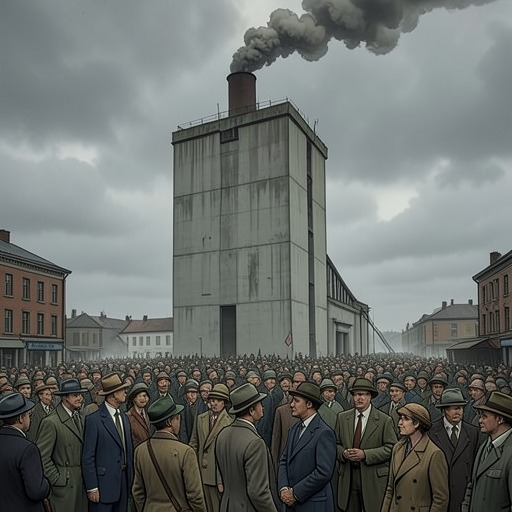
DecodedThe Japanese Army enters the narrative as a force whose speed and bombing reshape both the landscape of travel and the fate of University N. Its advance toward Tongzhen brings motorized warfare onto a road previously measured in hours on horseback, while its 1943 bombing burns the university to the ground and destroys a rare model of the Mathematical Bridge.
Advance Toward Tongzhen
When the Japanese Army advanced from the provincial capital toward Tongzhen, its advance motorbike division arrived within a couple of hours. The motorcycles were the first motor vehicles seen on the road between the provincial capital and Tongzhen. Their speed made the journey seem almost magical to local observers, as if the mountain range between the places had been removed.
The sudden arrival of the motorbike division changed the scale of distance in the account. Until then, the quickest journey from the city to Tongzhen took around seven or eight hours on a fast horse. Travel by horse-drawn carriage was slower; in later years, Young Lillie could no longer tolerate its jolting and travelled by boat instead, a journey of two days and two nights against the current. Against these established measures of movement, the division’s arrival within hours made the Army’s advance tangible as a new, unsettling speed.
Destruction of University N
In October 1943, Japanese bombing burned University N to the ground. The attack destroyed not only the institution’s buildings but also a 1:250 model of Newton’s Mathematical Bridge, a gift from Sir Joseph Larmor. The model had been designed by Rong Youying using 388 nails, and a full-size version had been constructed on the university grounds after Larmor brought the design to China in 1913.
By the time of the bombing, Rong Youying had been dead for twenty-nine years. She died in childbirth in the year after Larmor’s visit, before reaching forty. The bombing therefore destroyed the bridge model long after its designer’s death, severing a material link to the work that had helped bring the university renown. The narrative presents the loss as part of the destruction of the institution itself: the model and the university that housed it perished in the same fire.
Narrative Role and Consequences
The Japanese Army’s two appearances establish distinct but related consequences of military advance. On the road to Tongzhen, motorized movement makes distance suddenly seem smaller; at University N, bombing makes an established center of learning and its objects of memory disappear. One episode emphasizes the speed with which the Army can arrive, while the other records what its violence leaves behind.
The destroyed bridge model gives the university’s destruction a precise, personal dimension. It had embodied Rong Youying’s mathematical achievement and carried the history of Larmor’s visit, while its destruction came decades after her death. Through these details, the Army’s role extends beyond a change in the political or military landscape: its advance also determines which places, objects, and traces of earlier lives survive.