Special Investigative Team
DecodedThe Special Investigative Team was the coordinating body for the search for Rong Jinzhen’s stolen notebook, an investigation that expanded across B City and drew in thousands of personnel. Its records convey both the scale of the response and its limits: despite a sweeping search, the thief had already left the train, and the notebook remained missing as the investigators struggled to learn what had happened.
Formation and command
The case records identify the Special Investigative Team as an organization involved directly and indirectly in the inquiry. The narrative places its operational command in a guest house within the city garrison, where a deputy minister dispatched from General Headquarters was to lead the investigation. He had not yet arrived when Rong Jinzhen reached the site. Beneath him were five deputy heads, with responsibilities divided among the relevant military departments in A City and B City.
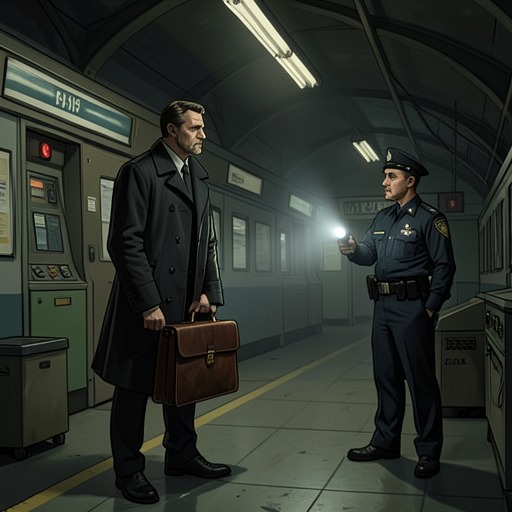
Zheng the Gimp was one of those deputy heads. He received Rong Jinzhen at the guest house and reported that the train had been searched from top to bottom without finding the thief. That result narrowed the search: the thief must have got off in B City. The account also links Zheng to Unit 701, where he would later become director, but distinguishes that future position from his role in the investigation’s command group.
A search spread across the city
The Special Investigative Team’s records present the inquiry as a vast mobilization rather than a routine theft investigation. More than 3,700 men were directly assigned to the work, including Rong Jinzhen and Vasili. Every one of the train’s 2,141 passengers was scrutinized, along with its 43 employees and more than 600 plainclothes military men in B City. The train was held up for five hours and thirty minutes; B City’s intelligence services spent 484 hours on the case, equivalent to ten days and four hours.
The scope extended well beyond the train. The recorded investigation reached B City’s nine rubbish tips and the homes of its residents, alongside the departments involved directly or indirectly in the case. This breadth reflected the team’s central difficulty: the train’s arrival did not mean the thief was still aboard. The doors were locked at the destination, but the investigators understood that the thief had most likely taken the briefcase and disembarked earlier, in B City. The city itself offered concealment in the crowd, while the notebook’s disappearance left the team without a clear trail.
Public appeal and the hotline
By the ninth day, the investigation had produced no information about the notebook, and the investigators’ confidence was ebbing. Headquarters agreed to make the loss public rather than keep it secret. The following morning, the B City Daily printed a widely circulated lost-property notice describing the missing notebook as belonging to a scientist and containing information about technological innovations under development by the nation.
Publicity risked worsening the case: the thief might hide or destroy the notebook once aware of the search. Yet at exactly 22:03 that evening, the Special Investigative Team’s office hotline rang. Three people reached for the phone; Vasili got there first and answered. The surviving passage records the call’s arrival and the initial greeting, but not enough of its contents to establish what the caller knew or whether the call solved the case. The moment nevertheless makes the hotline a point of contact between the broad, official search and information that might otherwise remain out of reach.
Secrecy and institutional setting
The team’s work unfolded within a wider system in which information, movement, and communication were closely controlled. Unit 701 inspected personal mail, and even a letter from Jan Liseiwicz written in English was referred for translation before officials could determine whether Rong Jinzhen would be allowed to read it. This is evidence of the security environment surrounding the investigation, not proof that the Special Investigative Team itself handled that correspondence. The distinction matters: the novel places the search operation among multiple bodies and layers of authority rather than treating them as one undifferentiated agency.
The search also becomes part of the story’s account of how a secret organization can command resources while leaving families and outsiders uncertain about the people it employs. Rong Jinzhen’s relatives later struggled to establish where he was, while the operation in B City mobilized thousands to recover a notebook whose significance the public notice could describe only in guarded terms. The Special Investigative Team therefore stands at the intersection of two forms of knowledge: the painstaking collection of clues in a city-wide inquiry, and the institutional secrecy that determines what may be known, by whom, and when.