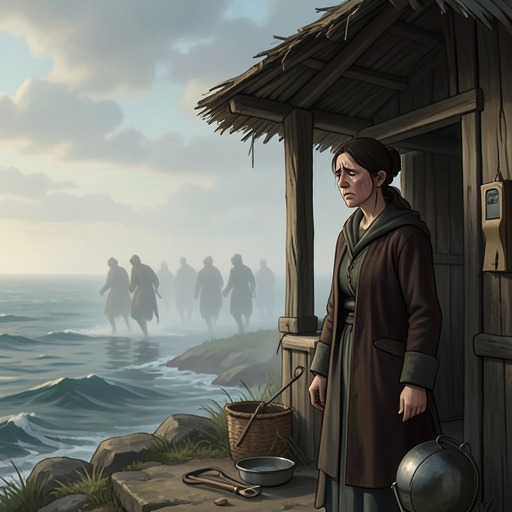
Felismena brings Arsileo and Belisa together again
DianaFelismena brings Arsileo and Belisa together again by uncovering the truth behind the false deaths that separated them and restoring the knowledge each needs to find the other. Her intervention begins in a shepherd’s hut, where she recognizes the supposedly dead Arsileo, assures him that Belisa is alive and faithful, and sets him on the way to the Temple of Diana. Polidora then carries the news to Belisa and brings her to him. The reunion reverses a deception that had made grief seem final, while making clear that its repair depends on several people passing truth onward.
The false deaths and their consequences
Belisa’s separation from Arsileo began with Alfeo, a reputed magician who wanted Belisa for himself and resented her attachment to Arsileo. Knowing that the lovers had arranged to meet beside a mulberry tree in his orchard, Alfeo used two spirits to impersonate Arsileo and his father, Arsenio. The staged scene made it appear that Arsenio had shot Arsileo with a crossbow and then killed himself in despair at having slain his son. Belisa believed what she saw: overcome by grief, she left home and disappeared into the wilderness.
The deception damaged more than the lovers’ immediate happiness. Belisa lived with the certainty that both men were dead, while Arsileo survived under a cloud of grief and separation. By the time Felismena encountered him, he had spent six months in a hut with Amarilida, who visited him with other shepherdesses and tried to console him. Their care could not reach the cause of his suffering: he believed himself cut off from Belisa, and had no news that could correct her presumed death or his own supposed loss to her.
Felismena recognizes Arsileo
When Arsileo recounts Alfeo’s plot, Felismena recognizes the shepherd as Belisa’s devoted suitor, the man she had thought dead. She judges that fortune should not deny relief to someone so deserving of it and resolves not to leave without giving him a great joy. Rather than announce herself at once, she approaches the hut as a lost shepherdess asking for shelter from the heat of midday. Arsileo welcomes her despite the modest lodging, and he and Amarilida share the food they have brought for themselves.
The conversation quickly turns from hospitality to identity. Felismena addresses Arsileo by name and reminds him that she knew him in a very different setting, when he studied at the Academia Salamantina. She then tells him that a shepherdess she knows would be overjoyed to learn that he is alive and explains that she will recount how she came to know this. Her revelation answers the central uncertainty left by Alfeo’s fraud: Belisa did not forget Arsileo, and the apparent evidence of his death was manufactured.
Felismena gives Arsileo her own account of events, including her encounter with the three savages and her arrival at Wise Felicia’s House. Arsileo listens as she describes what happened after the nymphs found her asleep on the islet in the pond, and learns that Belisa’s faith in him has never failed. He also receives a definite destination: the place where Belisa can be found. The information transforms his story from one of mourning into one with a possible reunion ahead.
Joy renewed, and the relay of news
Arsileo’s response shows how completely the revelation changes his condition. Hearing news of the person he loves, and learning that her devotion endured, fills him with such overwhelming joy that it nearly endangers his life. He weeps, takes Felismena’s hands, and kisses them in gratitude. Amarilida confirms the depth of his isolation by describing the six months he has passed in the hut, grieving in a way that ordinary companionship could not soothe. Felismena identifies the news itself, rather than comfort alone, as the remedy his sorrow requires.
The narrative later gives Polidora a decisive part in carrying that remedy to Belisa. After hearing Arsileo’s history and recognizing who he is, Polidora resolves to bring the news to her friend. She finds Belisa walking in the dense wood with Cintia and Dorida. Belisa still believes the deaths she witnessed were real: she remembers seeing one man pierced by an arrow and the other kill himself with his sword. When Polidora tells her that both are alive, Belisa first suspects that the claim is meant to reopen her grief or mock her suffering.
Polidora establishes why the story is credible. She explains that Arsileo himself told her what happened and identifies Alfeo’s sorcery as the cause of Belisa’s false belief. Belisa is stunned, but asks for proof and presses to know how Polidora learned the truth. Instead of asking Belisa to trust the report indefinitely, Polidora offers to show her Arsileo. She takes Belisa by the hand, and Cintia and Dorida join them on the way to the stream where he waits.
Recognition and aftermath
Before Belisa reaches him, she hears Arsileo singing. The voice supplies a recognition that argument alone could not: she identifies it as his, though she still frames her certainty through the possibility that she might be mistaken. When Arsileo sees her, joy momentarily robs him of speech. Once he can speak, he describes the sight of Belisa as recompense for the hardships he has endured. Belisa answers by contrasting the despair caused by his supposed death with the joy his living presence now brings. Their reunion rests on mutual recognition: she has not ceased to love him, and he has not ceased to love her.
The meeting gathers its witnesses into a shared aftermath. The nymphs are moved by the lovers’ words and tears, and the company goes together toward Felicia’s house as night approaches, recounting what has happened. Belisa asks after Arsenio and learns that, after she disappeared, he withdrew to an estate of his own, where he lives quietly and has put worldly concerns aside. Her relief at this news completes the correction of the fabricated scene: the father she believed dead is alive as well. At Felicia’s house, Belisa and Arsileo thank Felicia, whom they credit with helping bring about their good fortune.
Narrative role
The action is a carefully staged reversal of apparent death through recovered knowledge. Alfeo’s deception worked because Belisa treated what she saw as proof; Felismena’s intervention begins to undo it by recognizing Arsileo and telling him what he cannot know. The truth then travels through Polidora to Belisa, and the final proof arrives in the form of Arsileo himself and the sound of his song. Each step changes what the characters can believe and therefore what they can do.
Felismena initiates the restoration, but the narrative does not assign the whole reunion to her alone. Her recognition and disclosure give Arsileo hope and point him toward Belisa; Polidora carries the revelation to Belisa and physically guides her to him. Amarilida’s account testifies to the duration of Arsileo’s grief, while Cintia and Dorida accompany Belisa at the moment of return. Against Alfeo’s calculated use of false appearances, the reunion depends on truthful narration, corroboration, and presence. What had been made to look irreversible is not undone by magic of its own, but by the successive acts of recognition and disclosure that reconnect the separated lovers and restore news of Arsenio.