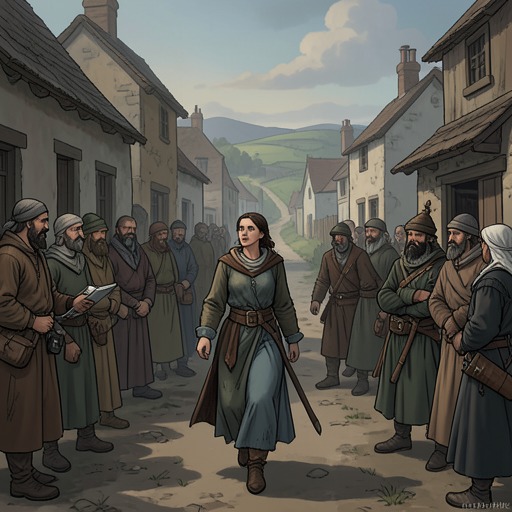
The tangled love affairs of Selvagia, Alanio, Ismenia, and Montano
DianaThe tangled love affairs of Selvagia, Alanio, Ismenia, and Montano turn pastoral love into a chain of shifting loyalties in which every change redirects desire rather than bringing it to rest. Told by Selvagia to Sireno and Silvano, the story moves from Ismenia’s attempt to manipulate Alanio’s affection to a four-person pattern of unrequited pursuit, and ends with separation, marriage, and Selvagia’s continued goodwill toward the man who has ceased to love her.
Setting and the First Entanglement
Selvagia situates her history in the Kingdom of the Lusitanos, in a fertile province between two rivers, where she lived in a village beside the Douro River. The annual celebration at the Temple of Minerva draws shepherds and shepherdesses from the surrounding country. On the night before the festival, the women keep vigil inside the temple, while the men may enter only to pay their respects and must then leave until the next day’s ceremonies. It is amid this regulated gathering that Selvagia’s account of love and deception takes shape.
Ismenia tells Selvagia that Alanio loves her, and Selvagia becomes attached to him. The arrangement is not simply a new couple formed by chance: Selvagia later writes to Ismenia that she was free before Ismenia deceived her in the temple, but is now bound to the will of the man Ismenia chose to give her. Selvagia’s letter thanks Ismenia for handing over what she calls her most precious jewel, while also insisting that Alanio has reason to love her and, by then, reason to forget Ismenia. The words expose the imbalance at the start of the story: Ismenia has helped direct Selvagia toward Alanio even as her own feelings for him remain a source of pain.
Ismenia’s Feigned Change of Heart
Ismenia cannot bear Alanio’s continuing attachment to Selvagia. She tries to make him abandon it, while Alanio likewise seeks ways to avoid seeing her, as though separation might repay some part of what he feels she owes him. Yet he keeps passing along the road between their villages, and Ismenia cannot endure hearing that he is in Selvagia’s village. Her efforts to relinquish him therefore intensify the attention she cannot escape.
She then chooses Montano, a shepherd who has long courted her and whom Alanio particularly dislikes, as the instrument of a sudden change. Ismenia pretends to return Montano’s love in the hope that the shock of losing her will make Alanio value what he had treated as secure. The stratagem does not remain a performance. Montano’s joy, services, and exertions on her behalf help turn the assumed attachment into a real one; Ismenia becomes firmly devoted to him and wants to see Alanio less than anyone. She makes her new preference plain, intending in part to retaliate for Alanio’s forgetfulness and his interest in Selvagia.
Alanio is pained to see Ismenia attached to a rival he dislikes, but his love for Selvagia initially keeps him from showing the full force of his jealousy. As days pass, however, he recognizes that his own conduct has helped his enemy prosper. He begins looking toward Ismenia again, limits his visits to Selvagia’s village, and conceals how often he comes and goes so Ismenia will not know. This shift weakens his bond with Selvagia without restoring the former relationship with Ismenia: her affection has moved on to Montano, and his efforts cannot dislodge it.
The Four-Way Pursuit
A chance family matter brings Montano into Selvagia’s village. Selvagia’s father and Felino, Montano’s father, meet repeatedly over business concerning the grazing lands of Extremo. During this period Montano sees Selvagia bringing her sheep to the fold and falls in love with her. His affection grows until, as Selvagia describes it, none of the four loves less intensely than the others: she loves Alanio, Alanio Ismenia, Ismenia Montano, and Montano Selvagia.
The resulting pattern is made visible through movement across the countryside. When Ismenia goes into the fields, Alanio follows; when Montano goes to tend his flock, Ismenia follows him; when Selvagia takes her sheep to the mountain, Montano follows her. Selvagia, in turn, goes to a woodland pasture when she learns that Alanio is there. Their repeated journeys do not bring the lovers together. Instead, they trace the same sequence of desire through different places, each person following someone whose attention is fixed elsewhere.
The pattern comes to a head in the forest of the valley between the two villages. Alanio has gone after Ismenia and finds her beside a stream, combing her golden hair. Selvagia hears that Alanio has gone there and takes goats from their enclosure as a reason to follow. She arrives to find him lamenting while Ismenia laughs at his tears and mocks his sighs. Ismenia welcomes Selvagia, but Selvagia confronts her over the earlier deception. Ismenia answers that Selvagia has already exacted her satisfaction: she took Alanio, whom Ismenia had loved more than herself, and now draws Montano away from his former devotion as well.
Montano arrives after Solisa, a shepherdess friendly with Selvagia, tells him where Selvagia has gone. The four are now together, but each turns toward a person who does not return that love. Selvagia asks Alanio why he has forgotten her; Alanio begs Ismenia for mercy; Ismenia complains of Montano’s cooling; and Montano reproaches Selvagia for her cruelty. The encounter gives the chain of loves a sharply balanced form: every appeal is answered by another person’s different, disappointed appeal.
Separation and Uneven Resolution
After the gathering, Selvagia sings of loving until she dies forgotten. The shepherds weep, especially Ismenia, and the company returns to its villages before the hour grows too late for their honor. The next day Selvagia’s father removes her from their home without explaining why and takes her to the house of her aunt Albania in another village. Selvagia remains there for some days without knowing the cause of her exile.
She later learns that Montano has married Ismenia and that Alanio intends to marry Silvia, another of Ismenia’s sisters. These outcomes settle two of the story’s connections, but they do not produce a reciprocal match for Selvagia: Montano’s marriage confirms his bond with Ismenia, while Alanio’s proposed marriage is to someone other than Selvagia. Even so, Selvagia asks God to grant Alanio happiness with his new wife. She explains that her love cannot do less than wish him every contentment, making constancy the final counterpoint to the repeated changes that shaped the affair.
Narrative Significance
The story’s central movement is not a single betrayal but a succession of changes with unequal consequences. Ismenia’s feigned attachment to Montano begins as a tactic to regain Alanio, yet becomes genuine; Alanio’s renewed pursuit of Ismenia arrives after her affection has shifted; and Montano’s love for Selvagia develops just as his own relationship with Ismenia takes hold. The apparent possibility of balancing the loves never lasts long enough to become a stable arrangement.
Selvagia’s retelling also places private desire beside conduct governed by reputation and social circumstance. At the Minerva festival, men and women occupy different spaces under the temple’s rules; in the forest, Selvagia and Ismenia dispute who owes whom redress; and after their meeting, the group separates because remaining out late would not suit their honor. Selvagia’s father then decides her removal without telling her why. Within these limits, songs, letters, journeys, and marriages become the means by which affection is declared or redirected. The ending leaves Selvagia physically displaced but emotionally steadfast: the lovers’ paths have separated, while her wish for Alanio’s happiness persists.