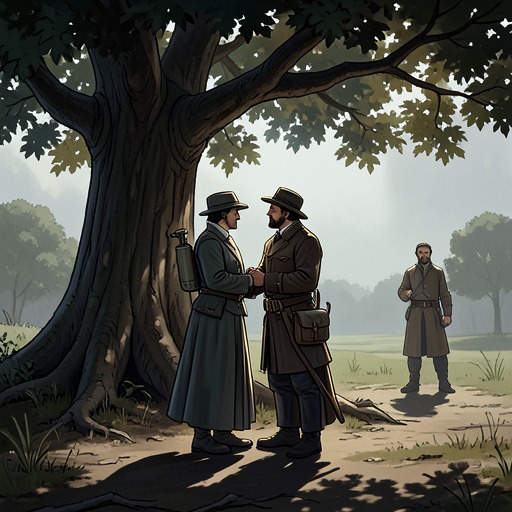
Felismena reveals her identity and past sacrifices to Don Félix
DianaFelismena reveals her identity and past sacrifices to Don Félix at the moment when her devotion has once again saved his life. Her account transforms an apparently small rescue into the culmination of a long, concealed history: she has loved him through repeated disguises, served his desires at personal cost, and now makes that debt impossible to overlook.
The Rescue That Prompts the Disclosure
Don Félix is fighting three knights on foot while their horses stand tethered nearby. He has already killed one opponent, but the remaining two have driven him into mortal danger. Watching from the scene, Felismena intervenes with her bow: one arrow pierces a knight through the faceplate, and a second passes beneath another’s breastplate and through his heart. The surviving knight can then overcome the final attacker. Only after the danger has passed does Don Félix remove his helmet and thank the shepherdess, promising to remember what he owes her.
Felismena recognizes him and is so shaken that she can scarcely speak. His gratitude, offered without knowledge of who has rescued him, becomes the opening for her answer. She tells him that this is not the first debt he owes her, and doubts that he will acknowledge it as he has failed to recognize far greater sacrifices. The scene’s reversal is sharp: the man who has just been saved is made to confront the woman whose devotion he had not understood.
The Service Behind Her Disguises
Felismena recalls their earlier life in the city, where Don Félix had served her with tournaments and jousts. She describes those attentions as either deception on his part or a deception she allowed herself to believe. When he was sent to court, she followed him in the guise of a page and spent a year serving him without revealing her feelings. She even acted as an intermediary, obtaining Celia’s favors for him while enduring the pain of helping him pursue another woman.
Her disclosure traces a series of costs rather than a single gesture. She left her homeland and freedom, entered Don Félix’s service, and concealed her love while attending to his distress over Celia. She says that she would have given her life to relieve his suffering. Now, in shepherdess’s dress, she has again put herself in danger for him. The changing garments mark different stages of the same attachment: public courtly service, hidden service as a page, and a rescue that makes her identity and history explicit.
From Concealment to Reckoning
Felismena presents her actions as evidence of a love that has persisted despite rejection and secrecy. Her account moves from the earlier courtship, through her year as Don Félix’s page, to the present rescue, making clear that the rescue cannot be separated from the longer pattern of service. She ends by placing his sword in his hand and telling him to take her life if he will neither remember nor recognize how deeply she has loved him. The appeal makes the disparity between them stark: she has repeatedly risked herself for his happiness, while she has received no comparable acknowledgment.
Don Félix does not answer with a considered explanation. His heart is overcome by the wrongs he has done her, and his blood loss compounds the shock; he faints at Felismena’s feet. Felismena takes his head into her lap and weeps, fearing that the joy of seeing him again will become despair. Dorida arrives with vessels of water: one restores Don Félix from his swoon, and another heals the wounds from the fight and removes the anguish associated with Celia. As he recovers, his love for Felismena is renewed, and he takes her hands, recognizing what he owes her. The disclosure therefore changes the relationship from concealed, one-sided service toward reciprocal recognition.
Love, Honor, and the Weight of Deeds
The scene places Felismena’s history of action beside other forms of love-language in the narrative. Sireno remembers Diana’s earlier assurances that family pressure would not turn her from him, and later rereads a letter in which she insists that she loves him and that her honor remains intact. Silvano, despite having loved Diana himself, expresses sympathy for Sireno rather than resentment toward him. In another story, Jarifa makes marriage the condition under which she can give herself to Abindarráez. These episodes show promises, constancy, and honorable restraint being tested in different circumstances; Felismena’s declaration is distinctive because its evidence is not only a vow but a record of repeated service and risk.
Her words also expose the limits of Don Félix’s former attentions. Tournaments and courtly favors had appeared to promise devotion, yet Felismena now sets them against her sustained sacrifices and the tears she spent arranging Celia’s favor for him. The rescue gives that history a visible, immediate consequence: the life Don Félix owes to her is joined to the emotional debt he has long failed to acknowledge. His collapse marks the force of that recognition, while his renewed love after Dorida’s intervention carries the scene from accusation toward reconciliation.