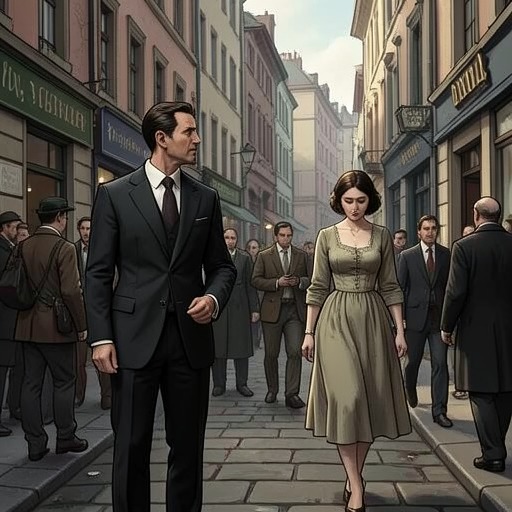
Araby bazaar
DublinersThe Araby bazaar is the destination the boy invests with the promise of romantic adventure, and the place where that imagined promise collapses. Its name first enters his life through a conversation with Mangan’s sister; by the time he reaches it, the journey has become an offering he hopes will give substance to his feelings. But the bazaar is nearly closed, its great hall dark and quiet, and its ordinary commercial scene leaves him facing not enchantment but his own vanity.
The bazaar as an imagined destination
The bazaar becomes important to the boy before he has seen it. Mangan’s sister asks whether he is going to Araby and says that it would be a splendid bazaar, one she would love to visit. She cannot go because a religious retreat is due that week. The exchange takes place while she turns a silver bracelet around her wrist, standing at the railings beneath a lamp. The boy is so confused when she first addresses him that he scarcely knows how to answer; the visit she mentions gives his unspoken adoration a specific destination.
When he tells her that he will bring her something if he goes, the bazaar becomes more than a place to visit. It is the imagined means by which he might convert feeling into a gift. The promise supplies a purpose for his journey, even though he has not yet chosen what to bring or knows how the girl will receive it. The story keeps the gap between those hopes and the actual bazaar in view: what matters to him is not yet the merchandise but the meaning he has attached to acquiring it for her.
That meaning takes hold of his days. The word Araby seems to call through the silence of his thoughts and to cast an Eastern enchantment over them. He longs to hasten the intervening days, struggles to attend to schoolwork, and finds the ordinary demands of life ugly and monotonous because they stand between him and his desire. In this way, the bazaar’s power is established chiefly through his imagination before the narrative shows its stalls, its visitors, or its hours of operation.
The journey and late arrival
The boy’s trip depends on an adult remembering his request. On Saturday morning he reminds his uncle that he wants to go that evening, but his uncle leaves him waiting. When the uncle finally returns, the aunt urges him to give the boy the money and let him go, saying that he has already kept him late enough. The uncle apologizes for forgetting and makes a joke about the old saying “All work and no play makes Jack a dull boy.” His delay has practical consequences: the boy sets out with the journey already pressed against the bazaar’s closing hour.
Holding a florin tightly, he walks down Buckingham Street toward the station. The crowded shops and glaring gas lamps remind him why he is travelling, but the train itself is nearly deserted. It leaves only after an intolerable delay and moves slowly among ruinous houses and over the twinkling river. At Westland Row Station, a crowd presses toward the carriage doors; porters push people back, explaining that the train is a special service for the bazaar. The boy remains alone in the bare carriage, and the train reaches an improvised wooden platform when the clock shows ten minutes to ten.
The arrival preserves the sense of a threshold while making the time pressure unmistakable. Before him stands a large building displaying the bazaar’s magical name, but he cannot find a sixpenny entrance. Afraid it will close, he passes quickly through a turnstile and hands a shilling to a weary-looking man. The boy has travelled a long way for a private purpose, yet his first contact with the place is a hurried payment at its entrance.
The bazaar after dark
Inside, the bazaar is a large hall with a gallery running around it halfway up. Nearly all the stalls are closed, and most of the hall lies in darkness. The boy describes the silence as like the quiet that settles in a church after a service. The comparison gives the building an unexpectedly solemn atmosphere, but the scene is not the radiant, abundant spectacle he has been anticipating: its remaining activity is sparse, and he walks into the centre timidly.
A few people remain by the stalls that are still open. At a curtained space lit by coloured lamps spelling Café Chantant, two men count money on a salver. The boy listens to the coins falling. The detail draws attention away from exotic display and toward the ordinary business of taking stock and handling money. Remembering only with difficulty why he has come, he approaches a stall with porcelain vases and flowered tea-sets.
At its entrance, a young woman talks and laughs with two young men. The boy notices their English accents and listens vaguely. The scene offers no intimate recognition of his promise, only a casual conversation alongside the goods for sale. He lingers before the stall, although he knows that staying is useless, trying to make his interest in the wares look more genuine. When he finally turns away, he hears two pennies fall against the sixpence in his pocket. A voice from the gallery announces that the light is out, and the upper part of the hall becomes completely dark.
Disillusionment and significance
The bazaar’s closing darkness completes a reversal between the boy’s expectation and what the place can provide. He had made Araby the centre of an inward romance, sustained by the girl’s mention of it and by his own promise to bring her something. At the stalls, however, he cannot find a purchase that answers that imaginative purpose. He remembers with difficulty why he has come, hesitates before the wares, and stays only to make his interest appear convincing. The encounter exposes the distance between the meaning he has imagined and the ordinary, nearly finished commercial event he actually reaches.
When the light goes out, he looks into the darkness and sees himself as a creature driven and derided by vanity; his eyes burn with anguish and anger. The judgment is directed at himself, not simply at the bazaar. Its force comes from recognizing how completely he had organized his hopes around the journey and how little the actual place can sustain them. The bazaar does not fulfill the role he assigned it as a setting for a romantic gift; instead, its closed stalls, money, casual talk, and extinguished lights bring his idealized desire to an abrupt end.
As a location, Araby therefore marks a transition from expectation to self-recognition. The boy’s journey is physical, but its decisive result is inward: the destination that seemed to promise a splendid experience leaves him confronting the vanity that shaped his anticipation. The late train, the hurried entrance, the nearly empty hall, and the final darkness form a sequence in which each concrete detail strips away another part of the enchantment. The name that had filled his waking and sleeping thoughts ends in a darkened room and an anguished awareness of himself.