Gretta Conroy and Michael Furey
DublinersGretta Conroy and Michael Furey are joined by a brief youthful love that survives as a charged memory after Michael’s death. Their relationship becomes known through Gretta’s recollection in the hotel room after the Morkan dance: a song recalls the boy she knew in Galway, and her account of his final visit unsettles Gabriel Conroy’s assumptions about his wife and his own capacity for love. Its significance lies not in a long shared history but in the intensity of a farewell that continues to shape the living.
Identity and Background
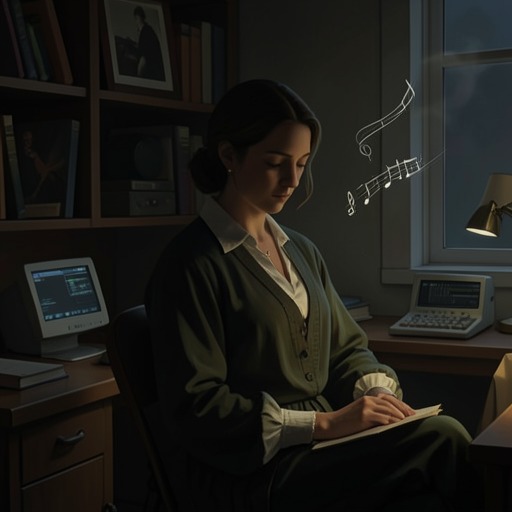
Gretta met Michael while living with her grandmother in Galway. She remembers him as a young boy, delicate and gentle, with large, dark eyes and a striking expression. He had a good singing voice and intended to study singing for the sake of his health. The song that summons Gretta’s memory is The Lass of Aughrim, which Michael used to sing; music gives the past a present voice before Gabriel understands what the memory contains.
Their relationship belongs to Gretta’s life before she came to Dublin. As she prepared to leave Galway for the convent, Michael was ill in lodgings there. His family in Oughterard had been notified, and people described his illness as decline, though Gretta says she never knew precisely what it was. The combination of her impending departure and his worsening illness makes their separation more than a postponed reunion: the summer return she hoped for never comes.
The Farewell in Galway
Unable to visit Michael while he was ill, Gretta wrote to tell him she was going to Dublin and would return in the summer, hoping he would be better by then. The letter offered the possibility of seeing each other again, but the night before her departure turned that anticipated return into an unresolved farewell.
Packing at her grandmother’s house on Nuns' Island, Gretta heard gravel thrown against the window. The glass was too wet for her to see through, so she ran downstairs, slipped out through the back, and found Michael shivering at the far end of the garden. She implored him to go home, warning that the rain could cost him his life. He did not want to live, he told her. Gretta recalls his eyes and his position by the wall, where a tree stood: the scene remains fixed in her mind as an image as well as a story.
Michael did go home. Gretta was at the convent for only a week when she learned that he had died. He was buried in Oughterard, where his family came from. Her grief at hearing the news is still immediate in the telling: she breaks off in sobs and flings herself face down on the bed. The episode closes not with a reunion or a completed farewell but with Gretta asleep, leaving the memory newly exposed to Gabriel.
Memory and Marriage
Gretta’s disclosure changes the emotional meaning of the hotel-room scene. Gabriel had approached the night expecting intimacy; Michael’s presence in her memory makes him aware that his wife carries a past passion of which he had not known. His first responses are anger and irony, and he is reluctant to appear interested in the dead boy. Yet Gretta’s remembered details—Michael’s voice, his eyes, the rain, the wall and tree—give the story a force that Gabriel’s possessiveness cannot master.
Gretta interprets Michael’s final visit as evidence that he loved her deeply, and says she thinks he died for her. The narrative establishes the circumstances—his existing illness, his night in the rain, and his death a week after her arrival at the convent—without resolving precisely how his visit relates to his death. That distinction matters: the force of the episode comes from Gretta’s remembered conviction and Gabriel’s response, not from a medical explanation or a claim that the rain alone caused Michael’s death.
Gabriel does not press Gretta for further answers. He continues to hold and caress her hand, though it does not respond to his touch, then lets it fall gently when her grief overwhelms her. The gesture marks the limit of the intimacy he had anticipated: he can remain beside her and witness her sorrow, but he cannot turn her memory into an experience shared on equal terms.
Aftermath and Significance
Left awake beside his sleeping wife, Gabriel imagines the young man beneath a dripping tree and recognizes that he has never felt such a passion for any woman. The memory therefore becomes a measure of the difference between Michael’s remembered devotion and Gabriel’s own experience. It does not simply provoke jealousy; it redirects Gabriel from his wounded pride toward pity, generosity, and an awareness of his own emotional limits.
Michael’s image also opens the story’s final movement toward the dead. Gabriel thinks of the older generation becoming shades and of the likelihood that he will one day sit in mourning after Julia’s death. In that widening meditation, Michael is at once Gretta’s lost lover and one of the dead whose existence presses upon the living. His remembered eyes and his position beneath the tree give an individual shape to the otherwise impalpable world Gabriel begins to imagine.
The renewed snowfall carries the relationship beyond the hotel room. Gabriel pictures snow falling over Ireland and over the churchyard in Oughterard where Michael lies buried. The concluding image joins present observation to the past Gretta has disclosed: the snow reaches the living and the dead alike, while Michael’s grave remains one specific place within its fall. Their brief love thus returns at the story’s end not as a recovered romance, but as a memory that changes Gabriel’s understanding of Gretta, of passion, and of mortality.