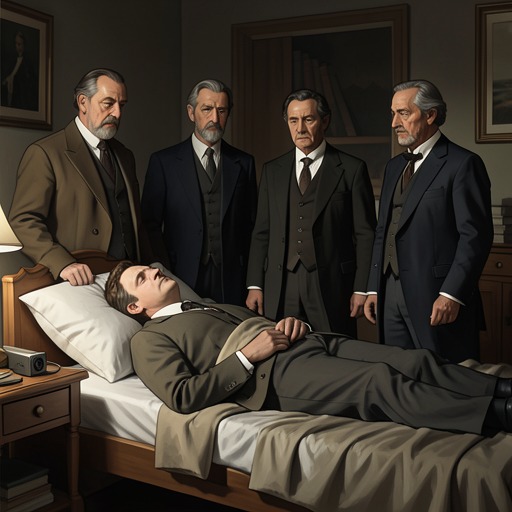
Tom Kernan and Mrs Kernan
DublinersTom Kernan and Mrs Kernan’s marriage is a durable but unequal domestic partnership: he repeatedly drinks and neglects his household, while she manages the practical and emotional work of keeping the family going. His fall after drinking brings that arrangement into view, and her response—clearing his pockets, caring for him, and accepting his friends’ plan for a Catholic retreat—shows both her clear-eyed knowledge of him and the limited hope she retains for change.
A marriage shaped by endurance
Mrs Kernan has been married to Tom for a quarter of a century. In recalling their courtship, she remembers him as a jovial, well-dressed man and takes pleasure in the image of herself leaving the Star of the Sea Church in Sandymount on his arm. That memory sits beside a less romantic account of married life: after three weeks, being a wife had begun to feel irksome, and later it became nearly unbearable. Motherhood, by contrast, presented no insuperable difficulties, and she kept house for Tom shrewdly over many years.
The family’s present circumstances show the practical shape of her work. The two eldest sons have left home: one works in a draper’s shop in Glasgow and the other as a clerk to a tea merchant in Belfast. They write regularly and sometimes send money, while the younger children are still at school. Mrs Kernan remains responsible for the household and for tending to Tom when his drinking leaves him unwell. Her care is not presented as an occasional gesture but as a settled part of the marriage’s daily economy.
Drinking, money, and the fall
Tom’s drinking affects his standing at home as well as his health. After a period of heavy drinking, he is brought home and put to bed; Mrs Kernan tells Mr Power that he has been drinking since Friday and worries that he will eventually ruin himself. She also says that the household had been waiting for him to come home with money, adding that he seems not to think he has a home. His absence is therefore both emotional and material: the family waits for his return and for the money he is expected to bring.
Mrs Kernan’s response is immediate and practical. After Mr Power leaves, she goes inside and empties Tom’s pockets. The small, decisive action places her in the role of managing the consequences of his drinking, while the narrative gives no indication that the underlying pattern has been resolved. The fall summons friends to intervene, but it is Mrs Kernan who remains at home with the effects of the episode.
Care without illusion
The marriage is not defined solely by resentment. Mrs Kernan accepts Tom’s frequent intemperance as part of life, nurses him when he is sick, and tries to get him to eat breakfast. She has scolded him after the latest episode, but she also judges his behavior in proportion: he has not been violent since their sons grew up, and he is willing to walk to the end of Thomas Street and back to secure even a small order. Her assessment retains practical knowledge of his shortcomings and of the habits that still make him dependable in limited ways.
That mixture of care and realism shapes her view of the proposed religious remedy. When Tom’s friends disclose their plan to take him to a retreat, she leaves the decision to Mr Cunningham. After twenty-five years, she has few illusions and suspects a man of Tom’s age will not change greatly before death. She can see an odd appropriateness in his accident, yet does not turn that thought into a refusal: the scheme might do good and, at least, could do no harm. Religion, for her, is a habitual and domestic faith, bounded largely by the kitchen and expressed in confidence in the Sacred Heart and the sacraments.
Friends and the prospect of reform
Mr Power has helped Tom before, including during domestic quarrels and through small, timely loans. Mrs Kernan distinguishes him from Tom’s other companions, whom she regards as present when Tom has money but unreliable in their concern for his family. Mr Power promises to speak with Mr Cunningham and to make Tom turn over a new leaf. The language of reform initially comes from the men around Tom, but the plan depends on Mrs Kernan’s consent and on her willingness to let them proceed.
When the friends later tell Tom that they will all make a retreat and confess their sins, he agrees with a slightly nervous smile. Mrs Kernan conceals her satisfaction and answers by pitying the priest who will have to hear their confessions. Her response is wry rather than triumphant: she hopes the intervention may help, but her long experience gives her little reason to expect a transformation. The scene leaves the marriage where it has long stood, between dutiful care and skepticism, with the proposed retreat offering a possibility rather than a demonstrated change.