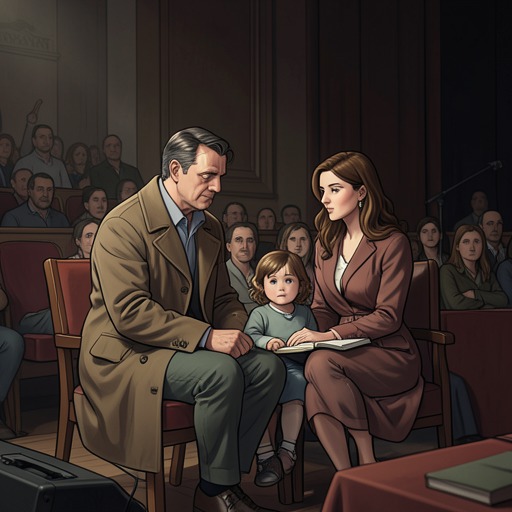
James Duffy–Mrs Emily Sinico relationship
DublinersJames Duffy–Mrs Emily Sinico relationship is a private intimacy built from conversation, books, music, and shared evenings, then broken when Mrs Sinico presses Duffy’s hand to her cheek. Duffy treats that gesture as a breach of the intellectual bond he believes they have formed and withdraws; after her death, the separation he once defended as necessary becomes the measure of his own loneliness and the lost life he believes he denied her.
Meeting and the Shape of Their Intimacy
Duffy first meets Mrs Sinico while sitting beside her and her daughter in the Rotunda, where a thinly attended concert makes the empty house seem to foretell failure. Mrs Sinico remarks on the poor audience and the hardship of singing to empty benches. Duffy takes this as an invitation to talk and is struck by how little awkward she seems. As they speak, he tries to fix her permanently in his memory: he notes her oval face, strongly marked features, steady dark-blue eyes, and a gaze that briefly discloses great sensibility before prudence reasserts itself. Her appearance, too, seems to him to carry a note of defiance.
They meet again a few weeks later at a concert in Earlsfort Terrace. Duffy uses moments when Mrs Sinico’s daughter is distracted to become more intimate with her. Mrs Sinico sometimes mentions her husband, but not in a way Duffy reads as a warning. Her husband, Captain Sinico, commands a mercantile boat between Dublin and Holland; they have one child. When Duffy encounters her a third time by chance, he finds the courage to arrange a meeting. It becomes the first of many: they meet in the evenings and choose quiet places for their walks.
Duffy dislikes the stealth required by those meetings and asks Mrs Sinico to invite him to her home instead. Captain Sinico welcomes his visits, believing that Duffy may be interested in his daughter. He has so thoroughly dismissed his wife from his own pleasures that he does not suspect another person might care for her. With the husband often away and the daughter out giving music lessons, Duffy and Mrs Sinico have opportunities to spend time together. Neither has had such an adventure before, and neither initially recognizes an incongruity in their growing closeness.
Their companionship becomes a shared intellectual life. Duffy lends Mrs Sinico books, gives her ideas, and tells her his theories; she listens, and sometimes answers with facts from her own life. With almost maternal solicitude, she encourages him to open himself fully and becomes his confidante. He tells her of attending meetings of the Irish Socialist Party, where he felt singular among sober workingmen in a poorly lit garret. He left after the party split into three sections, each with its own leader and meeting place. He considered the workers’ discussions timid, their interest in wages excessive, and their realism resentful of the precision made possible by leisure. He concludes that Dublin is unlikely to experience social revolution for centuries. When Mrs Sinico asks why he does not write his thoughts down, he scorns the prospect of competing with phrase-makers or submitting to what he regards as a morally and artistically obtuse middle class.
Emotional Closeness and the Breaking Point
At Mrs Sinico’s cottage outside Dublin, their relation moves beyond remote subjects. Their thoughts become entangled, and their evenings alone are sometimes spent in darkness: she lets the light fail without lighting the lamp. The discreet room, their isolation, and music still vibrating in their ears intensify their union. Duffy feels that the companionship wears away the rough edges of his character and makes his mental life more emotional. He sometimes hears himself speaking and imagines that, in Mrs Sinico’s eyes, he will rise to an angelic stature.
Yet the intimacy also contains its own limit. As Duffy draws closer to Mrs Sinico’s fervent nature, he hears what he recognizes as his own impersonal voice insist that the soul is incurably lonely and that people cannot give themselves away. The relationship thus develops around a tension between the lived experience of mutual closeness and Duffy’s abstract conviction that the self must remain separate. Mrs Sinico’s attentive listening allows him to disclose himself, but the principle he voices denies that such disclosure can amount to true union.
The break comes one night when Mrs Sinico, showing unusual excitement, catches up Duffy’s hand passionately and presses it to her cheek. Duffy is very much surprised. He takes her interpretation of his words as disillusioning, and does not visit her for a week. He then writes to arrange a final meeting. Unwilling for the encounter to be troubled by what he calls their ruined confessional, he chooses a little cakeshop near the Parkgate rather than the cottage where their intimacy had grown. In cold autumn weather they walk up and down the Park roads for nearly three hours and agree to end their intercourse. Duffy’s principle is that every bond leads to sorrow.
Their parting is strained rather than resolved. They walk silently toward the tram after leaving the Park; Mrs Sinico then trembles so violently that Duffy fears she may collapse. He says goodbye quickly and leaves her. A few days later, a parcel arrives containing the books and music he had lent her. The return of these objects closes the practical exchange between them, while the abrupt farewell leaves the emotional consequences unresolved.
Separation, Death, and Retrospective Recognition
Four years pass. Duffy resumes an even, orderly life and avoids concerts in case he might meet Mrs Sinico. His father dies, and the junior partner of his bank retires, but his routine continues: each morning he travels by tram into the city, and each evening he walks home after dining moderately and reading the evening paper. The account of the relationship’s aftermath makes the separation appear less like a single decision than a settled method of keeping feeling at a distance.
When Duffy learns that Mrs Sinico is dead, memory unsettles that routine. At first he asks himself what else he could have done, reasoning that he could neither continue a deceptive comedy with her nor live with her openly. He believes he had done what seemed best. But as he recalls their life together and alternates between two images of her, he recognizes that she has ceased to exist except as a memory. He imagines how lonely she must have been, sitting night after night alone in her room, and understands that his own life will be lonely until he, too, dies and becomes a memory—if anyone remembers him.
After nine o’clock, he leaves the public house and enters the Park by its first gate, walking beneath gaunt trees through the bleak alleys where they had walked four years earlier. In the darkness Mrs Sinico seems near: he thinks he hears her voice and feels her hand, and stops to listen. His recollection turns into self-accusation. He asks why he withheld life from her and why he sentenced her to death, as he feels his moral nature falling apart. The question marks a reversal in his understanding: what he had defended as a necessary refusal now appears to him as a decision with devastating consequences for a woman whose loneliness he had not fully acknowledged.
At Magazine Hill, the lights of Dublin burn redly and hospitably across the river. Duffy sees figures lying in the shadow beneath the Park wall and feels despair at what he regards as their furtive loves. He gnaws at the rectitude of his own life, believing that one human being had seemed to love him and that he denied her life and happiness, leaving her to ignominy and a shameful death. The scene does not restore the relationship; it leaves him outside the human fellowship he now recognizes as precious. As a goods train winds out of Kingsbridge Station and disappears into darkness, its laborious drone continues in his ears, repeating the syllables of her name.
Meaning of the Relationship
The relationship turns on a conflict between intimacy as lived experience and separation as Duffy’s governing idea. Mrs Sinico listens, encourages his self-disclosure, and shares quiet, music-filled evenings with him; Duffy is changed by the companionship, even as he treats the possibility of emotional surrender as a threat to his independence. His insistence that every bond leads to sorrow helps him justify the break, but the later return of memory exposes the cost of that certainty.
The ending also changes the meaning of the relationship’s physical and material details. The hand that Mrs Sinico presses to her cheek becomes, years later, a presence Duffy seems to feel in the Park. The books and music returned in a parcel had marked the termination of their meetings; after her death, the remembered companionship instead becomes an absence he cannot keep at the distance his orderly life once enforced. Their bond is never given a shared future. Its final consequence is Duffy’s recognition, too late to repair anything, that his defense of solitude has left both the dead woman and the living man alone.