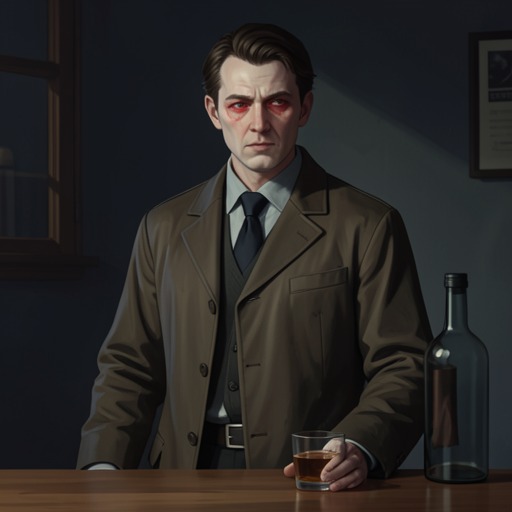
Farrington and his son Tom’s relationship
DublinersFarrington’s relationship with his son Tom is exposed in a brief, violent domestic scene: returning from a day of humiliation and loss, Farrington blames the boy for letting the kitchen fire die and beats him with a walking-stick. Tom’s offer to say a Hail Mary for his father makes the relationship’s imbalance unmistakable. The child responds to violence with fear and an appeal to care, while Farrington turns the anger he has accumulated elsewhere against someone unable to defend himself.
Household and Family
Farrington comes home by the side-door after his tram lets him down at Shelbourne Road. He loathes the return, and the kitchen he enters is empty, with its fire nearly out. He calls upstairs for Ada; the account identifies her as his wife, a small, sharp-faced woman who bullies him when he is sober and is bullied by him when he is drunk. They have five children, placing Tom within a crowded household whose relations are already marked by reciprocal intimidation rather than steady security.
Tom comes down the stairs in response to his father’s call. In the darkness, Farrington asks who is there, and the boy identifies himself as his father’s child. The encounter begins not with an explanation of what has happened to the fire, but with Farrington’s demand for his dinner. Tom says that he is going to cook it, a practical response that leaves him responsible for a task even as the scene reveals how little protection he has from his father’s temper.
Anger Carried into the Home
The violence against Tom follows a day in which Farrington feels defeated and humiliated. He has done for himself at the office, pawned his watch, spent all his money, and failed even to get drunk. He has also been beaten twice by a boy at arm-wrestling. By the time he waits for the tram, his anger has become resentment against everything around him. At home, that diffuse fury takes a specific target: the boy beside the extinguished fire.
The scene makes the shift from grievance to punishment abrupt. Farrington sits heavily while Tom lights the lamp, then demands to know what is for dinner. When Tom says he will cook, Farrington jumps up, points to the fire, and treats its being out as a deliberate offense. He seizes the walking-stick behind the door and rolls up his sleeve to give his arm free play. The ordinary household object becomes an instrument of force, and the domestic setting offers Tom no refuge from the anger that Farrington has brought back with him.
The Beating and Tom’s Appeal
Tom first cries out and runs whimpering around the table. Farrington follows, catches him by the coat, and corners him. Seeing no way to escape, Tom falls to his knees. Farrington strikes him vigorously with the stick, and one blow cuts the boy’s thigh. The details of pursuit, capture, and injury show that this is not merely an angry threat: Farrington uses his physical strength against a frightened child who has already been forced into submission.
Tom’s plea makes the emotional shape of the relationship especially stark. With his hands clasped and his voice shaking, he begs his father not to beat him and promises to say a Hail Mary for him. The prayer is offered as a desperate bargain for safety, not as proof that Farrington has earned filial trust. Tom’s response joins fear to an act of care for the person hurting him; the scene does not show that the appeal stops the beating, but it leaves the father’s violence beside the child’s offer of religious intercession.
Significance of the Relationship
The episode shows Farrington’s power in the family as uneven and contingent. His wife bullies him when he is sober, while he bullies her when drunk; Tom, however, appears in the scene as a child who runs, is caught, kneels, and pleads. The contrast makes clear that Farrington’s humiliations outside the home do not make him powerless in every setting. At home he can redirect his frustration toward a weaker family member.
The scene’s domestic cause is small—the kitchen fire has gone out—but the response is disproportionate: a walking-stick, a blow that cuts Tom’s thigh, and a boy promising prayer to escape further punishment. That disproportion connects Farrington’s defeat beyond the home to the fear he creates within it without excusing his conduct. The father-son relationship is therefore presented less through affection or shared history than through a concentrated encounter in which Farrington exercises force and Tom answers with terror and a plea for mercy.