The narrator’s relationship with Father Flynn
DublinersThe narrator’s relationship with Father Flynn joins a close apprenticeship in Catholic teaching to an uneasy response to the priest’s death. Father Flynn has been a friend and instructor to the boy, but after learning that he has died, the boy feels both regret and an unexplained freedom. The intimacy of their lessons does not resolve that contradiction; it makes the boy’s hesitation, memory, and silence more consequential.
Instruction and Familiarity
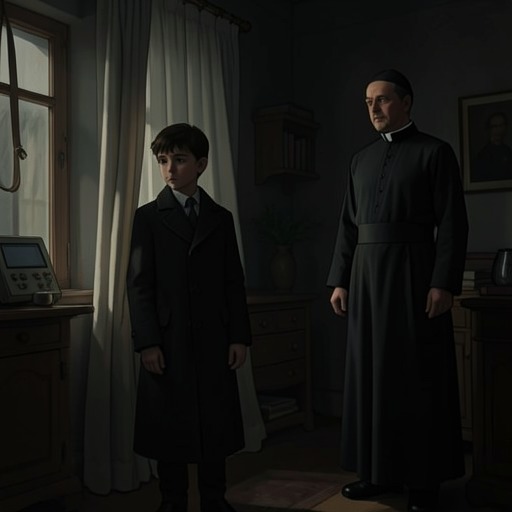
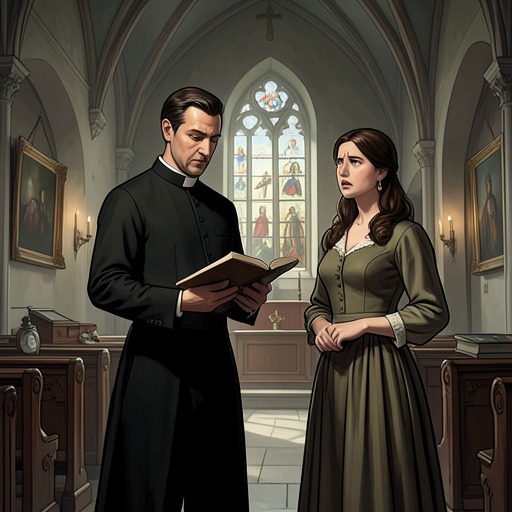
Father Flynn and the boy had been great friends, and the priest taught him a great deal. Their connection was practical as well as intellectual: the boy had learned the responses of the Mass by heart, and Father Flynn would put him through them, listening as he recited. The priest’s teaching made religious knowledge a shared routine rather than an abstraction.
The lessons ranged beyond memorized responses. Father Flynn had studied at the Irish college in Rome and taught the boy to pronounce Latin properly. He told him about the catacombs and Napoleon Bonaparte, and explained the ceremonies of the Mass and the vestments worn by a priest. The boy’s recollections therefore present Father Flynn as a guide to both the formal language and the historical and material world of Catholic practice.
Their instruction also included demanding questions. Father Flynn asked what one should do in particular circumstances and whether certain sins were mortal, venial, or merely imperfections. Through these questions, the boy began to see that institutions he had regarded as simple acts contained complicated rules and responsibilities. The duties of a priest toward the Eucharist and the secrecy of the confessional seemed so grave that he wondered how anyone could undertake them; Father Flynn’s lessons opened a previously uncomplicated religious world into one of intricate obligations.
The Priest as a Remembered Presence
The boy’s memories retain Father Flynn’s gestures as vividly as his teachings. When the boy recited the Mass responses, Father Flynn smiled pensively and nodded, sometimes pushing large pinches of snuff into his nostrils one at a time. His smile exposed discoloured teeth, with his tongue resting on his lower lip—a habit that had first made the boy uneasy, before he knew him well. Such details record familiarity without making the priest an uncomplicated object of comfort: the boy remembers both the closeness of their routine and his original discomfort.
The recollection of lessons also includes the priest’s physical vulnerability. Father Flynn’s hands trembled so much that he could not empty snuff into his black snuff-box without spilling it; the boy used to do it for him. Snuff drifted through the priest’s fingers onto his coat, and his red handkerchief, blackened by snuff stains, could not brush the grains away effectively. The boy’s memory of care is thus attached to a failing body and to small repeated acts of assistance, not only to the priest’s authority as a teacher.
Death and the Boy’s Conflicted Response
When the boy accepts that Father Flynn is dead, he wishes to go in and look at him but cannot bring himself to knock. Instead, he walks slowly along the sunny side of the street, reading theatrical advertisements. The ordinary brightness and distraction of this walk contrast with the expected conduct of mourning, and the boy notices that neither he nor the day seems to be in a mourning mood.
More troubling to him is the relief he discovers in himself. He feels annoyed to find a sensation of freedom, as if Father Flynn’s death has released him from something. That feeling stands beside his recognition that the priest taught him a great deal, so it cannot be reduced to indifference or lack of attachment. The boy does not explain what he feels freed from; the account preserves the contradiction rather than settling it.
An Unfinished Bond
The boy’s memories make Father Flynn’s influence both intimate and difficult to interpret. He recalls instruction in Latin, the Mass, Church rules, and priestly duties, as well as the gestures and bodily details of their private lessons. Yet when death makes a final visit possible, he does not enter at once. His knowledge of the priest and his reluctance to face the dead man occupy the same relationship, leaving the boy’s grief entangled with apprehension and release.
The bond is presented through the boy’s retrospective selection of remembered scenes: lessons, the handling of the snuff, and the priest’s characteristic smile return while the boy tries to understand his own reaction. Father Flynn’s death therefore changes the relationship without supplying a clear explanation of its tension. The boy can recognize the debt of instruction and still experience freedom; neither response cancels the other.